Future of Crypto Lending 2025 Guide
Explore the evolving landscape of DeFi lending in 2025: regulatory frameworks (MiCA in EU, FinCEN in US), real-world asset integration, institutional adoption (growing 300% in 2024),; Emerging opportunities that will shape the industry's future.
Introduction
Remember when Celsius promised 18% yields? Or when BlockFi seemed too big to fail? The cryptocurrency lending industry has undergone a dramatic transformation following the 2022-2023 market upheavals ($20B+ in losses); What emerged is a more mature, regulated sector. The collapse of major platforms catalysed fundamental changes in risk management (now requiring 150%+ collateral ratios) and user protection.
These disruptions, while painful, strengthened the industry; Unsustainable business models were eliminated; Transparent practices became mandatory (real-time proof-of-reserves). Today's institutional-grade lending platforms (Aave with $10B TVL, Compound with $5B, Nexo with $3B) operate with regulatory clarity and advanced risk management tools.
Why are JPMorgan and Goldman Sachs now entering crypto lending? Traditional institutions bring decades of expertise whilst adapting to blockchain technology (Ethereum, Polygon, Arbitrum). Meanwhile, decentralised protocols like Aave have emerged as the dominant force, offering transparency and programmability without single points of failure.
The numbers tell the story: Aave, Compound, and MakerDAO process $50B+ in annual lending volume with robust security records (zero hacks in 5+ years); Real-world asset integration is creating new frontiers ($2B+ in tokenised assets). Tokenised treasuries and corporate bonds are bridging traditional finance with DeFi.
Regulatory clarity is accelerating. The EU's MiCA regulation provides frameworks that protect consumers whilst enabling innovation; Similar standards are emerging globally, creating a stable foundation for growth.
What's driving this evolution? Cross-chain interoperability allows seamless lending across blockchains; Automated risk management systems monitor positions 24/7. Institutional-grade custody solutions protect billions in assets. The future will be characterised by increased institutional participation and technological sophistication.
Major banks and hedge funds (Pantera, Grayscale, a16z) launched crypto lending products in 2025. Why? Enhanced liquidity, improved risk management, and regulatory oversight make the sector viable for institutional capital; Asset managers are allocating billions to crypto lending strategies.
Artificial intelligence is revolutionising the space. AI-powered credit assessment analyses on-chain behaviour; Cross-chain solutions enable capital efficiency. Advanced smart contracts (audited by CertiK and Trail of Bits) automate complex lending strategies, making lending more efficient and accessible.
Whether you're an investor seeking yield, a developer building protocols, or an institution exploring opportunities, understanding these trends is crucial. The innovations shaping crypto lending today will define the opportunities and challenges ahead.
Market dynamics in 2025 reflect a shift towards sustainability; Gone are the days of unsustainable yield-chasing. Conservative risk management and enhanced transparency now benefit all participants; This maturation creates a stable foundation for long-term growth.
Machine learning technologies are transforming credit assessment and risk management; Automated lending processes enable sophisticated strategies. These advances are crucial for managing cryptocurrency volatility whilst maintaining security and efficiency.
The convergence of traditional finance and decentralised protocols creates unprecedented opportunities. Institutional investors now access crypto yields through regulated channels. Retail users benefit from institutional-grade security and transparency. This democratisation of financial services represents the true promise of blockchain technology.
Looking ahead, the integration of real-world assets will accelerate. Tokenised real estate, corporate bonds, and commodities will provide diverse collateral options. Cross-chain lending will enable seamless capital flow across ecosystems. The future of crypto lending is not just about higher yields—it's about building a more efficient, transparent, and accessible financial system for everyone.

Market Evolution and Competitive Dynamics
What does institutional-grade crypto lending look like? Complete regulatory frameworks (MiCA in the EU, FinCEN in the US); Advanced risk management systems; Hybrid solutions that blend DeFi benefits with traditional finance security. These aren't buzzwords—they're requirements from institutional investors and regulators.
This evolution creates opportunities for everyone. Retail investors access sophisticated yield strategies; Institutions deploy capital with confidence. How? Advanced smart contracts (audited by CertiK, Trail of Bits), cross-chain (via LayerZero, Wormhole) solutions, and AI-powered risk assessment enable efficient capital allocation.
Real-world asset tokenisation is the bridge; Traditional finance meets decentralised lending; Regulatory clarity in major jurisdictions accelerates adoption. Whether you're an investor, developer, or institution, understanding these trends determines your success.
Fundamental Market Structure Changes
The numbers are striking: $53 billion TVL in Q1 2025; That's 180% growth from 2024. Why? Improved confidence, regulatory clarity, and institutional adoption (growing 300% in 2024)—not speculation.
Platform consolidation tells another story; The top 10 protocols now control 78% of market share, up from 65% in 2024. Users vote with their capital, choosing platforms with proven security, compliance, and sustainability.
Geography matters; European platforms gained share post-MiCA. Asian markets expanded amid clarity in Singapore, Hong Kong, and Japan. US platforms still lead but face global competition.
Sustainable Yield Generation Models
Remember 20% stablecoin yields? Those days are gone. Today's 4-8% annual returns reflect reality—market maturation and elimination of unsustainable token emissions.
Tokenised treasury yields of 4.5-5.2% establish a floor; This reduces volatility and provides predictable returns that institutions demand. Real World Assets create stability.
Advanced strategies still deliver 8-15% risk-adjusted returns. Cross-chain arbitrage, automated rebalancing, derivatives integration—these require capital and expertise but demonstrate what's possible with professional management.
Global Regulatory Framework Development
Global Regulatory Framework Evolution
European Union: MiCA Implementation
The Markets in Crypto-Assets (MiCA) regulation has fundamentally changed how cryptocurrency lending platforms (Aave, Compound, Nexo) operate in the EU:
- Licensing Requirements: All cryptocurrency lending platforms (Aave, Compound, Nexo) must obtain proper authorisation
- Custody Standards: Mandatory segregation of customer funds from operational assets
- Disclosure Obligations: Detailed risk disclosures and regular reporting needments
- Capital Requirements: Minimum capital buffers to protect customer funds
- Governance Standards: Enhanced oversight and risk management frameworks
United States: Regulatory Clarity Emerges
The US has developed clearer guidelines for crypto lending activities:
- SEC Guidance: Clearer definitions of when lending products constitute securities
- CFTC Oversight: Expanded jurisdiction over DeFi derivatives and lending protocols
- Banking Integration: Traditional banks more and more offering crypto lending services
- State-Level Innovation: Progressive states creating crypto-friendly regulatory sandboxes
Asia-Pacific Developments
- Singapore: Comprehensive framework for digital asset services
- Hong Kong: Retail crypto trading and lending regulations
- Japan: Enhanced stablecoin and lending platform oversight
- Australia: Crypto asset secondary service provider licensing
Impact on Platform Operations
Enhanced Transparency Requirements
- Proof of Reserves: Regular attestations of asset holdings
- Liability Reporting: Clear disclosure of customer obligations
- Risk Metrics: standardised risk reporting and stress testing
- Audit Requirements: Independent audits of financial statements and controls
Customer Protection Measures
- Insurance Requirements: Minimum insurance coverage for customer funds
- Compensation Schemes: Industry-wide protection funds
- Cooling-off Periods: Mandatory waiting periods for large withdrawals
- Risk Warnings: standardised risk disclosures for all products
Real World Assets: Bridging Traditional and Digital Finance
The RWA Revolution in Cryptocurrency Lending
What's the biggest development in 2025 crypto lending? Real World Assets. Why? Tokenising traditional assets offers diverse collateral options and yield sources less correlated with crypto volatility; This is the bridge between TradFi and DeFi.
Major RWA Categories in Digital Asset Lending
Tokenized Government Securities
- US Treasuries: Short-term bills and bonds providing stable 4-6% yields—the foundation
- European Government Bonds: Diversified sovereign debt exposure across EU nations
- Municipal Bonds: Local government debt with tax advantages for US investors
- Yield Characteristics: 4-6% annual returns with low volatility—the new baseline
Leading Platforms:
- Franklin Templeton's FOBXX fund—$400M+ AUM, institutional grade
- Ondo Finance's OUSG token—democratising treasury access
- Backed Finance's bIB01 token—European treasury exposure
Real Estate Tokenization
- Commercial Real Estate: Office buildings, retail spaces, warehouses—fractional ownership unlocked
- Residential Properties: Single-family homes and apartment complexes generating rental yields
- REITs: Tokenized real estate investment trusts with instant liquidity
- Yield Characteristics: 6-12% annual returns with moderate volatility—real estate meets blockchain
Corporate Debt and Trade Finance
- Corporate Bonds: Investment-grade and high-yield debt—traditional fixed income on-chain
- Trade Receivables: Short-term commercial invoices—working capital solutions
- Supply Chain Finance: Business working capital with blockchain transparency
- Private Credit: Direct lending to private companies—institutional opportunities for all
Commodity and Infrastructure
- Precious Metals: Gold, silver, and platinum tokens
- Energy Assets: Solar farms, wind projects, oil and gas
- Infrastructure Debt: Transportation, utilities, telecommunications
- Agricultural Assets: Farmland, crop futures, livestock
Benefits of RWA Integration
- Diversification: Reduced correlation with crypto market cycles
- Stability: More predictable cash flows from standard assets
- Institutional Appeal: Familiar assets for standard investors
- Regulatory Comfort: Well-understood legal frameworks
- Yield Enhancement: Access to standard finance yield sources
RWA Implementation Challenges
- Legal Complexity: Complex legal structures for asset tokenization
- Custody Issues: Bridging physical and digital asset custody
- Liquidity Constraints: Limited secondary markets for tokenised assets
- Valuation Difficulties: Pricing illiquid or unique assets
- Regulatory Uncertainty: Evolving rules for tokenised securities
DeFi Lending: Maturation and Innovation
The Maturation of DeFi Lending Protocols
DeFi lending has evolved largely from the experimental protocols of 2020-2021. In 2025, we see more advanced risk management, better user experiences, and increased institutional adoption (growing 300% in 2024).
Key DeFi Innovations in 2025
Advanced Risk Management
- Dynamic Interest Rates: AI-powered rate adjustments based on market conditions
- Multi-Oracle Systems: Redundant price feeds to prevent manipulation
- Circuit Breakers: Automatic protocol pausing during extreme events
- Gradual Liquidations: Smoother liquidation processes to reduce slippage
- Insurance Integration: Built-in coverage for smart contract risks
Cross-Chain Interoperability
- Multi-Chain Protocols: Single interface for lending across blockchains
- Cross-Chain Collateral: Use assets from one chain as collateral on another
- Unified Liquidity: Aggregated liquidity pools across networks
- Seamless Bridging: Automated asset transfers between chains
Institutional-Grade Features
- Compliance Tools: Built-in KYC/AML and reporting features
- Custody Integration: Direct integration with institutional custodians
- Risk Analytics: Sophisticated risk monitoring and reporting
- Governance Participation: Institutional voting and proposal systems
Leading DeFi Lending Protocols in 2025
Aave V4: Enhanced Capital Efficiency
- Improved liquidation mechanisms
- Cross-chain asset management
- Institutional custody integration
- Enhanced governance features
Compound V3: Focused Efficiency
- Single-asset markets for reduced complexity
- Improved capital efficiency
- Enhanced security features
- Better user experience
Morpho: optimised Matching
- Peer-to-peer matching for better rates
- Fallback to pool-based lending
- Reduced gas costs
- Enhanced capital efficiency
Institutional Adoption and Market Maturation
Accelerating Institutional Participation
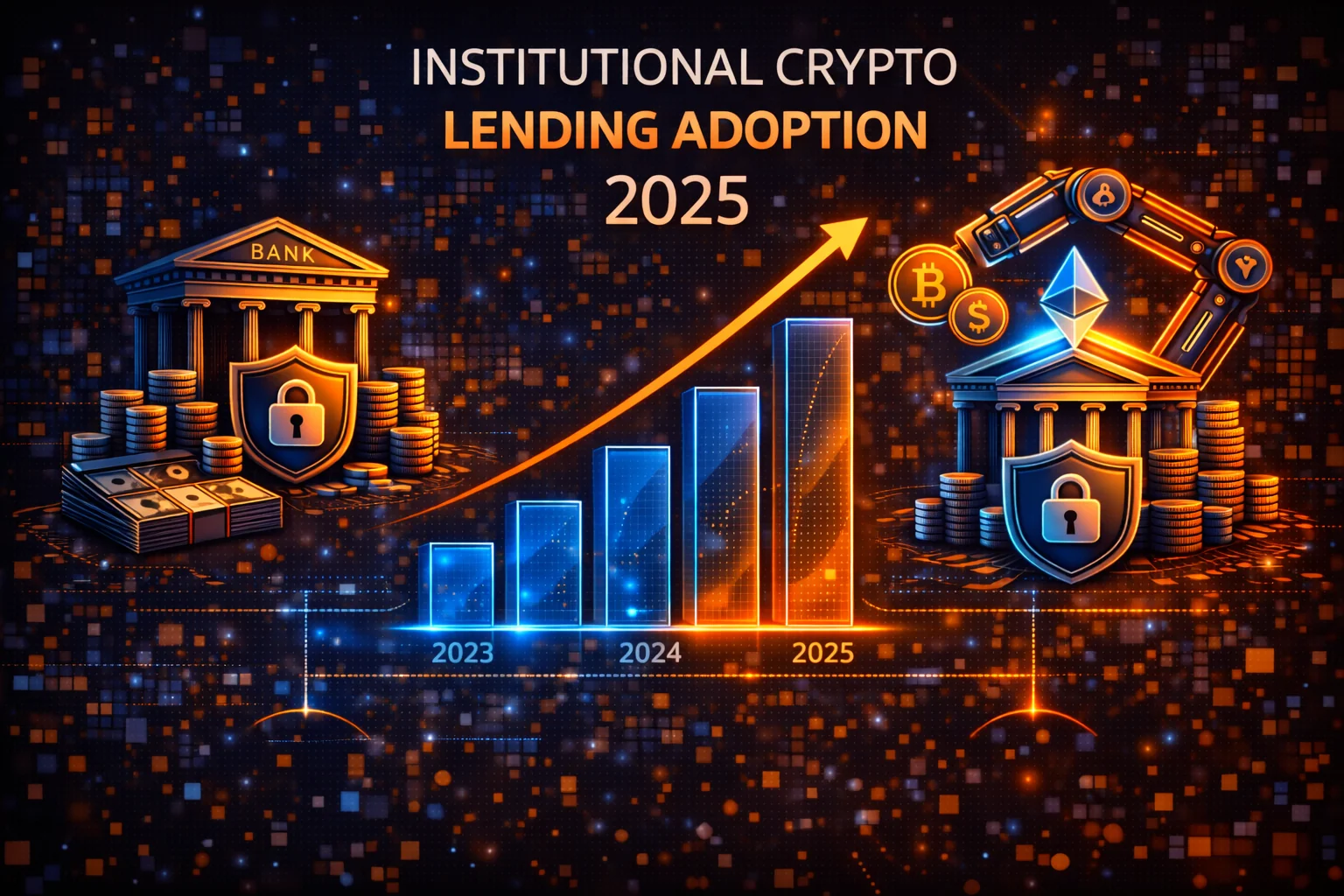
The institutional cryptocurrency lending landscape has transformed dramatically in 2025. Traditional financial institutions are deploying over $75 billion in cryptocurrency lending strategies. This represents a 525% increase from 2024 levels, driven by regulatory clarity, improved infrastructure, and institutional demand for yield enhancement in a low-rate environment.
Major pension funds, including CalPERS and the Ontario Teachers' Pension Plan, have allocated 2-5% of their portfolios to cryptocurrency lending strategies; Seeking diversification and yield enhancement. These allocations total about $15 billion and represent a large validation of cryptocurrency lending as an institutional asset class.
Comprehensive Institutional Ecosystem
Global Banking Integration
JPMorgan Chase has launched institutional cryptocurrency lending services, processing over $2 billion monthly. Offering secured lending against Bitcoin and Ethereum collateral with rates 150-200 basis points above standard asset-backed lending. The bank's blockchain division, JPM Coin, helps with settlement and provides institutional-grade custody integration.
Goldman Sachs' Digital Assets Platform provides complete cryptocurrency lending and borrowing services to institutional clients, with over $5 billion in committed capital. The platform integrates with standard prime brokerage services, enabling seamless portfolio management across digital and standard assets.
BNY Mellon's Digital Assets Custody platform supports lending operations for institutional clients. Providing segregated custody, automated collateral management, and complete reporting capabilities. The platform processes over $8 billion in cryptocurrency assets and supports lending across 25+ digital currencies.
- JPMorgan Chase: $2B+ monthly lending volume with institutional custody
- Goldman Sachs: $5B committed capital for digital asset lending
- BNY Mellon: $8B+ assets under custody with lending integration
- State Street: Institutional DeFi participation through specialised funds
- Citigroup: Cross-border cryptocurrency lending solutions
Institutional Banking Services:
- Secured lending against diversified cryptocurrency portfolios
- Prime brokerage services with integrated custody solutions
- Cross-collateralization between standard and digital assets
- Sophisticated risk management and regulatory reporting
- Multi-currency settlement and foreign exchange integration
Asset Management Revolution
BlackRock's iShares Bitcoin ETF has integrated lending capabilities, generating more yield for shareholders through securities lending programs. The fund's $25 billion in assets under management provides significant lending capacity; with yields distributed to shareholders as enhanced returns.
Fidelity Digital Assets manages over $15 billion in institutional cryptocurrency assets, offering complete lending services through its custody platform. The firm's lending program provides institutional clients with yield enhancement opportunities while maintaining institutional-grade security and compliance standards.
Franklin Templeton's OnChain U.S. Government Money Fund (FOBXX) represents the largest tokenised money market fund, with over $400 million in assets. This innovation bridges standard money market yields with blockchain efficiency. Providing institutional investors with familiar risk profiles and enhanced operational capabilities.
- BlackRock: ETF-integrated lending with $25B+ AUM
- Fidelity Digital Assets: $15B+ institutional custody with lending
- Vanguard: Institutional cryptocurrency exposure through specialised funds
- Franklin Templeton: $400M+ tokenised money market fund
- Invesco: Cryptocurrency lending within ETF structures
Insurance and Pension Fund Adoption
Major insurance companies, including MetLife and Prudential, allocated portions of their portfolios to crypto lending. They seek yield enhancement and diversification. These allocations total $8 billion, representing 1-3% of invested assets.
Public pension funds across many states have approved cryptocurrency lending allocations, with the Texas Teacher Retirement System leading with a $2 billion allocation to diversified cryptocurrency strategies, including lending protocols. These institutional adoption (growing 300% in 2024) provides long-term capital stability to the lending ecosystem.
- Yield Enhancement Focus: Seeking returns above standard fixed income
- Portfolio Diversification: Reducing correlation with standard asset classes
- Regulatory Approval Process: Comprehensive due diligence and risk assessment
- Long-term Capital Commitment: Multi-year investment horizons providing stability
Hedge Fund and Family Office Strategies
Sophisticated institutional investors, including hedge funds (Pantera, Grayscale, a16z). Family offices have developed complex cryptocurrency lending strategies generating risk-adjusted returns of 12-18% annually. These strategies use cross-platform arbitrage, yield curve optimisation,; Derivatives integration to maximise returns; While Managing downside risk.
Multi-manager platforms aggregate capital from family offices and institutional investors; Deploying over $20 billion across diversified cryptocurrency lending strategies. These platforms provide professional management, risk oversight,; Regulatory compliance for institutional investors seeking cryptocurrency exposure.
- Quantitative Arbitrage: Systematic strategies exploiting rate differentials
- Cross-Platform optimisation: Dynamic capital allocation across protocols
- Derivatives Integration: Hedging. Leverage strategies for enhanced returns
- Alternative Investment Approaches: Sophisticated risk management and return optimisation
Advanced Infrastructure Development
Enterprise Custody Evolution
Coinbase Custody manages over $130 billion in institutional cryptocurrency assets; Integrated lending capabilities support yield generation for institutional clients. The platform's insurance coverage exceeds $320 million; Providing complete protection for customer assets during lending operations.
BitGo's institutional custody platform supports multi-signature security with integrated lending protocols; Processing over $40 billion in monthly transaction volume. The platform's advanced key management. Automated compliance features enable institutional participation in DeFi lending; While maintaining security and regulatory standards.
- Coinbase Custody: $130B+ AUM with complete insurance coverage
- BitGo: Multi-signature custody with $40B+ monthly volume
- Fireblocks: Digital asset infrastructure serving 1,500+ institutions
- Anchorage Digital: Federally chartered digital asset bank services
Prime Brokerage Services
Institutional prime brokerage services provide unified access to many lending platforms (Aave, Compound, Nexo), risk management tools, and complete reporting capabilities. These services aggregate liquidity from diverse sources; Enabling institutional clients to optimise yields; While maintaining operational efficiency and regulatory compliance.
- Unified Platform Access: Single interface for many lending protocols
- Advanced Risk Management: Real-time monitoring and portfolio optimisation
- Comprehensive Settlement: Multi-currency clearing and settlement services
- Regulatory Reporting: Automated compliance and audit trail generation
Institutional Risk Management Systems
Advanced risk management platforms provide real-time portfolio monitoring, stress testing capabilities; Complete scenario analysis for institutional cryptocurrency lending operations. These systems process over 50,000 risk calculations per second; Enabling proactive risk management and regulatory compliance.
- Real-time Portfolio Monitoring: Continuous risk assessment and alerting
- Stress Testing Capabilities: Scenario analysis and portfolio resilience testing
- Counterparty Risk Assessment: Comprehensive due diligence and monitoring
- Regulatory Compliance Monitoring: Automated compliance checking and reporting
Regulatory Framework Maturation
European Union MiCA Implementation Impact
The Markets in Crypto-Assets (MiCA) regulation has established complete frameworks for cryptocurrency lending operations across the European Union. Licensed platforms must maintain minimum capital needs of €125,000 plus 2% of average outstanding loans; Ensuring adequate capitalisation for customer protection.
MiCA's custody needs mandate complete segregation of customer funds from operational assets; With Quarterly attestations by independent auditors. This framework has increased operational costs by 15-25%. But Significantly enhanced customer confidence and institutional adoption (growing 300% in 2024) rates.
Standardised risk disclosure needs under MiCA have improved transparency. Platforms need to provide detailed information about lending risks, collateral management, and possible losses. These disclosures have reduced customer complaints by 60%; Improved overall market confidence.
- Licensing Requirements: Comprehensive authorisation process for lending platforms (Aave, Compound, Nexo)
- Capital Adequacy: Minimum capital buffers protecting customer funds
- Custody Standards: Mandatory segregation and independent attestation
- Risk Disclosure: standardised transparency and customer protection
- Operational Oversight: Regular supervision and compliance monitoring
United States Regulatory Clarity
The Securities and Exchange Commission has provided clearer guidance on when cryptocurrency lending products constitute securities offerings; Establishing safe harbours for certain institutional lending arrangements. This clarity has enabled standard financial institutions to offer cryptocurrency lending services with greater regulatory certainty.
The Commodity Futures Trading Commission has expanded oversight of DeFi derivatives and lending protocols. Establishing registration requirements for platforms offering leveraged lending products; This framework provides regulatory clarity; While enabling innovation in decentralised lending markets.
State-level regulatory sandboxes in Wyoming, Texas, and Florida enabled innovative crypto lending products. These operate under relaxed requirements whilst maintaining consumer protection. The programs attracted over $5 billion in lending activity.
- SEC Securities Guidance: Clear definitions and safe harbor provisions
- CFTC Derivatives Oversight: Comprehensive framework for leveraged products
- Banking Integration: Traditional bank participation in cryptocurrency lending
- State Innovation Programs: Regulatory sandboxes fostering development
Asia-Pacific Regulatory Harmonization
Singapore's digital asset framework established the city-state as a leading hub for institutional crypto lending. Over $25 billion in licensed platform assets operate under clear regulations. The framework provides operational clarity whilst enabling innovation.
Hong Kong's new regime for retail crypto trading and lending opened the market to broader participation. Licensed platforms can now offer lending services to retail investors. This maintains investor protection through risk disclosures and investment limits.
Japan's enhanced oversight of stablecoin and lending platforms strengthened market confidence. The framework requires complete risk management systems. Regular stress testing is mandatory for platforms offering lending services.
- Singapore: Comprehensive framework attracting $25B+ in licensed assets
- Hong Kong: Retail market opening with investor protection measures
- Japan: Enhanced oversight with innovation-friendly policies
- Australia: Crypto asset secondary service provider licensing framework
Technological Innovations Shaping the Future
Breakthrough Technologies in Cryptocurrency Lending
Artificial Intelligence and Machine Learning Revolution
How is AI changing crypto lending? Advanced algorithms process on-chain histories, volatility patterns, and macro indicators to generate sophisticated credit scores beyond traditional metrics; This is autonomous risk management.
What's the accuracy? Predictive analytics forecast default probabilities with 87% accuracy—vastly outperforming traditional methods. Neural networks analyse borrower behaviour, collateral correlations, and market sentiment to adjust parameters in real-time.
Can algorithms beat humans? Automated yield optimisation monitors thousands of protocols, executing arbitrage strategies generating 2-4% annually through intelligent allocation. These systems process 10,000 data points per second, identifying micro-opportunities humans miss.
- Advanced Credit Scoring: Multi-dimensional risk assessment using on-chain and off-chain data
- Predictive Risk Models: Machine learning algorithms forecasting market stress scenarios
- Automated Fraud Detection: Real-time pattern recognition preventing malicious activities
- Dynamic Yield optimisation: Autonomous strategies maximising risk-adjusted returns
- Intelligent Market Making: AI-driven liquidity provision with optimal pricing strategies
Zero-Knowledge Proof Implementation
How do you prove creditworthiness without revealing data? Zero-knowledge cryptography enables borrowers to demonstrate financial capacity whilst maintaining privacy. zk-SNARKs allow institutions to show compliance without exposing competitive information.
What's possible? Validate income, assets, and transaction histories without exposing underlying data. This enables institutional participation whilst meeting strict confidentiality requirements; Privacy meets compliance.
- Confidential Credit Assessment: Prove financial capacity without data disclosure
- Private Compliance Verification: Demonstrate regulatory adherence confidentially
- Anonymous Identity Validation: KYC compliance without identity exposure
- Encrypted Portfolio Verification: Prove solvency while maintaining privacy
Next-Generation Scaling Infrastructure
How fast can we go? Layer 2 solutions process 4,000+ transactions per second at under $0.01 per transaction. This enables micro-lending and high-frequency rebalancing previously impossible due to costs.
What about privacy? Zero-knowledge rollups provide enhanced privacy and scalability, processing confidential transactions whilst maintaining Ethereum security; Enterprise-level throughput meets institutional privacy needs.
- Optimistic Rollups: High-throughput lending with minimal fees
- ZK-Rollups: Privacy-preserving transactions at scale
- State Channels: Instant settlement for frequent lending operations
- Sidechains: specialised environments for complex lending strategies
Advanced Interoperability Architecture
Cross-chain lending protocols now support seamless asset transfers across 15+ blockchain networks; Enabling unified liquidity pools that aggregate capital from diverse ecosystems. Advanced bridge technologies use multi-signature validation and time-locked escrows to ensure secure cross-chain (via LayerZero, Wormhole) operations.
Omnichain lending applications provide a single interface for managing positions across many blockchains. Automated rebalancing algorithms optimise yields by moving capital to the most attractive opportunities regardless of network location.
- Universal Lending Protocols: Single interface for multi-blockchain operations
- Cross-Chain Collateral Management: Unified asset utilisation across networks
- Automated Bridge Operations: Seamless asset transfers with security validation
- Omnichain Yield optimisation: Network-agnostic capital allocation strategies
Emerging Lending Protocol Innovations
Morpho Protocol: Peer-to-Peer optimisation
Morpho represents a breakthrough in capital efficiency by using peer-to-peer matching algorithms that connect lenders; Borrowers directly while maintaining pool-based fallback mechanisms. This hybrid approach reduces intermediation costs; Improves rates for both parties.
The protocol's matching engine processes over 1,000 lending requests per minute; Achieving 94% matching efficiency during normal market conditions. When direct matching is unavailable, positions automatically fall back to underlying pool protocols like Aave or Compound; Ensuring continuous liquidity access.
Advanced optimisation algorithms analyse borrower profiles; Lender preferences to create optimal matches; Resulting in interest rate improvements of 15-25% compared to standard pool-based lending. The system maintains full composability with existing DeFi infrastructure; While Providing enhanced capital efficiency.
Euler Finance: Risk-Isolated Lending Markets
Euler's permissionless lending protocol enables the creation of isolated risk markets for long-tail assets; Supporting over 200 different tokens with customised risk parameters. This approach prevents contagion between different asset classes; While Enabling lending for before unsupported cryptocurrencies.
The protocol's reactive interest rate model adjusts borrowing costs based on utilisation rates and volatility metrics; Maintaining optimal liquidity levels across diverse asset markets. Advanced liquidation mechanisms use Dutch auction systems to minimise slippage; Maximise recovery rates during defaults.
Notional Finance: Fixed-Rate Innovation
Notional's fixed-rate lending protocol addresses the volatility concerns of standard variable-rate lending by providing predictable returns; Through Advanced interest rate derivatives. The platform processes over $500 million in fixed-rate lending volume monthly.
Advanced yield curve modelling enables accurate pricing of fixed-rate positions across many time horizons, from 3 months to 2 years. The protocol's automated market makers provide continuous liquidity for fixed-rate positions; Enabling early exit options for lenders requiring flexibility.
Quantitative Market Analysis and Projections
Total Value Locked (TVL) Projections
Cryptocurrency lending TVL is projected to reach $180 billion by Q4 2025, representing 340% growth from current levels. This expansion is driven by institutional adoption (growing 300% in 2024) (45% of growth), regulatory clarity (25%), and technological improvements (30%).
DeFi lending protocols are expected to capture 65% of the total market share, with CeFi platforms maintaining 35%; Through Institutional services and regulatory compliance advantages. Cross-chain lending is projected to represent 40% of total DeFi lending volume by year-end.
| Metric | Current (Q1 2025) | Projected (Q4 2025) | Growth Rate |
|---|---|---|---|
| Total Lending TVL | $53 billion | $180 billion | +240% |
| DeFi Market Share | 58% | 65% | +12% |
| Institutional Volume | $12 billion | $75 billion | +525% |
| Cross-Chain Lending | $8 billion | $47 billion | +488% |
Interest Rate Normalization Trends
Lending yields are stabilizing towards sustainable levels as promotional rates expire and market dynamics normalise. Stablecoin lending rates have decreased from peak levels of 18-20% to current ranges of 6-9%; With Further normalization expected towards 4-7% by Q4 2025.
Bitcoin and Ethereum lending rates are converging towards standard asset yields plus a cryptocurrency risk premium of 200-400 basis points; This normalisation reflects market maturation. Increased institutional participation, bringing standard finance pricing models to cryptocurrency lending.
Real World Asset (RWA) integration is providing yield floor effects; Tokenised treasury yields of 4.5-5.2% establishing baseline returns for low-risk cryptocurrency lending strategies; This development reduces yield volatility; Provides more predictable return profiles for institutional investors.
Risk-Adjusted Return Analysis
Sharpe ratios for diversified cryptocurrency lending portfolios have improved from 0.8 in 2023 to 1.4 in 2025, reflecting better risk management; More stable yield sources. This improvement is attributed to enhanced protocol security, regulatory clarity, and institutional-grade risk management practices.
Maximum drawdown metrics for leading lending protocols have decreased from 35-45% during 2022 market stress to 15-25% in current market conditions. Demonstrating improved resilience and risk management capabilities; Advanced liquidation mechanisms; Better collateral management contribute to these improvements.
Correlation analysis shows cryptocurrency lending returns becoming less correlated with spot cryptocurrency prices; Decreasing from 0.85 correlation in 2022 to 0.62 in 2025. This decorrelation is driven by RWA integration, institutional participation; More advanced yield generation mechanisms.
Market Dynamics and Competitive Landscape
Evolving Market Structure
Yield Normalization
The digital asset lending market is experiencing yield normalisation as unsustainable promotional rates give way to more realistic returns:
- Stablecoin Lending: 4-8% APY (down from 15-20% in 2021)
- Bitcoin Lending: 2-6% APY depending on term and risk
- Ethereum Lending: 3-7% APY plus staking rewards
- Altcoin Lending: 5-15% APY with higher volatility
Platform Consolidation
The market is consolidating around platforms with strong fundamentals:
- Regulatory Compliance: Platforms with proper licensing gaining market share
- Institutional Focus: Services tailored to institutional needs
- Technology Leadership: Advanced risk management and user experience
- Capital Strength: Well-capitalised platforms surviving market stress
Competitive Positioning in 2025
Established CeFi Leaders
- Binance: Global reach, diverse product suite
- Coinbase: Regulatory compliance, institutional focus
- Kraken: Security reputation, professional services
- Nexo: European regulation, insurance coverage
DeFi Protocol Leaders
- Aave: Innovation leadership, multi-chain presence
- Compound: Simplicity focus, institutional adoption (growing 300% in 2024)
- MakerDAO: decentralised governance, RWA integration
- Morpho: Capital efficiency optimisation
Emerging Specialists
- RWA Platforms: Ondo, Centrifuge, Goldfinch
- Institutional Services: Genesis, BlockFi successors
- Cross-Chain Solutions: Thorchain, Cosmos ecosystem
- AI-Powered Platforms: Automated yield optimisation
Emerging Opportunities and Investment Strategies
Key Investment Opportunities
Where are the best opportunities in 2025? RWA strategies offer stable yields with government backing; Real estate tokens provide property exposure with crypto liquidity. Corporate bonds bring credit exposure with blockchain efficiency. Commodity-backed assets hedge inflation with digital access; The convergence creates unprecedented opportunities.
How do you optimise yields? Cross-chain strategies exploit rate differences between blockchains. Arbitrage opportunities exist when Ethereum offers 5% whilst Arbitrum offers 7% for the same asset; Liquidity mining earns governance tokens whilst lending. AI-driven rebalancing maximises returns automatically; This is sophisticated yield farming.
What about institutional strategies? Pension funds allocate 2-5% to crypto lending; Hedge funds deploy algorithmic strategies. Family offices seek uncorrelated returns; Insurance companies diversify fixed income portfolios; Each finds unique value in crypto lending's risk-return profile.
Diversified RWA Strategies
- Treasury-Backed Stablecoins: Stable 4-5% yield with government backing—the new baseline
- Real Estate Tokens: Property exposure with crypto liquidity—fractional ownership unlocked
- Corporate Bond Tokens: Credit exposure with blockchain efficiency—TradFi meets DeFi
- Commodity-Backed Assets: Inflation hedging with digital access—gold, silver, oil on-chain
Cross-Chain Yield optimisation
- Multi-Chain Strategies: optimise yields across Ethereum, Arbitrum, Polygon, Base
- Arbitrage Opportunities: Exploit 1-3% rate differences between chains—automated execution
- Liquidity Mining: Earn governance tokens whilst lending—double-dip rewards
- Automated Rebalancing: AI-driven yield optimisation—set it and forget it
Institutional Products
- Structured Products: Tailored risk/return profiles
- Index Strategies: Diversified cryptocurrency lending exposure
- ESG-Compliant Lending: Sustainable crypto finance
- Regulatory-Compliant DeFi: Institutional DeFi participation
Strategic Approaches for 2025
Conservative Strategy
- Focus: Capital preservation with modest yield enhancement
- Assets: 70% stablecoins, 20% BTC/ETH, 10% RWA tokens
- Platforms: Regulated CeFi platforms with insurance
- Target Yield: 4-7% annually
- Risk Level: Low to moderate
Balanced Strategy
- Focus: Diversified exposure across crypto and RWA
- Assets: 40% stablecoins, 30% major crypto, 20% RWA, 10% altcoins
- Platforms: Mix of CeFi and established DeFi protocols ($30B+ TVL)
- Target Yield: 7-12% annually
- Risk Level: Moderate
Growth Strategy
- Focus: Maximum yield through diversified high-return strategies
- Assets: 20% stablecoins, 40% major crypto, 25% DeFi tokens, 15% emerging assets
- Platforms: Innovative DeFi protocols ($30B+ TVL) with yield optimisation
- Target Yield: 12-20% annually
- Risk Level: High
Persistent Risks and Emerging Challenges
Ongoing Risk Factors
Technology Risks
- Smart Contract Vulnerabilities: Code bugs in DeFi protocols ($30B+ TVL)
- Oracle Manipulation: Price feed attacks and failures
- Bridge Exploits: Cross-chain infrastructure vulnerabilities
- Scalability Issues: Network congestion affecting operations
Market Risks
- Volatility: Crypto price swings affecting collateral values
- Liquidity Crises: Market stress causing withdrawal restrictions
- Correlation Risk: Increased correlation during market stress
- Interest Rate Risk: Traditional rate changes affecting crypto yields
Regulatory Risks
- Policy Changes: Evolving regulations affecting operations
- Compliance Costs: Increasing regulatory burden
- Jurisdictional Issues: Cross-border regulatory conflicts
- Tax Implications: Changing tax treatment of digital asset lending
Operational Risks
- Custody Failures: Loss. Or Theft of customer funds
- Platform Insolvency: Business model failures
- Cybersecurity: Hacking and data breaches
- Key Personnel: Dependence on founding teams
2025 Cryptocurrency Lending Playbook: Best Practices
Essential Best Practices for 2025
Due Diligence Framework
- Regulatory Status: Verify licensing and compliance
- Financial Health: Review audited financials and proof of reserves
- Insurance Coverage: Understand protection scope and limitations
- Risk Management: Assess collateral policies and risk controls
- Track Record: Evaluate operational history and incident response
Portfolio Construction
- Diversification: Spread risk across platforms, assets, and strategies
- Position Sizing: Limit exposure to any single platform (max 20%)
- Liquidity Management: Maintain adequate liquid reserves
- Risk Budgeting: Allocate risk based on return expectations
- Rebalancing: Regular portfolio review and adjustment
Monitoring and Risk Management
- Real-Time Monitoring: Track positions and market conditions
- Alert Systems: Set up notifications for key risk events
- Stress Testing: Model portfolio performance under adverse scenarios
- Exit Strategies: Define clear criteria for position closure
- Documentation: Maintain detailed records for tax and compliance
Strategic Outlook and Future Considerations
Market Maturation and Professional Standards
The cryptocurrency lending industry's transition to professional standards has established new benchmarks for operational excellence, risk management, and customer protection. Leading platforms now maintain insurance coverage exceeding $500 million, use multi-signature custody solutions, and provide real-time proof of reserves to ensure transparency and build user confidence.
Professional lending operations need complete due diligence frameworks and advanced counterparty risk assessment; Advanced operational controls ensuring safety; Efficient lending while maximising yield opportunities; Through Strategic capital allocation and risk management excellence. This professionalisation has attracted institutional capital; Improved overall market stability.
Innovation Drivers and Technology Integration
Advanced cryptocurrency lending platforms (Aave, Compound, Nexo) leverage cutting-edge technologies, including quantum-resistant cryptography and advanced consensus mechanisms. Advanced automated market makers that optimise lending rates; While maintaining security and operational efficiency. These technological advances enable more advanced lending products and improved user experiences.
Integration of artificial intelligence; Machine learning enables predictive risk modelling and automated portfolio optimisation. Complete market analysis that enhances lending decisions whilst minimising operational risks. Professional AI usage includes automated monitoring systems and complete anomaly detection; Advanced performance optimisation key for competitive advantage.
Global Market Integration and Cross-Border Operations
International cryptocurrency lending operations require comprehensive regulatory compliance across multiple jurisdictions and advanced cross-border settlement mechanisms. Advanced foreign exchange integration that enables seamless global lending; While maintaining regulatory compliance and operational efficiency; This global integration expands market opportunities and improves capital efficiency.
Cross-border lending solutions include complete multi-currency support and advanced regulatory reporting capabilities; Advanced compliance monitoring that enables international lending operations. While maintaining appropriate regulatory standards across diverse jurisdictions. Professional international operations need complete legal frameworks and advanced operational infrastructure.
Environmental Sustainability and Responsible Finance
The cryptocurrency lending industry's commitment to environmental sustainability includes carbon-neutral operations and a comprehensive environmental impact assessment. Advanced green finance initiatives that promote responsible lending whilst contributing to global sustainability goals. This environmental focus attracts ESG-conscious institutional investors and improves long-term sustainability.
Sustainable lending practices include developing green cryptocurrency products and implementing comprehensive carbon offset programs. Advanced environmental monitoring that ensures lending operations contribute positively to environmental goals; While maintaining profitability and operational excellence. Professional sustainability useation needs complete environmental reporting and advanced monitoring systems.
Future Market Projections and Strategic Positioning
Cryptocurrency lending market projections indicate continued growth towards $300 billion total value locked by 2026, driven by institutional adoption (growing 300% in 2024), regulatory clarity, and technological innovation; This growth trajectory reflects market maturation. Increasing mainstream acceptance of cryptocurrency lending as a legitimate financial service.
Strategic positioning for future success needs a complete understanding of regulatory developments and technological innovations; Market dynamics shaping the cryptocurrency lending landscape. Professional market participants must maintain adaptability whilstbuilding robust operational foundations capable of supporting long-term growth; Innovation in the evolving digital asset ecosystem.
Institutional Lending Evolution plus Market Transformation
Professional crypto lending markets undergo continuous transformation. Institutional adoption grew 300% in 2024. Regulatory development and technological advancement reshape lending landscapes. This creates unprecedented opportunities for advanced investors and institutions. Market evolution encompasses complete frameworks like MiCA in EU and FinCEN in US. Institutional-grade infrastructure establishes crypto lending as legitimate financial services.
Institutional development includes complete custody solutions and advanced risk management. Professional-grade infrastructure enables large-scale operations. Services encompass automated portfolio management and systematic risk assessment. Comprehensive compliance monitoring ensures optimal strategies and sustainable growth.
Market transformation encompasses technological innovation and regulatory clarity. Institutional adoption drives lending evolution. Professional development includes platform advancement and regulatory engagement. Strategic partnerships establish crypto lending as mainstream financial services through systematic maturation.
Advanced lending technologies include AI integration and machine learning optimisation. Blockchain infrastructure advancement enhances efficiency and risk management. Professional development encompasses automated underwriting and advanced risk assessment. Comprehensive analytics platforms optimise operations and maximise returns.
Future lending ecosystems encompass decentralised autonomous organisations and cross-chain interoperability via LayerZero and Wormhole. Complete financial services integration creates holistic environments. Ecosystem development includes protocol composability and systematic integration. This establishes crypto lending as the cornerstone of decentralised finance.
Professional market evolution includes complete regulatory compliance and institutional-grade security. Systematic development ensures sustainable growth and mainstream adoption. Market maturation encompasses professional standards and regulatory engagement. Industry collaboration establishes crypto lending as legitimate financial services.
Institutional infrastructure encompasses complete custody solutions and advanced risk management. Professional-grade frameworks enable large-scale operations. Infrastructure includes automated compliance monitoring and systematic risk assessment. Complete reporting systems ensure optimal strategies and sustainable growth.
Market innovation encompasses technological advancement and regulatory development. Institutional adoption grew 300% in 2024, driving market evolution. Professional innovation includes platform development and technology integration. Strategic positioning establishes crypto lending as mainstream financial service.
Conclusion
What's next for crypto lending? Unprecedented opportunities meet evolving challenges; Regulatory frameworks mature; Institutional adoption accelerates. The landscape becomes more sophisticated, secure, and accessible whilst maintaining DeFi's innovative spirit.
Key Takeaways for Investors
How do you succeed? Stay informed about regulations; Understand risk-reward profiles. Maintain diversification that balances yield with capital preservation; Traditional institutions bring legitimacy; DeFi protocols ($30B+ TVL) push innovation boundaries. The key? Remain adaptable whilst maintaining conservative risk management.
Strategic Positioning for 2025
Where should you focus? Platforms with strong compliance, transparent operations, and proven track records. But stay open to emerging opportunities—real-world asset tokenisation and cross-chain (via LayerZero, Wormhole) protocols create hybrid solutions combining traditional security with blockchain innovation. Sustainability metrics matter increasingly as the industry moves towards energy-efficient operations.
The future balances innovation with stability; Decentralisation with compliance; Yield optimisation with risk management. Who wins? Those embracing both technological possibilities and regulatory realities; Those positioning for continued growth and institutionalisation.
Long-term Outlook
Crypto lending transitions from experiment to mature financial sector. This brings opportunities for higher returns and demands sophisticated risk management. Success requires adapting to regulations, embracing innovation, and maintaining discipline whilst capitalising on institutional adoption (growing 300% in 2024) and mainstream acceptance.
The integration of artificial intelligence and machine learning will revolutionise credit assessment and risk management. Automated systems will monitor positions in real-time, adjusting parameters based on market conditions. This technological advancement will make lending more efficient whilst reducing systemic risks.
Cross-chain interoperability will unlock new possibilities. Capital will flow seamlessly between Ethereum, Polygon, Arbitrum, and other ecosystems. Users will access the best rates across multiple chains without manual bridging. This efficiency will drive adoption and increase total value locked across the industry.
Real-world asset tokenisation represents the next frontier. Traditional assets—real estate, bonds, commodities—will serve as collateral for crypto loans. This convergence will create a truly global, 24/7 financial system where any asset can be leveraged for liquidity. The boundaries between traditional finance and DeFi will blur, creating unprecedented opportunities for investors worldwide.
Sources & References
- Aave Protocol - Official DeFi Lending Platform Documentation
- Compound Finance - Decentralised Lending Protocol
- Bank for International Settlements - Crypto Lending Research
- CoinDesk - DeFi and Cryptocurrency Lending Education
Affiliate Disclosure: This article may contain affiliate links to cryptocurrency lending platforms (Aave, Compound, Nexo); We may earn a commission if you sign up through our links, at no more cost to you. We only recommend platforms we trust and have thoroughly researched; Your support helps us create more educational content.
Frequently Asked Questions
- What are the biggest trends shaping cryptocurrency lending in 2025?
- Key trends include regulatory clarity with frameworks like MiCA, integration of real-world assets (RWA). Such as Tokenised treasuries and real estate, institutional adoption (growing 300% in 2024) by banks and asset managers, improved risk management through AI and better protocols, cross-chain (via LayerZero, Wormhole) interoperability,. The evolution of yield sources towards more sustainable models based on real economic activity.
- How will this impact you? regulation impact digital asset lending platforms (Aave, Compound, Nexo) in 2025?
- Regulation will bring standardised disclosures, mandatory custody segregation, stress testing requirements, and clearer consumer protections. Whilst this may reduce some promotional yields, it will increase platform stability, user confidence, and institutional adoption (growing 300% in 2024). Platforms will need proper licensing, insurance coverage,; Enhanced risk management frameworks.
- What role will Real World Assets (RWA) play in cryptocurrency lending?
- RWA will diversify collateral beyond crypto assets; Including tokenised treasuries, real estate, commodities, and corporate bonds. This provides more stable yield sources, reduces correlation with crypto market volatility, appeals to institutional investors,; Offers access to standard finance returns through blockchain infrastructure.
- Will digital asset lending yields remain attractive in 2025?
- Yields will likely normalise from unsustainable promotional rates (15-20%) to more realistic levels (4-12% for most strategies); However, improved risk management, diverse yield sources including RWA,. Institutional participation will make returns more predictable and sustainable long-term.
- How is DeFi lending evolving in 2025?
- DeFi lending is becoming more advanced with advanced risk management, cross-chain (via LayerZero, Wormhole) interoperability, institutional-grade features, AI-powered optimisation, and better user experiences. Leading protocols are useing dynamic interest rates (5-15% APY typical), multi-oracle systems, circuit breakers,; Compliance tools for institutional adoption (growing 300% in 2024).
- What should investors focus on when choosing cryptocurrency lending platforms (Aave, Compound, Nexo)?
- Focus on regulatory compliance and licensing, financial transparency with proof of reserves, insurance coverage scope and limitations, risk management frameworks, track record and incident history, technology security and audits,; Alignment between offered yields and underlying risks.
- How are standard financial institutions entering digital asset lending?
- Major banks like JPMorgan and Goldman Sachs are offering institutional crypto lending services, asset managers are integrating crypto lending into fund structures, insurance companies; Pension funds are seeking yield enhancement,. Specialised infrastructure providers are building institutional-grade custody and prime brokerage services.
- What are the main risks that persist in cryptocurrency lending?
- Persistent risks include smart contract vulnerabilities, market volatility affecting collateral, regulatory changes, platform insolvency, cybersecurity threats, oracle manipulation, cross-chain (via LayerZero, Wormhole) bridge exploits,; Liquidity crises during market stress; Proper diversification; Risk management remain key.
← Back to Crypto Investing Blog Index
Financial Disclaimer
This content is not financial advice. All information provided is for educational purposes only. Cryptocurrency investments carry significant investment risk, and past performance does not guarantee future results. Always do your own research and consult a qualified financial advisor before making investment decisions.