Blockchain Technology: Complete Guide 2025
Understand blockchain technology from the ground up. Learn how distributed ledgers work, different consensus mechanisms, and real-world applications beyond cryptocurrency.
Introduction
Blockchain technology represents one of the most revolutionary innovations of the 21st century, fundamentally transforming how we think about data storage, transaction processing, and digital trust in the modern world. Originally developed as the underlying technology for Bitcoin, blockchain has evolved far beyond cryptocurrency to become a foundational technology with applications spanning finance, supply chain management, healthcare, voting systems, and countless other industries that require secure and transparent record-keeping.
At its core, blockchain is a distributed digital ledger that maintains a continuously growing list of records, called blocks, which are linked and secured using advanced cryptography. Each block contains a cryptographic hash of the previous block, a timestamp, and transaction data, creating an immutable chain of information that cannot be altered without detection. This revolutionary approach to data management eliminates the need for central authorities and intermediaries, enabling peer-to-peer transactions and interactions with unprecedented security and transparency.
The significance of blockchain technology extends far beyond its technical specifications and implementation details. It represents a fundamental paradigm shift towards decentralisation, where power and control are distributed amongst network participants rather than concentrated in the hands of a few central authorities. This decentralisation has profound and far-reaching implications for how we conduct business, manage assets, verify identities, and establish trust in digital environments.
Understanding blockchain technology is absolutely essential for anyone seeking to navigate the modern digital economy and participate in the ongoing technological revolution. Whether you're an investor looking to understand cryptocurrency markets and digital asset opportunities, a business owner exploring new operational efficiencies and competitive advantages, or simply a curious individual wanting to comprehend one of today's most important technological developments, blockchain knowledge has become increasingly valuable and necessary in our interconnected world.
The applications of blockchain technology continue to expand rapidly and significantly as developers, entrepreneurs, and established institutions discover new ways to leverage its unique properties of immutability, transparency, and decentralisation. From enabling secure digital payments without traditional banking intermediaries to creating tamper-proof supply chain records and transparent voting systems, blockchain is actively reshaping industries and creating new possibilities for innovation, economic growth, and social organisation across the global economy.
This comprehensive guide explores blockchain technology from the ground up, covering fundamental concepts, technical mechanisms, real-world applications, benefits, limitations, and future prospects in detail. Whether you're a complete beginner or someone looking to deepen your understanding, this guide provides the knowledge needed to comprehend and engage with blockchain technology in today's rapidly evolving digital landscape.
The transformative potential of blockchain technology lies not just in its technical capabilities, but in its ability to create new forms of economic and social organisation that transcend traditional boundaries and limitations. By enabling trustless interactions between parties who may never meet, blockchain opens unprecedented possibilities for global collaboration, financial inclusion, and innovation that were previously constrained by geographical, political, or institutional barriers. Understanding these implications is crucial for anyone seeking to navigate the future of digital commerce and social interaction.
As blockchain technology continues to mature and evolve, we're witnessing the emergence of increasingly sophisticated applications that leverage its core principles while addressing scalability, energy efficiency, and user experience challenges. From layer-2 solutions that enhance transaction throughput to interoperability protocols that connect different blockchain networks, the ecosystem is rapidly developing solutions that make blockchain technology more accessible and practical for mainstream adoption across various industries and use cases.
What is Blockchain Technology?
Blockchain is a distributed digital ledger that records transactions across multiple computers in a way that makes them nearly impossible to change, hack, or cheat. Think of it as a digital notebook that's copied across thousands of computers worldwide, where everyone can see every entry, but no one can erase or modify past entries.
The name "blockchain" comes from its structure: transactions are grouped into "blocks" that are linked together in a chronological "chain." Each block contains a cryptographic hash of the previous block, creating an unbreakable chain of records.
For a comprehensive technical overview, the original Bitcoin whitepaper by Satoshi Nakamoto introduced the foundational concepts of blockchain technology that underpin modern distributed ledger systems.
The Evolution of Digital Trust
Before blockchain, digital transactions required trusted intermediaries, such as banks, payment processors, or governments, to verify and record transactions. Blockchain eliminates this need through mathematical proof and cryptographic security, creating "trustless" systems where parties can transact directly without needing to know or trust each other.
Cryptographic Foundations
Hash Functions
Blockchain relies heavily on cryptographic hash functions, particularly SHA-256 (Secure Hash Algorithm), a 256-bit hash function. These functions take any input and produce a fixed-length output that appears random:
- Deterministic: Same input always produces same output
- Avalanche effect: Tiny input change completely changes output
- One-way function: Impossible to reverse-engineer the input
- Collision resistant: Nearly impossible to find two inputs with same output
Example Hash Demonstration
| Input | SHA-256 Hash Output |
|---|---|
| "Hello World" | a591a6d40bf420404a011733cfb7b190d62c65bf0bcda32b57b277d9ad9f146e |
| "Hello World!" | 7f83b1657ff1fc53b92dc18148a1d65dfc2d4b1fa3d677284addd200126d9069 |
| "hello world" | b94d27b9934d3e08a52e52d7da7dabfac484efe37a5380ee9088f7ace2efcde9 |
Digital Signatures
Blockchain uses public-key cryptography to create digital signatures that prove ownership and authorise transactions:
- Private key: Secret number used to sign transactions (like a password)
- Public key: Derived from private key, used to verify signatures (like a username)
- Address: Hash of public key, used as account identifier
- Digital signature: Mathematical proof that transaction was authorized by private key owner
Block Structure Deep Dive
Block Header Components
| Component | Size | Purpose | Example |
|---|---|---|---|
| Previous Block Hash | 32 bytes | Links to previous block | 000000000019d6689c085ae165831e93... |
| Merkle Root | 32 bytes | Summary of all transactions | 4a5e1e4baab89f3a32518a88c31bc87f... |
| Timestamp | 4 bytes | When block was created | 1231006505 (Unix timestamp) |
| Difficulty Target | 4 bytes | Mining difficulty | 0x1d00ffff |
| Nonce | 4 bytes | Proof of work solution | 2083236893 |
Merkle Trees
Blockchain uses Merkle trees to summarise all transactions in a block efficiently:
- Leaf nodes: Individual transaction hashes
- Branch nodes: Hash of two child nodes
- Root node: Single hash representing entire block
- Efficiency: Can verify any transaction without downloading entire block
Key Blockchain Characteristics
decentralisation Spectrum
| Aspect | centralised | decentralised | Distributed |
|---|---|---|---|
| Control | Single authority | Multiple authorities | No central authority |
| Failure Points | Single point of failure | Multiple points of failure | No single point of failure |
| Examples | Traditional banks | Consortium blockchains | Bitcoin, Ethereum |
Immutability Mechanisms
- Cryptographic linking: Each block references previous block's hash
- Proof of work: Computational cost makes changes expensive
- Network consensus: Majority must agree on changes
- Distributed storage: Thousands of copies make tampering detectable
Network Effects and Security
Security Through decentralisation
Blockchain security increases with network size and distribution:
- Hash rate distribution: More miners = harder to attack
- Geographic distribution: Global nodes resist local attacks
- Economic incentives: Attacking costs more than honest participation
- Transparency: All participants can verify network state
Attack Vectors and Defenses
| Attack Type | Description | defence Mechanism | Success Probability |
|---|---|---|---|
| 51% Attack | Control majority of network hash rate | Economic incentives, high cost | Very low (major networks) |
| Double Spending | Spend same coins twice | Confirmation requirements | Decreases with confirmations |
| Sybil Attack | Create many fake identities | Proof of work/stake requirements | Low (well-designed networks) |
| Eclipse Attack | Isolate node from network | Multiple connection sources | Medium (individual nodes) |
How Blockchain Works: Step by Step
1. Transaction Initiation
When someone wants to send cryptocurrency or data, they create a transaction. This transaction includes the sender's address, the recipient's address, the amount, and a digital signature proving ownership.
2. Broadcasting to Network
The transaction is broadcast to the blockchain network, where thousands of computers (nodes) receive and validate it. Each node checks whether the transaction adheres to the network's rules.
3. Validation Process
Network participants (miners or validators) verify the transaction by checking:
- Digital signatures are valid
- Sender has sufficient balance
- Transaction follows network rules
- No double-spending attempts
4. Block Creation
Valid transactions are collected into a new block along with:
- Timestamp of block creation
- Hash of the previous block
- Merkle root (summary of all transactions)
- Nonce (number used once for proof of work)
5. Consensus Achievement
The network uses consensus mechanisms (like Proof of Work or Proof of Stake) to agree on the new block. This ensures all nodes have the same version of the blockchain.
6. Block Addition
Once consensus is reached, the new block is added to the blockchain and distributed to all nodes. The transaction is now permanently recorded and cannot be reversed.
Consensus Mechanisms Explained
Consensus mechanisms are the rules that blockchain networks use to agree on valid transactions and maintain security without the need for a central authority.
| Consensus Type | How It Works | Energy Usage | Examples |
|---|---|---|---|
| Proof of Work (PoW) | Miners compete to solve puzzles | Very High | Bitcoin, Litecoin |
| Proof of Stake (PoS) | Validators chosen by stake amount | Very Low | Ethereum 2.0, Cardano |
| Delegated PoS (DPoS) | Token holders vote for delegates | Low | EOS, Tron |
| Proof of Authority (PoA) | Pre-approved validators | Very Low | VeChain, Private chains |
Proof of Work (PoW)
Miners use computational power to solve complex mathematical puzzles. The first to solve the puzzle gets to add the following block and receive rewards. This system is very secure but energy-intensive.
Proof of Stake (PoS)
Validators are chosen to create new blocks based on their stake (ownership) in the network. This system uses 99% less energy than PoW while maintaining security through economic incentives.
Types of Blockchain Networks
Public Blockchains
- Open to everyone: Anyone can participate, view, and transact
- Fully decentralised: No single entity controls the network
- Examples: Bitcoin, Ethereum, Litecoin
- Use cases: Cryptocurrencies, DeFi, NFTs
Private Blockchains
- Restricted access: Only authorized participants can join
- centralised control: Single organisation manages the network
- Examples: Hyperledger Fabric, R3 Corda
- Use cases: Enterprise solutions, supply chain management
Consortium Blockchains
- Semi-decentralised: Controlled by a group of organisations
- Selective participation: Pre-approved members only
- Examples: Energy Web Chain, IBM Food Trust
- Use cases: Industry collaborations, regulatory compliance
Hybrid Blockchains
- Mixed approach: Combines public and private elements
- Selective transparency: Some data public, some private
- Examples: JPM Coin, Facebook's Diem (cancelled)
- Use cases: Central bank digital currencies (CBDCs)
Real-World Blockchain Applications
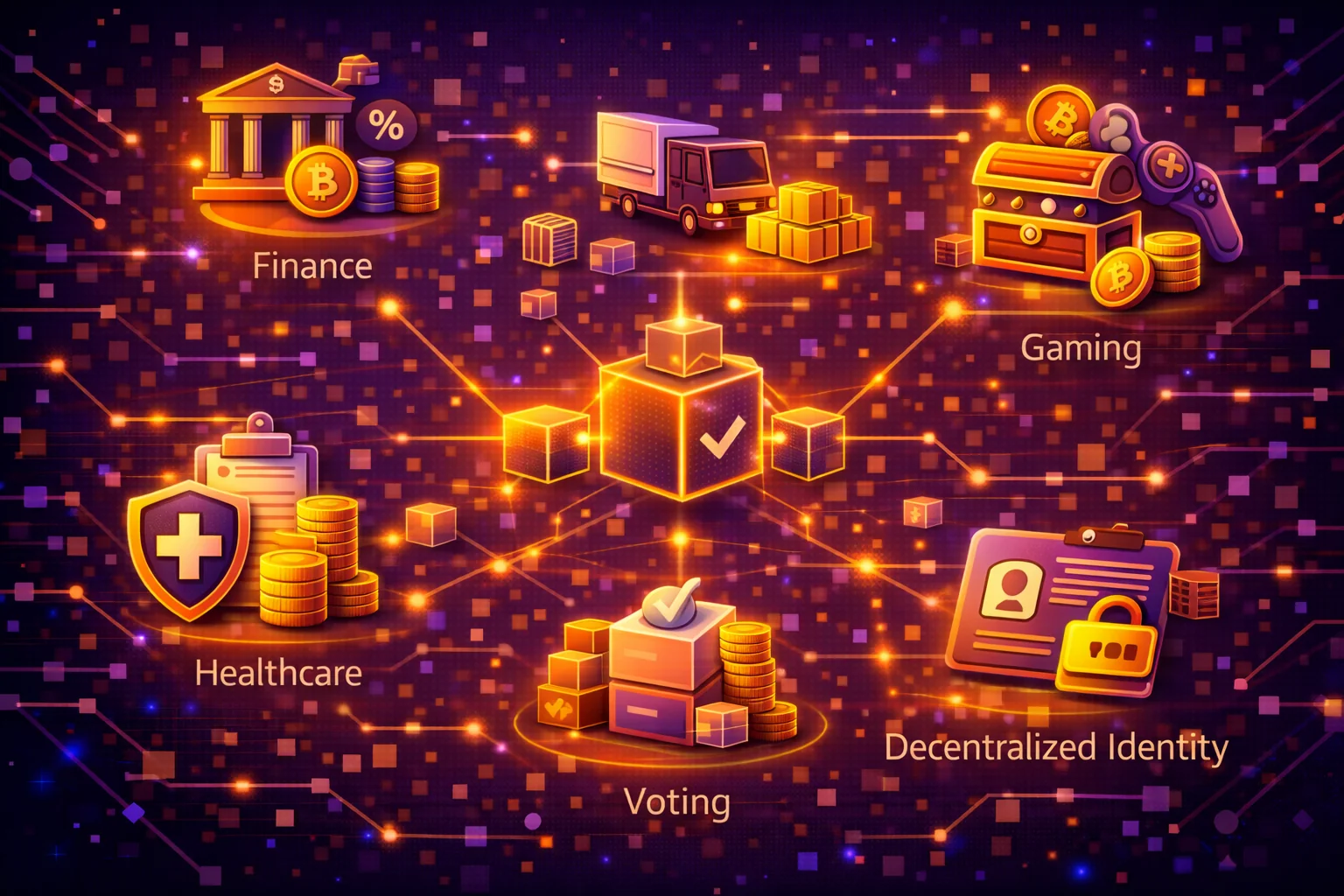
The IBM Blockchain research documents numerous enterprise implementations across supply chain, finance, and healthcare sectors, demonstrating blockchain's practical value beyond cryptocurrency.
Financial Services Revolution
Cross-Border Payments
Traditional international transfers typically take 3-5 business days and cost $25-$ 50. Blockchain solutions offer same-day settlement at a fraction of the cost:
| Solution | Settlement Time | Cost | Coverage |
|---|---|---|---|
| Traditional SWIFT | 3-5 days | $25-50 + 3-5% | Global |
| Ripple (XRP) | 3-5 seconds | $0.0002 | 300+ financial institutions |
| Stellar (XLM) | 2-5 seconds | $0.00001 | Emerging markets focus |
| JPM Coin | Instant | Minimal | JPMorgan clients only |
Trade Finance Digitization
Blockchain streamlines complex trade finance processes:
- Letters of Credit: HSBC and Standard Chartered reduced processing time from 5-10 days to under 24 hours
- Bill of Lading: Maersk's TradeLens platform tracks 30% of global container shipments
- Invoice Financing: Automated verification and faster payments to suppliers
- Compliance: Real-time regulatory reporting and audit trails
decentralised Finance (DeFi) Ecosystem
| DeFi Category | Total Value Locked | Leading Protocols | Use Cases |
|---|---|---|---|
| Lending/Borrowing | $15B+ | Aave, Compound, MakerDAO | Collateralized loans, yield generation |
| decentralised Exchanges | $8B+ | Uniswap, SushiSwap, Curve | Token swapping, liquidity provision |
| Derivatives | $3B+ | dYdX, Synthetix, GMX | Futures, options, synthetic assets |
| Insurance | $500M+ | Nexus Mutual, Cover Protocol | Smart contract coverage |
Supply Chain Transparency
Food Safety and Traceability
Blockchain enables end-to-end food tracking, crucial for safety and authenticity:
Walmart's Food Traceability Initiative
- Problem: Food contamination outbreaks took weeks to trace
- Solution: IBM Food Trust blockchain platform
- Results: Trace contamination source in 2.2 seconds vs 7 days
- Scale: Tracks products from 100+ countries
Nestlé's Supply Chain Transparency
- Products: Coffee, palm oil, milk powder
- Technology: OpenSC blockchain platform
- Benefits: Verify ethical sourcing, combat counterfeiting
- Consumer access: QR codes provide full product history
Pharmaceutical Anti-Counterfeiting
WHO estimates 10% of medicines in developing countries are counterfeit. Blockchain provides a solution:
| Company | Platform | Coverage | Key Features |
|---|---|---|---|
| Pfizer | MediLedger | US prescription drugs | FDA compliance, serialization |
| Novartis | Chronicled | Global supply chain | Temperature monitoring, authenticity |
| Roche | Modum.io | European distribution | IoT sensors, compliance automation |
Healthcare Data Management
Electronic Health Records (EHR)
Blockchain addresses major healthcare data challenges:
- Interoperability: Different systems can share data securely
- Patient control: Individuals own and control their health data
- Privacy: Selective sharing with authorized providers only
- Audit trails: Complete record of who accessed what data when
Clinical Trial Integrity
Blockchain ensures clinical trial data integrity and transparency:
- Data immutability: Prevent post-hoc data manipulation
- Patient consent: Transparent, revocable consent management
- Regulatory compliance: Automated reporting to health authorities
- Multi-site coordination: Secure data sharing between research centers
Digital Identity and Credentials
Self-Sovereign Identity (SSI)
Blockchain enables individuals to control their digital identity without relying on centralised authorities:
| Traditional Identity | Self-Sovereign Identity |
|---|---|
| Controlled by institutions | Controlled by individuals |
| Siloed across platforms | Portable across services |
| Privacy risks from data breaches | Minimal data exposure |
| Requires multiple accounts | Single identity for all services |
Academic Credential Verification
Universities worldwide are adopting blockchain for diploma verification:
- MIT: Issues digital diplomas on blockchain since 2017
- University of Melbourne: Blockchain credentials for continuing education
- Singapore Management University: Tamper-proof academic transcripts
- Benefits: Instant verification, reduced fraud, global recognition
Voting and Governance
Blockchain Voting Systems
Several jurisdictions have piloted blockchain voting with promising results:
| Location | Election Type | Technology | Results |
|---|---|---|---|
| Estonia | National elections | KSI blockchain | 46% of votes cast online |
| West Virginia, USA | Military overseas voting | Voatz mobile app | Successful pilot program |
| Moscow, Russia | Municipal elections | Ethereum-based system | Electronic voting option |
| Switzerland | Local referendums | Various pilots | Ongoing trials |
Entertainment and Creative Industries
Non-Fungible Tokens (NFTs)
NFTs have revolutionised digital ownership and creator monetisation:
- Digital art: $25B+ in NFT sales in 2021-2022
- Music royalties: Artists receive direct payments from fans
- Gaming assets: True ownership of in-game items
- Virtual real estate: Land ownership in metaverse platforms
Content Creator Economy
| Platform | Blockchain | Creator Benefits | User Benefits |
|---|---|---|---|
| Audius | Solana | Direct fan payments, no middlemen | Uncensored music discovery |
| Mirror | Ethereum | Tokenized writing, crowdfunding | Support favourite writers directly |
| Theta Network | Theta | decentralised video streaming | Earn tokens for sharing bandwidth |
Benefits of Blockchain Technology
Transparency and Trust
All transactions are recorded on a public ledger that anyone can verify and audit. This transparency builds trust between parties who don't know each other, eliminating the need for intermediaries like banks or governments.
Security and Immutability
Cryptographic hashing and distributed consensus make blockchain extremely secure. Once data is recorded, it becomes nearly impossible to alter, providing a permanent and tamper-proof record.
decentralisation
No single point of failure or control. The network continues operating even if some nodes go offline, and no single entity can manipulate the system for its benefit.
Cost Reduction
By eliminating intermediaries and automating processes with smart contracts, blockchain can significantly reduce transaction costs, especially for cross-border payments and complex business processes.
Global Accessibility
Blockchain networks operate 24/7 and are accessible to anyone with an internet connection, providing financial services to the unbanked and enabling global commerce.
Blockchain Limitations and Challenges
Scalability Issues
Most blockchains can only process a limited number of transactions per second. Bitcoin handles ~7 TPS, Ethereum ~15 TPS, compared to Visa's ~65,000 TPS capacity.
Energy Consumption
Proof-of-work blockchains, such as Bitcoin, consume enormous amounts of energy. However, newer consensus mechanisms like Proof of Stake address this issue with 99% lower energy usage.
Regulatory Uncertainty
Governments worldwide are still developing regulations for blockchain and cryptocurrency, creating uncertainty for businesses and users. This regulatory landscape continues to evolve rapidly.
Technical Complexity
Blockchain technology is complex and requires specialised knowledge to implement properly. User interfaces are often difficult for non-technical users, limiting mainstream adoption.
Storage Limitations
Storing large amounts of data on-chain is expensive and impractical. Most blockchains are better suited for storing transaction records rather than large files or databases.
The Future of Blockchain Technology
According to World Economic Forum analysis on blockchain trends, the technology is evolving beyond cryptocurrency towards enterprise adoption, with focus on interoperability, sustainability, and regulatory compliance.
Interoperability
Future blockchain networks will be able to communicate and share data seamlessly, creating a connected ecosystem of specialised blockchains rather than isolated networks.
Quantum Resistance
As quantum computers develop, blockchain networks are implementing quantum-resistant cryptography to maintain security against future quantum attacks.
Green Blockchain
The shift from energy-intensive Proof of Work to eco-friendly consensus mechanisms will make blockchain technology more sustainable and environmentally responsible.
Central Bank Digital Currencies (CBDCs)
Many countries are developing blockchain-based digital versions of their national currencies, potentially revolutionizing how money works in the digital age.
Layer 2 Scaling Solutions
Layer 2 solutions are revolutionising blockchain scalability by processing transactions off the main chain while maintaining security:
| Solution Type | How It Works | Examples | Benefits |
|---|---|---|---|
| State Channels | Off-chain transaction channels | Lightning Network (Bitcoin) | Instant payments, minimal fees |
| Optimistic Rollups | Assume transactions valid, verify if challenged | Arbitrum, Optimism | EVM compatibility, lower costs |
| ZK-Rollups | Zero-knowledge proofs for validation | Polygon zkEVM, zkSync | Faster finality, privacy features |
| Sidechains | Independent chains with bridges | Polygon PoS, xDai | Custom consensus, specialised features |
Cross-Chain Interoperability
The future of blockchain is multi-chain, with specialised networks working together:
Bridge Technologies
- Atomic Swaps: Direct peer-to-peer exchanges between different blockchains
- Wrapped Tokens: Representations of assets from one chain on another (e.g., WBTC on Ethereum)
- Cross-Chain Protocols: Cosmos IBC, Polkadot parachains, Chainlink CCIP
- Multi-Chain DEXs: Thorchain, Anyswap, enabling seamless asset swaps
Interoperability Statistics (2025)
| Metric | Value | Growth (YoY) |
|---|---|---|
| Cross-chain bridge TVL | $8.5 billion | +145% |
| Active blockchain networks | 200+ | +67% |
| Cross-chain transactions daily | 2.3 million | +234% |
| Interoperability protocols | 45+ | +88% |
Web3 Integration
Blockchain will power the next generation of the internet (Web3), enabling decentralised applications, digital ownership, and user-controlled data:
Web3 Infrastructure Components
- decentralised Storage: IPFS, Arweave, Filecoin for censorship-resistant data storage
- decentralised Computing: Ethereum Virtual Machine, Internet Computer for running applications
- decentralised Identity: ENS domains, Unstoppable Domains for human-readable addresses
- decentralised Governance: DAOs (decentralised Autonomous Organizations) for community decision-making
Web3 Adoption Metrics (2025)
| Category | Active Users | Total Value | Key Applications |
|---|---|---|---|
| DeFi Protocols | 6.2 million | $45 billion TVL | Uniswap, Aave, Compound |
| NFT Marketplaces | 2.8 million | $15 billion volume | OpenSea, Blur, Magic Eden |
| GameFi Platforms | 1.4 million | $8 billion market cap | Axie Infinity, The Sandbox |
| Social DApps | 890,000 | $2 billion valuation | Lens Protocol, Farcaster |
Sustainability and Green Blockchain
Environmental concerns have driven innovation in sustainable blockchain technologies:
Energy Consumption Comparison
| Network | Consensus | Annual Energy Use | Per Transaction |
|---|---|---|---|
| Bitcoin | Proof of Work | 120 TWh | 700 kWh |
| Ethereum (pre-merge) | Proof of Work | 78 TWh | 238 kWh |
| Ethereum (post-merge) | Proof of Stake | 0.0026 TWh | 0.034 kWh |
| Cardano | Proof of Stake | 0.0054 TWh | 0.52 kWh |
| Solana | Proof of History + PoS | 0.0017 TWh | 0.00051 kWh |
Carbon Neutral Initiatives
- Ethereum Foundation: Carbon negative since genesis through offset programs
- Algorand: First carbon-negative blockchain through partnership with ClimateTrade
- Tezos: Energy-efficient PoS with ongoing sustainability research
- Hedera: Council governance focused on sustainability and energy efficiency
Investing in Blockchain Technology
Direct Blockchain Investment Options
Investors can gain exposure to blockchain technology through various methods:
Cryptocurrency Holdings
| Category | Examples | Investment Thesis | Risk Level |
|---|---|---|---|
| Layer 1 Protocols | Bitcoin, Ethereum, Solana | Base layer infrastructure value | Medium-High |
| Layer 2 Solutions | Polygon, Arbitrum, Optimism | Scaling solution adoption | High |
| DeFi Tokens | UNI, AAVE, COMP | decentralised finance growth | Very High |
| Infrastructure | LINK, GRT, FIL | Blockchain infrastructure demand | High |
Traditional Investment Vehicles
- Blockchain ETFs: BLOK, BITQ, LEGR for diversified exposure
- Crypto ETFs: BITO, ETHE for regulated cryptocurrency exposure
- Blockchain Stocks: Companies like MicroStrategy, Coinbase, Block (Square)
- Mining Stocks: Marathon Digital, Riot Blockchain, Hive Blockchain
Blockchain Venture Capital Trends
Institutional investment in blockchain continues growing:
| Year | Total VC Investment | Number of Deals | Average Deal Size |
|---|---|---|---|
| 2023 | $9.2 billion | 1,245 | $7.4 million |
| 2024 | $12.8 billion | 1,567 | $8.2 million |
| 2025 (projected) | $18.5 billion | 2,100 | $8.8 million |
Enterprise Blockchain Architecture and Implementation
Institutional Blockchain Deployment Strategies
Enterprise blockchain implementations require sophisticated architectural considerations that balance decentralisation benefits with corporate governance requirements, regulatory compliance, and operational efficiency. Leading financial institutions and multinational corporations have developed comprehensive frameworks for blockchain integration that address scalability, security, and interoperability challenges while maintaining compatibility with existing enterprise systems and regulatory frameworks.
Professional blockchain implementations typically involve hybrid architectures that combine public blockchain benefits with private network control mechanisms. These systems enable organisations to leverage blockchain's transparency and immutability advantages while maintaining necessary privacy controls, access restrictions, and compliance capabilities required for enterprise operations. The architectural complexity of these systems requires deep understanding of distributed systems, cryptographic protocols, and enterprise integration patterns.
Enterprise Consensus Mechanisms
| Consensus Type | Enterprise Use Cases | Governance Model | Performance Characteristics |
|---|---|---|---|
| Practical Byzantine Fault Tolerance (pBFT) | Financial settlements, trade finance | Permissioned validator set | High throughput, low latency |
| Raft Consensus | Supply chain tracking, audit trails | Leader-based coordination | Strong consistency, partition tolerance |
| Proof of Authority (PoA) | Consortium networks, regulatory reporting | Identity-based validation | Energy efficient, predictable performance |
| Delegated Proof of Stake (DPoS) | Governance systems, voting platforms | Stakeholder democracy | Fast finality, democratic governance |
Advanced Smart Contract Architecture
Enterprise smart contract development requires sophisticated design patterns that address complex business logic, regulatory compliance, and operational requirements. Professional implementations utilise modular contract architectures with upgradeable components, comprehensive access controls, and extensive testing frameworks to ensure reliability and security in production environments. These systems often incorporate formal verification methods, automated testing suites, and continuous integration pipelines to maintain code quality and security standards.
Advanced smart contract patterns include proxy contracts for upgradeability, factory patterns for standardised deployments, and oracle integration for external data feeds. Professional developers implement comprehensive error handling, event logging, and monitoring capabilities to ensure operational visibility and debugging capabilities. Security considerations include reentrancy protection, overflow prevention, and access control mechanisms that prevent unauthorised modifications or fund extraction.
Smart Contract Security Frameworks
- Formal Verification: Mathematical proofs of contract correctness using tools like Certora, TLA+, and Coq
- Static Analysis: Automated code analysis with Slither, MythX, and Securify for vulnerability detection
- Dynamic Testing: Comprehensive test suites with Hardhat, Truffle, and Foundry for behavior verification
- Audit Processes: Professional security audits by firms like ConsenSys Diligence, Trail of Bits, and OpenZeppelin
- Bug Bounty Programs: Incentivized security research through platforms like Immunefi and HackerOne
Institutional DeFi Integration
Institutional participation in decentralised finance requires sophisticated risk management frameworks, compliance procedures, and operational controls that address regulatory requirements whilstleveraging DeFi protocol benefits. Professional DeFi strategies involve multi-protocol diversification, automated risk monitoring, and comprehensive due diligence processes that evaluate smart contract security, protocol governance, and market risk factors.
Advanced institutional DeFi implementations utilise professional custody solutions, institutional-grade interfaces, and comprehensive reporting systems that provide necessary transparency and control for fiduciary responsibilities. These systems often incorporate automated rebalancing, yield optimisation algorithms, and risk management protocols that maintain exposure within predetermined parameters whilstmaximising returns through sophisticated strategy execution.
Institutional DeFi Risk Management
| Risk Category | Mitigation Strategies | Monitoring Tools | Response Protocols |
|---|---|---|---|
| Smart Contract Risk | Multi-signature wallets, time delays, audit requirements | Forta network, Tenderly monitoring | Emergency pause mechanisms, fund recovery procedures |
| Liquidity Risk | Diversified protocol exposure, liquidity buffers | DeFiPulse, DeBank analytics | Automated position sizing, emergency exits |
| Governance Risk | Governance participation, proposal monitoring | Snapshot, Tally governance tracking | Voting strategies, delegation frameworks |
| Regulatory Risk | Compliance frameworks, legal analysis | Regulatory monitoring services | Jurisdiction-specific strategies, exit procedures |
Advanced Scalability Solutions and Performance optimisation
Layer 2 Scaling Architecture
Advanced blockchain scalability solutions utilise sophisticated cryptographic techniques and architectural innovations to achieve transaction throughput that rivals traditional payment systems while maintaining decentralisation and security properties. These solutions employ various approaches including state channels, optimistic rollups, zero-knowledge rollups, and sidechains, each with distinct trade-offs regarding security assumptions, finality guarantees, and operational complexity.
Professional implementation of Layer 2 solutions requires comprehensive understanding of cryptographic proofs, fraud detection mechanisms, and economic incentive structures that ensure system security and liveness. Advanced deployments often utilise multiple scaling solutions simultaneously, creating complex multi-layer architectures that optimise for different use cases, transaction types, and security requirements while maintaining interoperability and user experience consistency.
Zero-Knowledge Proof Systems
Zero-knowledge proof technology represents one of the most significant cryptographic advances in blockchain scalability, enabling systems to verify transaction validity without revealing transaction details or requiring full computation replay. Advanced ZK systems utilise sophisticated mathematical constructions including zk-SNARKs (Zero-Knowledge Succinct Non-Interactive Arguments of Knowledge) and zk-STARKs (Zero-Knowledge Scalable Transparent Arguments of Knowledge) to achieve unprecedented scalability improvements.
| ZK Technology | Proof Size | Verification Time | Setup Requirements | Quantum Resistance |
|---|---|---|---|---|
| zk-SNARKs (Groth16) | ~200 bytes | ~2-5 ms | Trusted setup required | Not quantum resistant |
| zk-STARKs | ~100-200 KB | ~10-50 ms | No trusted setup | Quantum resistant |
| PLONK | ~400 bytes | ~5-10 ms | Universal setup | Not quantum resistant |
| Bulletproofs | ~1-2 KB | ~100-500 ms | No trusted setup | Not quantum resistant |
Sharding and Parallel Processing
Advanced blockchain architectures implement sophisticated sharding mechanisms that partition network state and computation across multiple parallel chains while maintaining security and consistency guarantees. Professional sharding implementations address complex challenges including cross-shard communication, state synchronization, and security assumptions that ensure individual shard compromises cannot affect overall network security.
Modern sharding solutions utilise advanced cryptographic techniques including erasure coding, polynomial commitments, and distributed key generation to achieve security properties that approach those of monolithic blockchains while providing significant scalability improvements. These systems often incorporate adaptive sharding mechanisms that dynamically adjust shard configuration based on network load, transaction patterns, and security requirements.
Sharding Implementation Strategies
- State Sharding: Partition account state across multiple shards with cross-shard transaction protocols
- Transaction Sharding: Distribute transaction processing while maintaining global state consistency
- Network Sharding: Separate validator sets for different shards with rotation mechanisms
- Adaptive Sharding: Dynamic shard creation and merging based on network conditions
- Cross-Shard Communication: Atomic transaction protocols for multi-shard operations
Quantum-Resistant Cryptography and Future-Proof Security
Post-Quantum Cryptographic Transition
The emergence of quantum computing capabilities poses significant challenges to current blockchain cryptographic foundations, requiring comprehensive migration strategies to quantum-resistant algorithms that maintain security properties while preserving network functionality and user experience. Professional blockchain implementations must address quantum threats through systematic cryptographic upgrades that protect against both current and future quantum attack capabilities.
Advanced post-quantum cryptographic implementations utilise sophisticated mathematical constructions including lattice-based cryptography, hash-based signatures, and multivariate cryptography to achieve security properties that resist quantum attacks. These systems require careful analysis of performance trade-offs, signature sizes, and computational requirements that may impact blockchain scalability and user experience while providing necessary security guarantees.
Quantum-Resistant Algorithm Comparison
| Algorithm Family | Security Basis | Signature Size | Key Size | Performance Impact |
|---|---|---|---|---|
| Lattice-based (Dilithium) | Learning with Errors | ~2.4 KB | ~1.3 KB | Moderate increase |
| Hash-based (SPHINCS+) | Hash function security | ~7.8 KB | ~32 bytes | Significant increase |
| Multivariate (Rainbow) | Multivariate polynomials | ~66 bytes | ~1.9 MB | Large key storage |
| Isogeny-based (SIKE) | Supersingular isogenies | ~336 bytes | ~378 bytes | High computation cost |
Hybrid Cryptographic Systems
Professional blockchain implementations increasingly utilise hybrid cryptographic approaches that combine classical and post-quantum algorithms to provide security against both current and future threats while maintaining backwards compatibility and performance characteristics. These systems enable gradual migration strategies that minimise disruption while providing comprehensive protection against evolving threat landscapes.
Advanced hybrid implementations incorporate sophisticated key management systems, algorithm agility frameworks, and migration protocols that enable seamless transitions between cryptographic systems as quantum computing capabilities evolve. These approaches require comprehensive security analysis, performance optimisation, and interoperability testing to ensure reliable operation across diverse network conditions and threat scenarios.
Market Dynamics and Economic Factors
Regulatory Environment Evolution
Blockchain technology adoption accelerates across industries beyond cryptocurrency, including supply chain management, digital identity, and decentralised computing. Enterprise implementations focus on scalability and interoperability solutions.
Institutional Adoption Impact
Enterprise blockchain implementations drive standardisation and interoperability improvements that benefit all network participants. Corporate adoption creates demand for scalable infrastructure and professional-grade tools while maintaining the decentralised principles that define blockchain technology.
Technology Innovation Cycles
Blockchain development cycles focus on scalability solutions, energy efficiency improvements, and enhanced security protocols. These technological advances address real-world implementation challenges while preserving the transparency and immutability that make blockchain valuable.
Technical Implementation and Advanced Strategies
Mastering blockchain technology requires understanding cryptographic principles, consensus algorithms, and distributed system architecture. Technical professionals can leverage this knowledge to evaluate blockchain projects, assess security models, and make informed decisions about technology adoption and investment strategies.
Protocol-Level Considerations
Blockchain architectures vary fundamentally in their approach to decentralisation, scalability, and security trade-offs. Bitcoin prioritises security and decentralisation through proof-of-work mining, whilstnewer blockchains like Ethereum 2.0 emphasise energy efficiency through proof-of-stake, and alternative networks explore novel consensus mechanisms like delegated proof-of-stake or practical Byzantine fault tolerance.
Smart Contract Integration
Yield optimisation Techniques
Advanced Considerations and Professional Implementation
Understanding blockchain architecture involves grasping consensus mechanisms, cryptographic principles, and distributed ledger functionality. Technical professionals analyse block structure, transaction validation processes, and network security models to comprehend how blockchain technology enables trustless peer-to-peer transactions and decentralised application development.
Future Trends and Emerging Developments
The blockchain landscape continues evolving with emerging technologies like quantum-resistant cryptography, cross-chain interoperability protocols, and advanced privacy solutions. These developments address current limitations while opening new possibilities for blockchain applications across industries and use cases.
Integration with artificial intelligence, Internet of Things devices, and traditional financial systems creates hybrid solutions that combine blockchain's transparency and security with existing infrastructure efficiency. These convergence trends suggest blockchain technology will become increasingly embedded in everyday digital interactions rather than remaining a standalone technology.
Environmental sustainability initiatives drive development of more energy-efficient consensus mechanisms and carbon-neutral blockchain networks. These improvements address environmental concerns while maintaining security and decentralisation principles that make blockchain technology valuable for long-term adoption and institutional acceptance.
Future Outlook
Blockchain technology continues evolving rapidly with new innovations emerging regularly across different sectors and applications worldwide, driving unprecedented transformation in digital infrastructure.
Conclusion
Blockchain technology represents one of the most significant technological innovations of the 21st century, fundamentally changing how we think about trust, verification, and value transfer in digital systems. From its origins as the underlying technology for Bitcoin, blockchain has evolved into a versatile platform supporting diverse applications across finance, supply chain management, healthcare, and governance.
Understanding blockchain technology is essential for anyone looking to participate in the digital economy of the future. Whether you're interested in cryptocurrency investing, exploring DeFi opportunities, or simply staying informed about technological developments, blockchain knowledge provides the foundation for making informed decisions in an increasingly digital world.
As blockchain technology continues to mature and evolve, we can expect to see even more innovative applications that solve real-world problems while creating new opportunities for economic growth and social impact. The key to success in this rapidly changing landscape is maintaining a commitment to continuous learning, staying informed about technological developments, and approaching blockchain opportunities with both enthusiasm and appropriate caution. The future belongs to those who understand and can effectively leverage the transformative power of blockchain technology.
The technology continues evolving rapidly, with new consensus mechanisms, scaling solutions, and applications emerging regularly. Whilst challenges remain around scalability, energy consumption, and regulatory frameworks, the fundamental value proposition of blockchain—enabling trustless, transparent, and decentralised systems—continues driving innovation and adoption across industries.
As blockchain technology matures and integrates more deeply into existing systems, its impact will likely become even more profound. By understanding the core principles and staying informed about developments, you can better navigate the opportunities and challenges that blockchain technology presents in our increasingly connected and digital world.
The investment opportunities in blockchain technology continue to expand beyond traditional cryptocurrency holdings, encompassing blockchain infrastructure companies, decentralised applications, and innovative financial products that leverage distributed ledger technology. Smart investors recognise that blockchain represents not just a technological shift, but a fundamental transformation in how value is created, stored, and transferred in the digital economy, making blockchain literacy an essential skill for future financial success.
Frequently Asked Questions About Blockchain
- What is blockchain technology in simple terms?
- Blockchain is a digital ledger that records transactions across multiple computers in a way that makes them nearly impossible to change. Think of it as a digital notebook that's copied across thousands of computers worldwide, where everyone can see every entry, but no one can erase or modify past entries.
- How does blockchain ensure security?
- Blockchain uses cryptographic hashing, distributed consensus, and network effects to ensure security. Each block is linked to the previous one through cryptographic hashes, making tampering detectable. The distributed nature means thousands of copies exist, and the majority must agree on any changes.
- What's the difference between blockchain and cryptocurrency?
- Blockchain is the underlying technology - a distributed ledger system. Cryptocurrency is one application of blockchain technology. Whilst Bitcoin was the first use case, blockchain now powers supply chains, voting systems, digital identity, and many other applications beyond digital money.
- Why is blockchain considered revolutionary?
- Blockchain eliminates the need for trusted intermediaries in digital transactions. Before blockchain, digital transactions required banks, payment processors, or governments to verify and record transactions. Blockchain creates "trustless" systems where parties can transact directly without needing to know or trust each other.
- What are the main types of blockchain networks?
- There are four main types: Public blockchains (open to everyone like Bitcoin), Private blockchains (restricted access for organisations), Consortium blockchains (controlled by a group of organisations), and Hybrid blockchains (combining public and private elements).
- How energy-intensive is blockchain technology?
- It depends on the consensus mechanism. Proof-of-Work blockchains, such as Bitcoin, consume significant energy; however, newer Proof-of-Stake systems, like Ethereum 2.0, use 99% less energy. Many modern blockchains are designed to be environmentally sustainable.
- Can blockchain be hacked or manipulated?
- Whilst individual wallets or exchanges can be hacked, the blockchain itself is extremely difficult to manipulate. A successful attack would require controlling 51% of the network's computing power, which is economically impractical for major networks like Bitcoin or Ethereum.
- What industries benefit most from blockchain?
- Financial services, supply chain management, healthcare, digital identity, voting systems, and entertainment see the most benefit. Any industry that requires transparency, traceability, or the elimination of intermediaries can benefit from blockchain technology.
- How fast are blockchain transactions?
- Transaction speed varies by network. Bitcoin processes ~7 transactions per second, Ethereum around 15 TPS, while newer blockchains like Solana can handle over 65,000 TPS. Layer 2 solutions and newer consensus mechanisms are addressing scalability challenges.
- What's the future of blockchain technology?
- The future includes improved interoperability between different blockchains, quantum-resistant security, more energy-efficient consensus mechanisms, Central Bank Digital Currencies (CBDCs), and integration with Web3 applications for a more decentralised internet.
- Do I need technical knowledge to use blockchain?
- Not necessarily. Whilst understanding the technology helps, many user-friendly applications and wallets make blockchain accessible to non-technical users. However, basic security knowledge is important for safely managing digital assets.
- How does blockchain compare to traditional databases?
- Traditional databases are centralised, controlled by single entities, and can be modified by administrators. Blockchain databases are distributed, controlled by network consensus, and create immutable records. Blockchain trades some efficiency for transparency and decentralisation.