Crypto Collateral Explained 2025
Master cryptocurrency collateral for safe borrowing. Complete guide covering types, calculations, and management strategies for 2025.
Introduction
Cryptocurrency collateral underpins both decentralised and centralised lending systems. It enables trustless borrowing mechanisms. These have revolutionised access to liquidity in the digital asset ecosystem. Understanding how collateral works is essential. You need to know how to calculate appropriate collateral ratios. Managing collateral positions effectively is crucial. This knowledge is vital for anyone seeking to leverage their cryptocurrency holdings. You can use them for additional capital, trading opportunities, or liquidity needs.
The concept of collateral in cryptocurrency lending differs significantly from traditional finance. It has unique characteristics. These include real-time valuation and automated liquidation mechanisms. You can use volatile digital assets as collateral for loans. These differences create both opportunities and risks. They require specialised knowledge and careful management. You must navigate successfully in the dynamic cryptocurrency market environment.
Collateral requirements in crypto lending typically exceed those in traditional finance. This is due to the inherent volatility of digital assets. Most platforms require borrowers to deposit cryptocurrency worth 150-200% of their loan value. This overcollateralisation protects lenders against rapid price fluctuations. It enables automated, trustless lending systems. These operate without traditional credit checks or lengthy approval processes.
The variety of acceptable collateral types has expanded significantly in 2025. Options range from major cryptocurrencies like Bitcoin and Ethereum to stablecoins. Governance tokens and even tokenised real-world assets are now accepted. Each collateral type carries different risk profiles. They have varying loan-to-value ratios and liquidation thresholds. Collateral selection is a critical strategic decision. It impacts borrowing capacity, risk exposure, and overall portfolio management.
Managing cryptocurrency collateral effectively requires continuous monitoring of market conditions. You must understand liquidation mechanisms. Implementing proactive risk management strategies prevents forced liquidations during market volatility. The automated nature of crypto lending platforms requires more active management. This is more responsive than traditional lending relationships. Borrowers bear full responsibility for maintaining adequate collateral ratios.
The technological infrastructure supporting crypto collateral systems relies on smart contracts and oracles that provide real-time price feeds, enabling instant liquidations when collateral values fall below predetermined thresholds. This automation eliminates counterparty risk for lenders but requires borrowers to understand the technical mechanisms and potential failure points that could affect their collateral positions.
Cross-platform collateral strategies have become increasingly sophisticated in 2025, with users leveraging multiple protocols simultaneously to optimise borrowing capacity, diversify risk, and access different yield opportunities. Understanding how to coordinate collateral across different platforms while managing aggregate risk exposure has become a valuable skill for advanced cryptocurrency users seeking to maximise their capital efficiency.
This comprehensive guide explores all aspects of cryptocurrency collateral, from fundamental concepts and calculation methods to advanced management strategies and platform-specific requirements. Whether you're considering your first collateralised crypto loan or looking to optimise existing positions, understanding these principles will help you leverage your digital assets safely and effectively while minimising liquidation risks and maximising capital efficiency in your cryptocurrency investment strategy.
The regulatory landscape surrounding cryptocurrency collateral has evolved significantly, with clearer guidelines emerging in major jurisdictions on the treatment of digital assets as collateral for lending. These developments have increased institutional participation and improved the overall security and legitimacy of cryptocurrency lending platforms, creating more opportunities for both retail and institutional borrowers.
Cross-chain collateral solutions have emerged as a significant innovation, allowing borrowers to use assets from different blockchain networks as collateral for loans on various platforms. This interoperability has increased flexibility and capital efficiency while creating new complexities in risk assessment and collateral management that borrowers must understand and navigate.
The integration of artificial intelligence and automated risk management tools has transformed how collateral positions are monitored and managed, with sophisticated algorithms providing real-time alerts, automated rebalancing, and predictive analytics that help borrowers maintain healthy collateral ratios and avoid liquidations during volatile market conditions.
What is Crypto Collateral?
Crypto collateral is cryptocurrency you deposit with a lending platform or protocol to secure a loan. It functions as security for the lender, ensuring they can recover their funds if you fail to repay. The collateral remains locked until you have fully repaid the loan, including interest.
Unlike traditional loans, where lenders assess your creditworthiness, crypto loans rely entirely on collateral value. This makes crypto borrowing accessible to anyone with sufficient cryptocurrency holdings, regardless of credit history or geographic location.
How Collateral Works
- Smart Contracts (DeFi): Collateral locked in transparent smart contracts on blockchains like Ethereum
- Platform Custody (CeFi): centralised platforms hold your collateral in secure custody
- Hybrid Solutions: Some platforms combine both approaches for enhanced security and flexibility
The key principle is overcollateralization: you must deposit more value than you borrow to protect lenders from cryptocurrency's inherent price volatility.
Why Collateral is Required
Volatility Protection
Cryptocurrency prices can fluctuate dramatically within hours. Collateral requirements create a buffer that protects lenders from sudden price drops. If your Bitcoin collateral drops 30% in value, the overcollateralization ensures the loan remains secured.
Consider a practical example: you deposit £10,000 worth of Bitcoin as collateral to borrow £5,000 USDT (50% LTV). If Bitcoin's price drops 40%, your collateral is now worth £6,000. The loan remains overcollateralized at 120%, protecting the lender whilst giving you time to add more collateral or repay the loan before liquidation occurs.
No Credit Checks
Crypto lending operates without traditional credit systems. Lenders are not aware of your identity, credit score, or financial history. Collateral replaces credit assessment, making loans accessible globally while protecting lender interests.
This democratisation of lending means someone in Argentina with poor credit history but substantial cryptocurrency holdings can access the same loan terms as a high-net-worth individual in London. The collateral value determines loan eligibility, not your personal financial background or geographic location.
Instant Liquidity
Collateral enables instant loan approval. Since lenders have security from day one, they can provide funds immediately without lengthy verification processes.
Traditional bank loans require weeks of documentation, credit checks, and approval processes. Crypto-collateralised loans can be approved within minutes on DeFi protocols like Aave or within hours on centralised platforms like Nexo. This speed makes crypto lending ideal for time-sensitive opportunities or urgent liquidity needs.
Consider real-world scenarios where instant liquidity proves invaluable: capitalising on sudden market opportunities, covering unexpected expenses without selling long-term holdings, or bridging cash flow gaps in business operations. The ability to access funds within minutes whilst maintaining cryptocurrency exposure provides flexibility impossible with traditional finance.
Risk Mitigation Through Overcollateralization
Overcollateralization ratios typically range from 150% to 300%, depending on the collateral asset and platform. This substantial buffer protects lenders from multiple risk factors simultaneously: price volatility, liquidation delays, market manipulation, and smart contract vulnerabilities.
For instance, Aave requires 175% collateralization for ETH loans. This means borrowing £1,000 requires £1,750 in collateral. If Ethereum drops 30%, your collateral is still worth £1,225, maintaining 122.5% collateralization before liquidation triggers occur.
Learn more in our comprehensive crypto borrowing guide.
Types of Crypto Collateral

Tier 1: Premium Collateral
Bitcoin (BTC)
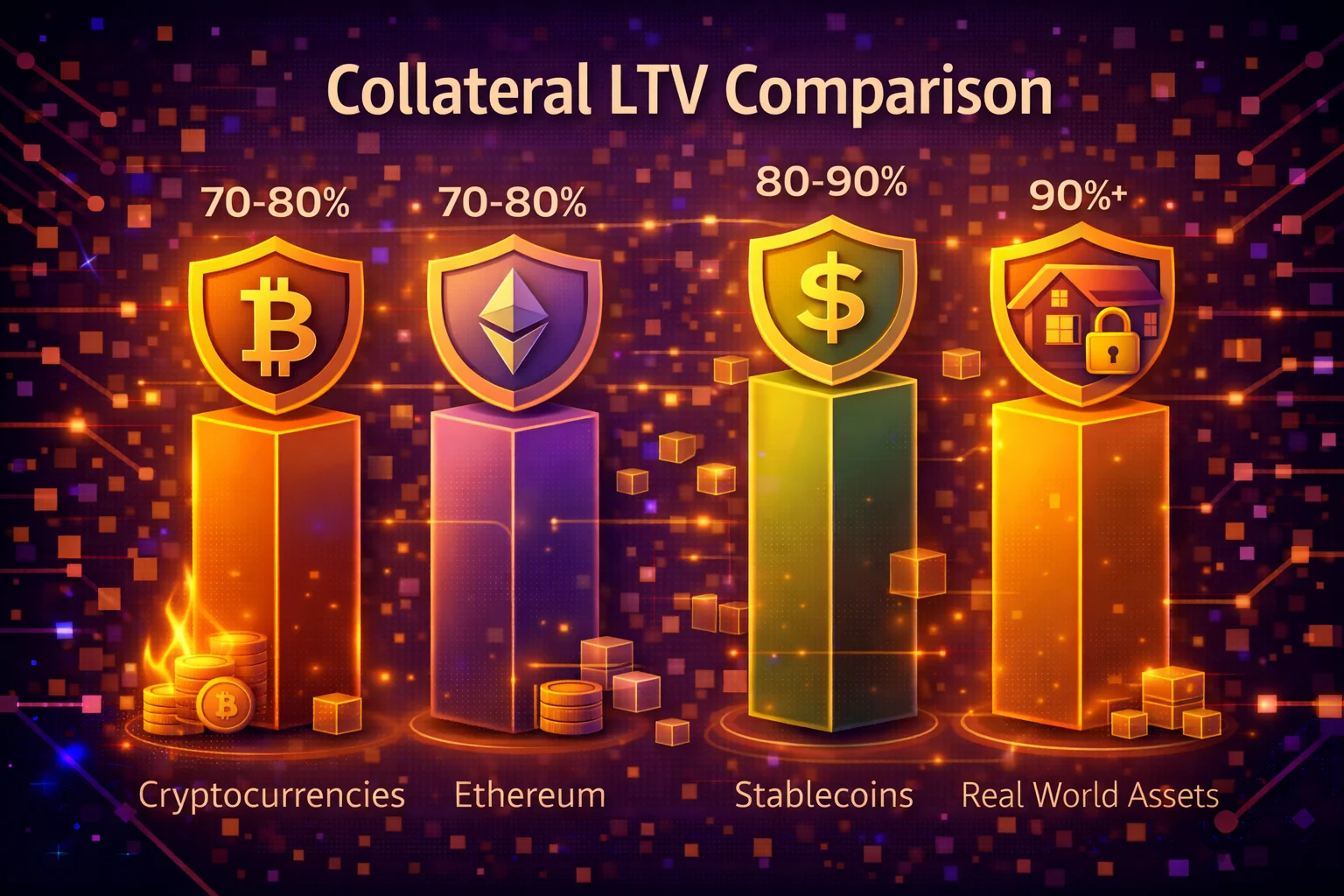
- LTV Range: 50-70% on most platforms
- Advantages: Highest acceptance, most liquid, established track record
- Best For: Large loans, long-term positions, conservative strategies
Ethereum (ETH)
- LTV Range: 60-75% on most platforms
- Advantages: Wide acceptance, DeFi integration, staking opportunities
- Best For: DeFi borrowing, medium to large loans
Stablecoins (USDC, USDT, DAI)
- LTV Range: 80-95% on most platforms
- Advantages: Minimal liquidation risk, highest LTV ratios
- Considerations: No price appreciation potential
Tier 2: Major Altcoins
- BNB (Binance Coin): 40-60% LTV, strong on Binance ecosystem
- ADA (Cardano): 35-50% LTV, growing DeFi acceptance
- SOL (Solana): 40-55% LTV, popular in DeFi protocols
- AVAX (Avalanche): 35-50% LTV, emerging DeFi platform
Collateral to Avoid
- Meme Coins: Extreme volatility, limited acceptance
- New Projects: Unproven track record, low liquidity
- Low Market Cap Tokens: Price manipulation risks
Start Borrowing with Quality Collateral
Explore Nexo LoansCollateral Requirements by Platform
CeFi Platforms
Nexo
- BTC/ETH LTV: Up to 50%
- Stablecoin LTV: Up to 90%
- Liquidation Threshold: 83.33% LTV
- Supported Assets: 40+ cryptocurrencies
DeFi Protocols
Aave
- BTC LTV: Up to 70%
- ETH LTV: Up to 80%
- Liquidation Penalty: 5-15% depending on asset
- Supported Assets: 30+ cryptocurrencies
Compound
- Collateral Factor: 50-80% depending on asset
- Liquidation Incentive: 8% bonus for liquidators
- Supported Assets: 15+ major cryptocurrencies
For detailed comparisons, see our platform guide and CeFi vs DeFi comparison.
How to Calculate Collateral Needs
Basic Formula
Required Collateral = Loan Amount ÷ LTV Ratio
Example 1: Bitcoin at 50% LTV
- Desired Loan: $10,000 USDT
- Platform LTV: 50%
- Required Collateral: $10,000 ÷ 0.50 = $20,000 in BTC
- BTC Price: $50,000
- BTC Amount: $20,000 ÷ $50,000 = 0.4 BTC
Example 2: Ethereum at 75% LTV
- Desired Loan: $5,000 USDC
- Platform LTV: 75%
- Required Collateral: $5,000 ÷ 0.75 = $6,667 in ETH
- ETH Price: $3,000
- ETH Amount: $6,667 ÷ $3,000 = 2.22 ETH
Safe Collateral Calculation
For safety, use lower LTV than maximum:
Safe Collateral = Loan Amount ÷ (Maximum LTV × 0.7)
Example 3: Conservative Approach
- Desired Loan: $10,000
- Maximum LTV: 70%
- Safety Factor: 0.7
- Effective LTV: 49%
- Safe Collateral: $20,408
Liquidation Price
Liquidation Price = (Loan × Liquidation Threshold) ÷ Collateral Amount
Learn more about LTV optimisation.
Collateral Setup Walkthrough
Step-by-Step Collateral Deposit Process
Here's exactly how to set up collateral for your first crypto loan:
Phase 1: Platform Selection and Account Setup
- Choose your platform: Compare LTV ratios, supported assets, and fees
- Complete KYC verification: Upload ID documents and proof of address
- Enable security features: Set up 2FA and withdrawal whitelisting
- Fund your account: Transfer cryptocurrency to the platform
Phase 2: Collateral Assessment and Planning
- Calculate required collateral: Use platform calculators or manual formulas
- Choose collateral mix: Balance stability vs growth potential
- Set safety margins: Target 30-40% below maximum LTV
- Plan monitoring schedule: Daily checks during volatile periods
Phase 3: Collateral Deposit and Loan Initiation
- Navigate to borrowing section: Find loan or borrow feature
- Select collateral assets: Choose from your available balances
- Enter loan amount: Platform shows required collateral automatically
- Review terms carefully: Interest rates, liquidation thresholds, fees
- Confirm transaction: Collateral locks, loan funds become available
Common Setup Mistakes to Avoid
- Using maximum LTV: Always leave substantial safety buffer
- Single asset collateral: Diversify to reduce concentration risk
- Ignoring liquidation thresholds: Know exact price levels that trigger liquidation
- No monitoring plan: Set up alerts and check regularly
- Insufficient reserves: Keep extra crypto for emergency top-ups
Platform-Specific Setup Tips
Nexo Setup optimisation
- NEXO token benefits: Hold NEXO tokens for better LTV ratios and lower rates
- Loyalty levels: Higher tiers unlock better terms and features
- Automatic repayment: Set up from earnings to reduce manual management
- Insurance coverage: Verify your collateral is covered by platform insurance
Aave Setup optimisation
- Health factor monitoring: Keep above 2.0 for safety, 1.5 minimum
- Stable vs variable rates: Choose based on market conditions and loan duration
- Collateral switching: Use collateral swap feature to rebalance without repaying
- Flash loan opportunities: Advanced users can leverage flash loans for refinancing
Compound Setup optimisation
- Collateral factor understanding: Each asset has different borrowing power
- COMP token rewards: Earn governance tokens while borrowing
- Interest rate models: Understand how utilisation affects rates
- Liquidation mechanics: 8% liquidation incentive affects liquidation timing
Platform-Specific Collateral Guides
CeFi Platform Collateral Management
Nexo Collateral Strategy
Nexo offers some of the most flexible collateral management in CeFi:
- Automatic LTV management: Platform can automatically adjust collateral ratios
- Partial liquidation: Only sells minimum collateral needed to restore health
- Grace periods: 24-hour window to add collateral before liquidation
- Collateral substitution: Swap collateral types without affecting loan
BlockFi Collateral Approach
BlockFi focuses on simplicity and institutional-grade security:
- Conservative LTV ratios: Lower maximum ratios for enhanced safety
- Manual collateral calls: Human oversight before liquidations
- Institutional custody: Gemini custody for enhanced security
- Limited asset selection: Focus on major cryptocurrencies only
DeFi Protocol Collateral Management
Aave Collateral optimisation
Aave provides the most sophisticated DeFi collateral management:
- Health factor system: Real-time risk assessment with clear thresholds
- Collateral and debt ceiling: Protocol-level risk management
- Isolation mode: New assets with limited borrowing power
- E-mode (Efficiency mode): Higher LTV for correlated assets
- Rate switching: Change between stable and variable rates
Compound Collateral Mechanics
Compound pioneered many DeFi lending concepts:
- cToken system: Collateral earns interest while locked
- Collateral factor: Asset-specific borrowing power (50-80%)
- Liquidation incentive: 8% bonus encourages timely liquidations
- Close factor: Maximum 50% of debt can be liquidated at once
MakerDAO Vault Management
MakerDAO offers unique single-collateral vaults:
- Vault isolation: Each collateral type in separate vault
- Stability fee: Interest rate determined by governance
- Liquidation penalty: Additional fee on liquidated collateral
- Debt ceiling: Maximum DAI that can be minted per collateral type
Cross-Platform Collateral Strategies
Arbitrage Opportunities
Different platforms offer varying LTV ratios for the same assets:
- Rate shopping: Compare borrowing rates across platforms
- LTV optimisation: Use platforms with highest LTV for your collateral
- Feature arbitrage: Leverage unique features like Aave's rate switching
- Risk distribution: Spread collateral across platforms to reduce platform risk
Collateral Migration Strategies
Move collateral between platforms to optimise terms:
- Flash loan refinancing: Use flash loans to move positions without capital
- Gradual migration: Slowly move collateral as loans mature
- Rate cycle timing: Move when rate differentials are largest
- Feature upgrades: Migrate to access new platform features
Collateral Tax Implications
Tax-Efficient Collateral Selection
Choose collateral strategically to minimise tax impact:
- Use appreciated assets: Avoid selling assets with large gains
- Harvest losses separately: Sell underwater assets instead of using as collateral
- FIFO vs LIFO: Consider cost basis methods when selecting specific coins
- Holding period optimisation: Use long-term holdings to maintain favorable tax treatment
Liquidation Tax Consequences
Understand tax implications of liquidation events:
- Forced sale treatment: Liquidations typically trigger taxable events
- Loss deduction: Liquidation losses may be deductible
- Timing considerations: Year-end liquidations affect current tax year
- Documentation needs: Keep detailed records of liquidation events
Collateral Management Strategies
Diversification Strategy
Don't put all collateral in one single cryptocurrency asset type.
Balanced Portfolio
- 50% Bitcoin: Stable, widely accepted
- 30% Ethereum: Good LTV, DeFi integration
- 20% Stablecoins: Safety buffer
Active Monitoring
Daily Checks
- Health Factor: Check platform indicators
- Collateral Value: Monitor total worth
- LTV Ratio: Ensure within safe limits
- Market Conditions: Watch price movements
Automated Alerts
- Price Alerts: Notifications when collateral drops
- LTV Warnings: Alerts approaching liquidation
- Health Factor Alerts: Critical threshold warnings
Rebalancing
When to Add Collateral
- LTV exceeds 60%: Restore buffer
- Market volatility increases: Proactive expansion
- Approaching liquidation: Emergency addition
Collateral Risks and Protection
Primary Risks
Liquidation Risk
- Cause: Collateral price drops below threshold
- Impact: Loss of collateral at unfavorable prices
- Protection: Maintain conservative LTV, monitor daily
Volatility Risk
- Cause: Market volatility, news events
- Impact: Sudden LTV increases
- Protection: Use stable collateral, large buffers
Smart Contract Risk (DeFi)
- Cause: Bugs, exploits, oracle failures
- Impact: Loss of collateral
- Protection: Use audited protocols, diversify
Platform Risk (CeFi)
- Cause: Insolvency, hacks, regulatory actions
- Impact: Loss of access to collateral
- Protection: Use regulated platforms, check insurance
Protection Strategies
- Conservative LTV: Target 30-40% for volatile assets
- Reserve Funds: Keep extra crypto for emergencies
- Platform Insurance: Choose platforms with coverage
- Diversification: Don't keep all collateral on one platform
Learn more in our risks guide and protection strategies.
Advanced Collateral Strategies
Multi-Platform Collateral Distribution
Advanced borrowers distribute collateral across multiple platforms to reduce platform-specific risks and optimise rates.
Example Distribution Strategy
- 40% on Nexo: CeFi convenience, 0% APR option, insurance coverage
- 40% on Aave: DeFi transparency, multichain access, flash loan opportunities
- 20% Reserve: Emergency collateral for market volatility
Collateral Rotation Strategy
Rotate collateral types based on market conditions to optimise returns and minimise risks.
Bull Market Rotation
- Increase BTC/ETH collateral: Benefit from price appreciation
- Reduce stablecoin collateral: No upside potential
- Target LTV: 40-50% for growth assets
Bear Market Rotation
- Increase stablecoin collateral: minimise liquidation risk
- Reduce volatile asset collateral: Protect against drops
- Target LTV: 25-35% for maximum safety
Yield-Generating Collateral
Some platforms allow using yield-generating assets as collateral, earning passive income while borrowing.
Liquid Staking Derivatives
- stETH (Lido): Earn ETH staking rewards while using as collateral on Aave
- rETH (Rocket Pool): decentralised staking rewards plus borrowing capability
- Typical APY: 3-5% on staked ETH while borrowing
Interest-Bearing Tokens
- aTokens (Aave): Earn supply interest while using as collateral
- cTokens (Compound): Compound interest accrual on collateral
- Strategy: Offset borrowing costs with collateral yields
Tax-Efficient Collateral Management
Strategic collateral selection can optimise tax outcomes in many jurisdictions.
Long-Term Holdings as Collateral
- Benefit: Borrow against assets without triggering capital gains
- Strategy: Use oldest holdings with largest unrealized gains
- Tax Advantage: Defer taxes while accessing liquidity
Loss Harvesting Opportunities
- Underwater Assets: Consider selling for tax loss instead of using as collateral
- Profitable Assets: Use as collateral to avoid realising gains
- Rebalancing: Tax-efficient portfolio adjustments through collateral swaps
Collateral Efficiency Metrics
Track these metrics to optimise your collateral strategy:
Capital Efficiency Ratio
Formula: Borrowed Amount ÷ Total Collateral Value
- High Efficiency (60%+): Maximum capital utilisation, higher risk
- Medium Efficiency (40-60%): Balanced approach
- Low Efficiency (more than 40%): Conservative, maximum safety
Collateral Yield Rate
Formula: (Collateral Earnings - Borrowing Costs) ÷ Collateral Value
- Positive Yield: Collateral earnings exceed borrowing costs
- Neutral Yield: Break-even strategy
- Negative Yield: Paying net cost for liquidity access
Emergency Collateral Protocols
Prepare emergency procedures before market crashes:
Pre-Approved Actions
- Trigger Points: Define LTV levels requiring action (e.g., 55%, 65%, 75%)
- Response Plan: Document exact steps for each trigger level
- Resource Allocation: Identify which reserves to deploy first
- Platform Access: Ensure login credentials and 2FA readily available
Automated Protection Tools
- DeFi Saver: Automated collateral top-ups and debt repayments
- Instadapp: One-click refinancing and collateral swaps
- Yearn Vaults: Automated yield optimisation on collateral
- Custom Bots: Program automatic responses to market conditions
For comprehensive risk management, review our liquidation protection guide.
Institutional Collateral Management and Professional Strategies
Enterprise-Grade Collateral Frameworks
Institutional cryptocurrency lending requires sophisticated collateral management frameworks. These address regulatory compliance and fiduciary responsibilities. Comprehensive risk management protocols are essential. They maintain operational efficiency and competitive advantage in professional lending markets. Enterprise collateral management encompasses advanced portfolio diversification strategies. Sophisticated monitoring systems are implemented. Comprehensive audit trails are maintained. Integration with institutional custody solutions ensures professional-grade security. This provides operational excellence for large-scale cryptocurrency lending operations.
Professional collateral management implementations leverage advanced analytics. Automated monitoring systems are essential. Comprehensive reporting capabilities are provided. Integration with institutional risk management frameworks enables professional asset managers to optimise collateral utilisation. This maintains regulatory compliance and fiduciary standards. Advanced institutional features include sophisticated multi-signature governance systems. Comprehensive transaction monitoring is implemented. Advanced reporting capabilities are provided. Integration with institutional custody solutions delivers enterprise-grade security and operational efficiency.
Advanced Risk Assessment and Mitigation Strategies
Professional cryptocurrency collateral management requires sophisticated risk assessment methodologies. These address market volatility, liquidity risks, and counterparty exposure. Regulatory compliance requirements are met. Optimal capital efficiency is maintained. Competitive positioning in institutional lending markets is preserved. Advanced risk management encompasses comprehensive stress testing. Scenario analysis is performed. Correlation modelling is implemented. Systematic implementation of proven risk mitigation techniques ensures institutional-grade protection. This maintains optimal performance and operational efficiency.
The implementation of advanced risk mitigation strategies requires ongoing assessment of market conditions. Systematic evaluation of collateral performance is essential. Comprehensive monitoring of liquidation risks is performed. Sophisticated optimisation techniques ensure maximum capital efficiency. Acceptable risk levels are maintained for institutional investors. Professional risk management considerations include advanced diversification strategies. Comprehensive liquidity management is implemented. Sophisticated hedging techniques are employed. Systematic implementation of proven risk mitigation methodologies provides institutional-grade protection. This maximises long-term performance and capital preservation objectives.
Practical Implementation Guidelines
Cryptocurrency collateral management requires detailed understanding of loan-to-value ratios, liquidation thresholds, and market volatility impacts that affect borrowing capacity. Effective collateral strategies combine asset diversification with risk monitoring to maintain healthy borrowing positions whilstmaximising capital efficiency across lending platforms.
Step-by-Step Execution Framework
Strategic collateral implementation begins with comprehensive planning that includes collateral evaluation, platform selection, and risk management procedures. Professional borrowers establish clear protocols for collateral allocation, loan-to-value monitoring, and margin call responses that maintain consistency while allowing flexibility for market opportunities and changing collateral values.
Security and Operational Procedures
Robust collateral security frameworks encompass multi-signature wallets, hardware wallet integration, and secure backup procedures that protect against both technical failures and security breaches. Professional borrowers implement comprehensive operational security protocols including collateral verification procedures, liquidation monitoring systems, and emergency response plans.
Performance Tracking and optimisation
Systematic collateral monitoring requires specialised tools and methodologies that account for cryptocurrency lending characteristics including real-time collateral ratios, liquidation thresholds, and margin requirements. Regular performance evaluation enables strategy refinement and optimisation while maintaining alignment with long-term borrowing objectives and risk management parameters.
Conclusion
Understanding cryptocurrency collateral is fundamental to successful participation in the digital asset lending ecosystem. This applies whether through decentralised protocols or centralised platforms. The unique characteristics of crypto collateral include real-time valuation and automated liquidation mechanisms. The variety of acceptable asset types creates both opportunities and challenges. These require careful consideration and active management.
Effective collateral management combines several key elements. These include conservative position sizing and diversified asset selection. Continuous monitoring is essential. Proactive risk management strategies minimise liquidation risk whilst maximising capital efficiency. The key to success lies in understanding the specific requirements and risks of different platforms. You must maintain appropriate safety margins and emergency response procedures.
The evolution of cryptocurrency collateral systems continues to bring innovations. These include cross-chain collateral solutions and automated management tools. Improved risk assessment mechanisms are emerging. These developments are making cryptocurrency lending more accessible and safer for users. They expand the range of strategies available for leveraging digital asset holdings.
As the cryptocurrency lending landscape matures, the importance of understanding collateral mechanics will only increase. Whether you're a conservative borrower seeking liquidity or an advanced user implementing complex leverage strategies, mastering the principles is essential. Cryptocurrency collateral management is crucial for long-term success in the digital asset ecosystem.
The regulatory environment surrounding cryptocurrency collateral continues to evolve, with jurisdictions worldwide developing frameworks that provide greater clarity for both lenders and borrowers. This regulatory maturation brings increased legitimacy to the space whilst introducing compliance requirements that users must navigate. Understanding the regulatory implications of collateral-based borrowing in your jurisdiction is essential for maintaining compliance and protecting your interests.
Technology continues to advance the capabilities of collateral management systems, with artificial intelligence and machine learning algorithms providing increasingly sophisticated risk assessment and monitoring tools. These technological improvements enable more precise collateral valuation, better prediction of liquidation risks, and automated responses to market volatility that can help protect borrowers from unexpected losses.
The integration of traditional finance principles with blockchain technology has created a new paradigm for collateral-based lending that combines the best aspects of both worlds. The transparency and efficiency of decentralised systems merge with the stability and user protection of traditional banking, creating opportunities that were previously impossible in either domain alone.
Looking forwards, the continued growth and maturation of cryptocurrency lending markets will likely bring further innovations in collateral management, including improved cross-chain solutions, more sophisticated risk models, and enhanced user interfaces that make complex strategies accessible to a broader audience. Staying informed about these developments and continuously refining your collateral management approach will be key to maximising the benefits whilst minimising the risks of cryptocurrency-backed borrowing.
The future of cryptocurrency collateral looks promising. Ongoing developments in risk management, automation, and cross-chain interoperability are creating new opportunities. These enable efficient capital utilisation. By understanding the fundamentals covered in this guide and staying informed about emerging developments, users can effectively leverage their cryptocurrency holdings. They can manage risks appropriately in the evolving DeFi landscape.
Remember that successful collateral management requires ongoing education. Careful risk assessment is necessary. Adaptation to changing market conditions is vital. Start with conservative approaches. Gradually increase your understanding through practical experience. Always prioritise capital preservation over aggressive leverage strategies. The cryptocurrency lending ecosystem offers tremendous opportunities. These are available for those who approach it with knowledge, caution, and proper risk management practices.
Advanced Collateral Management and Professional Strategies
Sophisticated Collateral Portfolio Construction
Professional cryptocurrency collateral management involves sophisticated portfolio construction techniques. These optimise capital efficiency through strategic asset selection. Diversification strategies are essential. Dynamic position management across multiple lending platforms and protocols is crucial. Advanced practitioners implement comprehensive frameworks. These evaluate collateral assets based on volatility characteristics, liquidity profiles, and correlation structures. This maximises borrowing capacity whilst minimising liquidation risk. It works across different market conditions and volatility scenarios.
Portfolio construction includes understanding the mathematical relationships between different assets. Modern portfolio theory applications are implemented for collateral optimisation. Systematic approaches to asset allocation balance risk and return objectives. Professional users utilise advanced analytics tools. Correlation analysis methodologies are employed. Optimisation algorithms enable sophisticated collateral portfolio management. These maintain appropriate risk levels and operational efficiency. They support complex lending strategies and capital management operations.
Dynamic Risk Management and Liquidation Protection
Advanced collateral management requires comprehensive risk management frameworks. These address market volatility, liquidation risks, and operational challenges. Systematic monitoring is essential. Automated protection systems are implemented. Strategic hedging techniques are employed. Risk management includes real-time monitoring systems. Automated alert mechanisms are crucial. Dynamic rebalancing protocols maintain optimal loan-to-value ratios. These protect against liquidation events across different market conditions and volatility environments.
Liquidation protection strategies include understanding liquidation mechanics across different platforms. Automated protection systems are implemented. Contingency plans preserve capital whilst maintaining borrowing capacity. Professional users implement sophisticated monitoring infrastructure. Automated risk management protocols are essential. Comprehensive protection strategies enable confident collateral management. These maintain appropriate safety margins and operational efficiency. They work throughout various market conditions and stress scenarios.
Cross-Platform optimisation and Multi-Protocol Strategies
Professional collateral management involves strategic utilisation of multiple lending platforms and protocols. This optimises borrowing terms. It diversifies counterparty risk. Arbitrage opportunities are captured across different market conditions and platform characteristics. Cross-platform optimisation includes understanding different collateral requirements. Interest rate structures vary by platform. Risk parameters differ across lending platforms. Systematic approaches to platform selection and allocation optimisation are implemented.
Multi-protocol strategies include leveraging the unique characteristics of different DeFi lending protocols, centralised lending platforms, and hybrid solutions to create optimal borrowing structures that maximise capital efficiency while managing risk exposure. Professional users implement comprehensive platform analysis frameworks, automated optimisation systems, and strategic allocation methodologies that enable sophisticated multi-platform collateral management while maintaining appropriate risk management and operational efficiency across diverse lending ecosystems.
Institutional Collateral Management and Compliance
Institutional collateral management requires comprehensive frameworks that address regulatory compliance, fiduciary standards, and risk management requirements while enabling optimal capital utilisation and borrowing strategies. Institutional considerations include understanding regulatory implications of collateral usage, implementing appropriate governance frameworks, and maintaining comprehensive documentation and reporting systems that meet professional standards and regulatory requirements for institutional asset management operations.
Compliance management includes working with specialised legal and regulatory professionals to implement appropriate frameworks that ensure full compliance with applicable regulations while optimising collateral utilisation and borrowing strategies. Professional users implement comprehensive compliance monitoring systems, automated reporting capabilities, and systematic risk management protocols that meet institutional standards while enabling sophisticated collateral management and borrowing operations through systematic approach to regulatory compliance and professional excellence.
Technology Integration and Automation Excellence
Advanced collateral management leverages sophisticated technology solutions including automated monitoring systems, risk management protocols, and optimisation algorithms that maximise efficiency while minimising operational complexity and manual intervention requirements. Technology integration includes comprehensive analytics platforms, automated rebalancing systems, and real-time monitoring capabilities that enable systematic approach to collateral management while maintaining optimal risk-adjusted returns and operational efficiency.
Automation excellence includes implementation of intelligent allocation algorithms, automated risk monitoring systems, and comprehensive performance tracking that enable continuous optimisation of collateral strategies while adapting to changing market conditions and opportunity sets. Professional users implement custom technology solutions that integrate with multiple lending platforms while providing unified monitoring and optimisation capabilities for sophisticated collateral management and borrowing operations through systematic automation and optimisation protocols that maintain professional standards and operational excellence.
Sources & References
- Aave. (2025). "Aave Documentation". Collateralization mechanics and liquidation processes.
- Compound. (2025). "Compound Protocol Docs". Collateral factors and borrowing limits explained.
- MakerDAO. (2025). "MakerDAO Documentation". Vault collateralization and stability mechanisms.
- Nexo. (2025). "Nexo Borrowing Guide". CeFi collateral requirements and loan-to-value ratios.
Frequently Asked Questions
- What is crypto collateral?
- Crypto collateral is cryptocurrency you deposit to secure a loan. It acts as security for lenders, ensuring they can recover funds if you default. The collateral remains locked until the loan is repaid.
- How much collateral do I need?
- Most crypto loans require 150-200% collateral of the loan amount. For example, to borrow $10,000, you need $15,000-$20,000 in cryptocurrency collateral.
- What cryptocurrencies can be used as collateral?
- Bitcoin and Ethereum are most widely accepted with the highest LTV ratios. Major altcoins, such as BNB, ADA, and SOL, are also accepted. Stablecoins can be used but offer limited upside potential.
- What happens if crypto prices drop?
- If collateral value drops significantly, you may face liquidation, where your collateral is sold to repay the loan. Prevent this by adding more collateral or maintaining conservative LTV ratios.
- Can I withdraw collateral before repaying?
- No, collateral remains locked until you fully repay the loan plus interest. Some platforms allow partial withdrawal if your LTV remains within safe limits.
- What's the difference between CeFi and DeFi collateral?
- CeFi platforms hold collateral in custody with human oversight. DeFi protocols lock collateral in smart contracts with automatic liquidations. CeFi offers flexibility, DeFi offers transparency.
- What is a safe LTV ratio?
- A safe LTV ratio is 30-50% for volatile cryptocurrencies. This provides a substantial buffer against price drops. Conservative borrowers use 25-30% LTV to minimise liquidation risk.
- Can I use multiple cryptocurrencies?
- Yes, most platforms allow diversified collateral portfolios. This reduces risk from single-asset price crashes.
- How often should I monitor my collateral ratio?
- Monitor daily during volatile periods, weekly during stable markets. Set up automated alerts at 70-80% LTV to provide early warning before approaching liquidation thresholds. Many platforms offer mobile notifications and email alerts for ratio changes.
- What happens to my collateral during market crashes?
- During severe market downturns, collateral values drop rapidly, potentially triggering liquidations across the ecosystem. Maintain conservative ratios and consider adding collateral proactively during volatile periods to avoid forced liquidation at unfavorable prices and protect your investment portfolio effectively for long-term success.
← Back to Crypto Investing Blog Index
Financial Disclaimer
This content is not financial advice. All information provided is for educational purposes only. Cryptocurrency investments carry significant investment risk, and past performance does not guarantee future results. Always do your own research and consult a qualified financial advisor before making investment decisions.