DeFi Interest Rate Models Explained 2026
Understand how DeFi protocols calculate interest rates algorithmically based on supply and demand
Introduction: Understanding DeFi Interest Rate Models
One of the most fascinating aspects of DeFi lending is how interest rates are determined. Unlike traditional banks, which set rates by committees and are influenced by central bank policy, DeFi protocols use algorithmic interest rate models that respond to market conditions in real time. This fundamental difference represents a paradigm shift in how financial markets operate—from human-controlled to algorithm-controlled rate setting.
Understanding these models is crucial for anyone participating in DeFi lending, whether you're supplying assets to earn yield or borrowing against your collateral. The interest rate you receive or pay isn't arbitrary—it's the result of mathematical formulas designed to balance supply and demand whilst ensuring protocol stability. These formulas are transparent, predictable, and execute automatically without human intervention, creating a truly decentralised financial system.
The beauty of DeFi interest rate models lies in their simplicity and elegance. Whilst traditional banking involves complex decision-making processes, regulatory considerations, and profit margins, DeFi protocols distil rate determination down to a single key metric: utilisation rate. This metric—the percentage of supplied assets that are currently borrowed—drives all rate calculations and creates a self-balancing system that responds instantly to market conditions.
In 2026, DeFi lending protocols have processed trillions of dollars in transactions, with interest rates adjusting automatically every block (approximately every 12 seconds on Ethereum). This continuous adjustment ensures that rates always reflect current market conditions, unlike traditional finance, where rates might change only quarterly or annually. The result is a more efficient market where capital flows to where it's most needed, guided by price signals rather than committee decisions.
In this comprehensive guide, we'll demystify DeFi interest rate models by explaining:
- How interest rates are calculated algorithmically using utilisation-based formulas
- The role of utilisation rate in determining rates and why it's the single most important metric
- Why supply rates differ from borrow rates and how protocols distribute interest
- How different protocols (Aave, Compound, Euler) implement their models with specific parameters
- Real-world examples with actual numbers showing how rates change in practise
- How to predict rate changes based on market conditions and utilisation trends
- Advanced concepts like kink points, target utilisation rates, and reserve factors
- Practical strategies for maximising returns as a lender or minimising costs as a borrower
By the end of this article, you'll understand exactly why rates change, how to interpret utilisation curves, and how to make informed decisions about when to lend or borrow based on current market dynamics. You'll be able to assess a protocol's utilisation rate and predict whether utilisation will rise or fall, giving you a significant advantage in optimising your DeFi lending positions.
Whether you're a beginner trying to understand why your supply APY changed overnight, or an experienced user looking to optimise your borrowing costs, this guide provides the technical depth and practical insights you need to master DeFi interest rate models.
The implications of algorithmic interest rate models extend beyond individual users. These models create more efficient capital markets by eliminating intermediaries, reducing friction, and ensuring that rates always reflect true supply and demand. They also introduce new dynamics that don't exist in traditional finance, such as the ability to arbitrage across protocols' rates or to predict rate movements based on on-chain data. Understanding these models is essential for anyone serious about DeFi lending.
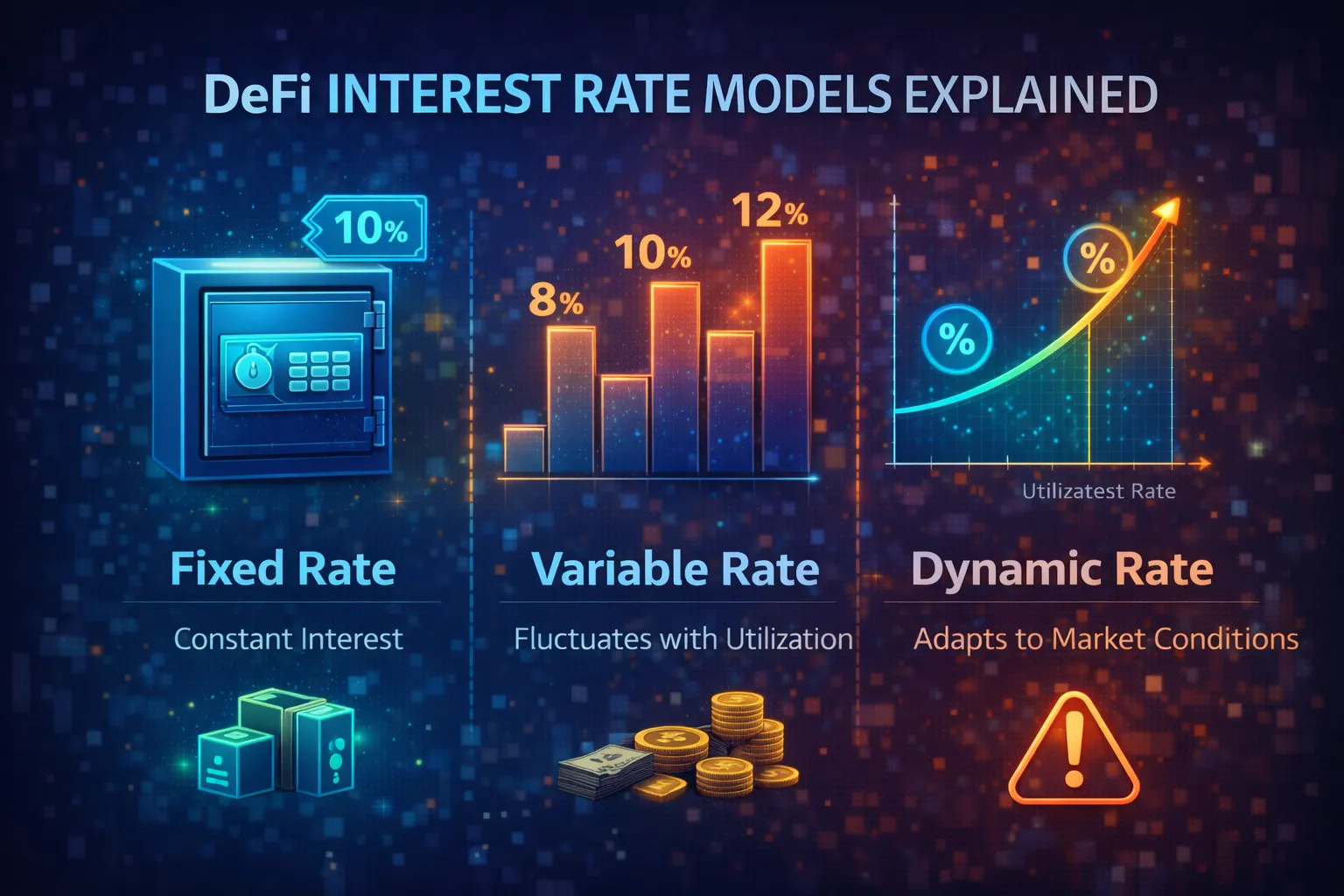
How Rates Are Calculated
DeFi lending protocols calculate interest rates using algorithmic models that respond to a single key metric: utilisation rate. This approach creates a self-balancing system where rates adjust automatically to maintain protocol health.
The Core Formula
At its simplest, the relationship is:
Higher Utilisation → Higher Interest Rates
Lower Utilisation → Lower Interest Rates
This makes intuitive sense: when more assets are borrowed (high utilisation), the protocol needs to attract more lenders by offering higher rates. When few assets are borrowed (low utilisation), rates can be lower because there's plenty of liquidity available.
The Mathematical Model
Most DeFi protocols use a piecewise linear model with two slopes:
Below Optimal Utilisation:
Borrow Rate = Base Rate + (Utilisation Rate / Optimal Utilisation) × Slope 1
Above Optimal Utilisation:
Borrow Rate = Base Rate + Slope 1 + ((Utilisation Rate - Optimal Utilisation) / (1 - Optimal Utilisation)) × Slope 2
This creates a "kinked" interest rate curve that increases gradually below the optimal point and sharply above it.
Key Parameters
- Base Rate: Minimum interest rate (typically 0-2% APY)
- Optimal Utilisation: Target utilisation rate (typically 80-90%)
- Slope 1: Rate increase below target utilisation (gradual)
- Slope 2: Rate increase above optimal utilisation (steep)
These parameters are set by protocol governance and vary by asset based on its volatility and liquidity characteristics.
Why This Model Works
The piecewise linear model achieves three critical objectives simultaneously:
1. Liquidity Management: By increasing rates sharply above optimal utilisation, the model ensures that some liquidity always remains available for withdrawals. If utilisation reaches 95-100%, rates spike to 50-100%+ APY, incentivising borrowers to repay and lenders to supply more assets. This prevents the protocol from running out of liquidity, which would freeze withdrawals and damage user trust.
2. Capital Efficiency: The gradual slope below the target rate encourages borrowing by keeping rates reasonable. If rates were always high, borrowers would avoid the protocol, leaving capital idle. The model balances lenders' earnings with affordable borrowing costs, maximising capital efficiency whilst maintaining safety margins.
3. Market Responsiveness: Rates update automatically every block (approximately every 12 seconds on Ethereum), responding instantly to supply and demand changes. When someone borrows $1 million in USDC, utilisation increases, and rates rise within seconds. When someone repays, the rate decreases immediately. This real-time adjustment creates efficient markets where rates always reflect current conditions.
Real-World Example: USDC on Aave
Let's examine how Aave calculates USDC interest rates with actual parameters (2026):
Parameters:
- Base Rate: 0%
- Optimal Utilisation: 90%
- Slope 1: 4%
- Slope 2: 60%
Scenario 1: Low Utilisation (50%)
Borrow Rate = 0% + (50% / 90%) × 4% = 2.22% APY
At 50% utilisation, borrowers pay only 2.22% APY—very affordable, encouraging more borrowing.
Scenario 2: Optimal Utilisation (90%)
Borrow Rate = 0% + (90% / 90%) × 4% = 4% APY
At the optimal point, rates are moderate at 4% APY, balancing borrower demand with lender supply.
Scenario 3: High Utilisation (95%)
Borrow Rate = 0% + 4% + ((95% - 90%) / (100% - 90%)) × 60% = 34% APY
Above the target utilisation rate, rates spike dramatically to 34% APY, strongly incentivising repayment and discouraging new borrowing. This protects protocol liquidity.
Scenario 4: Critical Utilisation (99%)
Borrow Rate = 0% + 4% + ((99% - 90%) / (100% - 90%)) × 60% = 58% APY
At 99% utilisation, rates reach 58% APY—extremely high to ensure some liquidity remains available. In practise, utilisation rarely exceeds 95% because these high rates quickly bring it back down.
How Rates Update in Practise
Interest rates update automatically through smart contract logic:
- User Action: Someone deposits, withdraws, borrows, or repays
- Utilisation Recalculation: Smart contract recalculates utilisation rate based on new total borrowed and total supplied
- Rate Update: Smart contract applies the interest rate formula using current utilisation
- New Rate Applied: All existing positions immediately accrue interest at the new rate
This happens within a single transaction, typically taking 12-15 seconds on the Ethereum mainnet. Users can see rate changes in real time on protocol interfaces, with rates updated every block as market conditions change.
Variable vs Stable Rates
Some protocols (notably Aave) offer both variable and stable interest rates:
Variable Rates:
- Change every block based on utilisation
- Lower rates when utilisation is low
- Higher rates when utilisation is high
- Best for short-term borrowing or when you expect rates to decrease
Stable Rates:
- Fixed at the time of borrowing (but can be rebalanced by protocol)
- Typically 1-2% higher than the current variable rate
- Provide predictability for long-term borrowing
- Can be rebalanced to a variable if utilisation becomes too high
Most users choose variable rates because they're typically lower and respond to market conditions. Stable rates are useful for budgeting long-term borrowing costs, but the premium paid often exceeds the benefit unless rates spike dramatically.
- Capital Efficiency: Encourages high utilisation (80-90%) to maximise returns for lenders
- Liquidity Protection: Sharp rate increases above the target threshold discourage excessive borrowing
- Market Responsiveness: Rates adjust automatically every block based on current utilisation
This creates a self-correcting system: if utilisation gets too high, rates spike, encouraging more supply and less borrowing until equilibrium is restored.
Utilisation Rate Impact
Utilisation rate is the single most important metric in DeFi lending. It determines interest rates, protocol health, and liquidity availability. Understanding how it works is essential for both lenders and borrowers.
What is Utilisation Rate?
Utilisation rate measures what percentage of supplied assets are currently borrowed:
Utilisation Rate = (Total Borrowed / Total Supplied) × 100%
Example:
- Total USDC Supplied: $100 million
- Total USDC Borrowed: $70 million
- Utilisation Rate: 70%
This means 70% of the supplied USDC is actively earning interest from borrowers, whilst 30% sits idle in the protocol.
Utilisation Zones
Protocols typically operate in three zones:
Low Utilisation (0-50%):
- Plenty of liquidity available
- Low interest rates (1-3% APY)
- Easy to borrow or withdraw
- Capital inefficiency for lenders
Optimal Utilisation (50-90%):
- Balanced supply and demand
- Moderate interest rates (3-8% APY)
- Good capital efficiency
- Sufficient liquidity for withdrawals
High Utilisation (90-100%):
- Limited liquidity available
- Very high interest rates (10-50%+ APY)
- Difficult to withdraw (may need to wait)
- Maximum capital efficiency but risky
Real-World Example: USDC on Aave
Let's examine how utilisation affects rates using real data from Aave V3 (January 2026):
At 40% Utilisation:
- Supply APY: 1.8%
- Borrow APY: 4.2%
- Spread: 2.4% (protocol revenue + reserve)
At 80% Utilisation (Optimal):
- Supply APY: 4.5%
- Borrow APY: 5.8%
- Spread: 1.3%
At 95% Utilisation:
- Supply APY: 18.2%
- Borrow APY: 22.5%
- Spread: 4.3%
Notice how rates spike dramatically above 90% utilisation. This is intentional—the protocol is signalling "we need more supply" and "borrowing is expensive right now."
How Utilisation Changes
Utilisation changes constantly based on user actions:
Utilisation Increases When:
- Users borrow more assets
- Lenders withdraw their supply
- Borrowers repay less than new borrows
Utilisation Decreases When:
- Users supply more assets
- Borrowers repay their loans
- New supply exceeds new borrows
The interest rate model responds to these changes every block (every 12 seconds on Ethereum), creating a dynamic, self-balancing system.
Why Optimal Utilisation Matters
Protocols set a "target utilisation" rate (typically 80-90%) because it represents the sweet spot between:
- Capital Efficiency: Most supplied assets are earning interest
- Liquidity Safety: Enough unborrowed assets for withdrawals
- Rate Stability: Rates are predictable and reasonable
When utilisation stays near optimal, everyone benefits: lenders earn good yields, borrowers pay reasonable rates, and the protocol maintains healthy liquidity.
Supply vs Borrow Rates
One of the most common questions in DeFi lending is: "Why is the borrow rate higher than the supply rate?" The answer lies in how protocols distribute interest and maintain reserves.
The Interest Flow
When borrowers pay interest, it doesn't all go to lenders. Here's how it's distributed:
Interest Paid by Borrowers = 100%
- Reserve Factor: 10-20% (protocol treasury)
- Distributed to Lenders: 80-90%
- Net Lender APY: Borrow APY × (1 - Reserve Factor) × Utilisation Rate
This means if borrowers pay 10% APY and the protocol fee is 10%, lenders receive 9% APY (90% of 10%).
Reserve Factor Explained
The protocol fee serves several critical purposes:
- Protocol Revenue: Funds development, audits, and operations
- Insurance Fund: Covers bad debt from liquidation failures
- Governance Treasury: Resources for protocol improvements
- Emergency Buffer: Safety net for unexpected events
Reserve factors vary by asset based on risk:
- Stablecoins (USDC, DAI): 10% protocol fee
- Major Assets (ETH, WBTC): 15% reserve factor
- Volatile Assets (altcoins): 20-25% reserve factor
Calculating Supply Rate
The supply rate formula accounts for both utilisation and the reserve factor:
Supply Rate = Borrow Rate × Utilisation Rate × (1 - Reserve Factor)
Example Calculation:
- Borrow Rate: 8% APY
- Utilisation Rate: 75%
- Reserve Factor: 10%
Supply Rate = 8% × 0.75 × (1 - 0.10) = 8% × 0.75 × 0.90 = 5.4% APY
This means lenders earn 5.4% APY whilst borrowers pay 8% APY. The 2.6% difference covers the reserve factor and the fact that only 75% of the supplied assets are earning interest.
Why the Spread Varies
The difference between borrow and supply rates (the "spread") changes based on utilisation:
At Low Utilisation (30%):
- Borrow Rate: 4% APY
- Supply Rate: 1.08% APY
- Spread: 2.92%
At Optimal Utilisation (80%):
- Borrow Rate: 6% APY
- Supply Rate: 4.32% APY
- Spread: 1.68%
At High Utilisation (95%):
- Borrow Rate: 25% APY
- Supply Rate: 21.38% APY
- Spread: 3.62%
Notice that the spread is smallest at the target rate. This is because more of the supplied capital is actively earning interest, making the protocol more efficient.
Compound Interest Accrual
Both supply and borrow rates compound continuously in DeFi protocols:
- Aave: Interest accrues every block (~12 seconds)
- Compound: Interest accrues every block (~12 seconds)
- Effective APY: Slightly higher than stated APR due to compounding
For example, a 5% APR with continuous compounding becomes approximately 5.13% APY. Most protocols display APY (Annual Percentage Yield), which accounts for compounding.
Real-Time Rate Updates
Rates update automatically every block based on current utilisation:
- User supplies 1M USDC → utilisation decreases → rates decrease
- User borrows 500K USDC → utilisation increases → rates increase
- User repays loan → utilisation decreases → rates decrease
This creates a truly dynamic market where rates respond instantly to supply and demand, unlike traditional finance, where rate changes require committee meetings and announcements.
Protocol Comparisons
Whilst all DeFi lending protocols use algorithmic interest rate models, each implements them differently. Understanding these differences helps you choose the right protocol for your needs.
Aave V3 Interest Rate Model
Model Type: Piecewise linear with two slopes
Key Parameters (USDC Example):
- Base Rate: 0%
- Optimal Utilisation: 90%
- Slope 1: 4%
- Slope 2: 60%
- Reserve Factor: 10%
Characteristics:
- Very gradual rate increase below 90% utilisation
- Extremely steep increase above 90% (up to 64% APY at 100%)
- Encourages high capital efficiency
- Strong liquidity protection mechanism
Rate Examples:
- At 50% utilisation: 2.2% borrow APY, 1.0% supply APY
- At 90% utilisation: 4.0% borrow APY, 3.2% supply APY
- At 95% utilisation: 18.0% borrow APY, 15.4% supply APY
Compound V3 Interest Rate Model
Model Type: Piecewise linear with kink
Key Parameters (USDC Example):
- Base Rate: 0%
- Kink Utilisation: 80%
- Slope 1: 5.25%
- Slope 2: 46%
- Reserve Factor: 15%
Characteristics:
- Moderate rate increase below 80% utilisation
- Sharp increase above 80% (kink point)
- Lower optimal utilisation than Aave
- Higher reserve factor (more protocol revenue)
Rate Examples:
- At 50% utilisation: 3.3% borrow APY, 1.4% supply APY
- At 80% utilisation: 5.2% borrow APY, 3.5% supply APY
- At 95% utilisation: 19.4% borrow APY, 15.7% supply APY
Euler Finance Interest Rate Model
Model Type: Reactive interest rate model
Key Innovation: Rates adjust based on recent utilisation trends, not just current utilisation
Characteristics:
- Smoother rate transitions
- Less volatile rates during rapid utilisation changes
- Considers 24-hour utilisation average
- More predictable for borrowers
Advantages:
- Reduces rate manipulation opportunities
- More stable rates for long-term positions
- Better user experience during volatile periods
Morpho Optimiser
Model Type: Peer-to-peer matching layer on top of Aave/Compound
How It Works:
- Matches lenders and borrowers directly
- Falls back to underlying protocol (Aave/Compound) if no match
- Improves rates for both sides by reducing spread
Rate Improvement:
- Lenders: +0.5-1.5% APY vs base protocol
- Borrowers: -0.5-1.0% APY vs base protocol
- No additional risk (same underlying protocol)
Comparison Table
| Protocol | Optimal Utilisation | Base Rate | Reserve Factor | Rate Volatility |
|---|---|---|---|---|
| Aave V3 | 90% | 0% | 10% | High above 90% |
| Compound V3 | 80% | 0% | 15% | High above 80% |
| Euler | Variable | Variable | Variable | Low (smoothed) |
| Morpho | Follows base | Follows base | 0% (P2P) | Follows base |
Which Model is Best?
For Lenders:
- Aave: Best for high capital efficiency (90% optimal utilisation)
- Morpho: Best rates through P2P matching
- Euler: Best for rate stability
For Borrowers:
- Compound: More predictable rates (lower optimal utilisation)
- Morpho: Lower rates through P2P matching
- Euler: Smoother rate transitions
For Risk-Averse Users:
- Compound: Lower optimal utilisation = more liquidity buffer
- Euler: Reactive model reduces rate manipulation risk
- MakerDAO: Stability fee provides predictable borrowing costs
Historical Rate Volatility Analysis
Understanding how rates have behaved historically helps predict future movements and choose appropriate protocols:
Aave USDC Rate Volatility (2025 Data):
- Average borrow rate: 4.2% APY
- Minimum: 1.8% APY (during low utilisation periods)
- Maximum: 42% APY (during May 2025 volatility spike)
- Standard deviation: 3.2% (moderate volatility)
- Time above 10% APY: 8% of the year
Compound USDC Rate Volatility (2025 Data):
- Average borrow rate: 3.8% APY
- Minimum: 2.1% APY
- Maximum: 38% APY
- Standard deviation: 2.8% (lower volatility than Aave)
- Time above 10% APY: 6% of the year
Compound's lower optimal utilisation (80% vs 90%) results in slightly more stable rates because the protocol reaches the steep part of the curve less frequently. However, Aave's higher optimal utilisation typically offers better rates during normal market conditions.
Gas Efficiency Considerations
Interest rate models also affect gas costs for users:
Aave V3:
- Supply: ~150,000 gas (~$5-15 depending on gas prices)
- Borrow: ~200,000 gas (~$7-20)
- Repay: ~180,000 gas (~$6-18)
- Withdraw: ~160,000 gas (~$5-16)
Compound V3:
- Supply: ~100,000 gas (~$3-10) - 33% cheaper
- Borrow: ~130,000 gas (~$4-13) - 35% cheaper
- Repay: ~120,000 gas (~$4-12) - 33% cheaper
- Withdraw: ~110,000 gas (~$4-11) - 31% cheaper
For smaller positions (under $5,000), Compound's lower gas costs can significantly impact net returns. For larger positions (over $50,000), the rate difference between protocols typically matters more than gas costs.
Multi-Protocol Strategy
Advanced users often employ multi-protocol strategies to optimise returns:
Diversification Approach:
- 40% in Aave (highest rates, most features)
- 30% in Compound (simplicity, lower gas)
- 30% in Morpho (rate optimisation)
This approach balances rate optimisation with risk diversification. If one protocol experiences issues, only a portion of your capital is affected.
Rate Arbitrage Approach:
- Monitor rates across protocols daily
- Move capital to the highest-yielding protocol when the rate difference exceeds gas costs
- Typically profitable for positions over $10,000
- Can add 0.5-1.5% APY through active management
Utilisation-Based Approach:
- Supply to protocols with 75-85% utilisation (optimal rates)
- Avoid protocols with 90%+ utilisation (liquidity risk)
- Borrow from protocols with 50-70% utilisation (lower rates)
- Rebalance monthly based on utilisation trends
Practical Strategies for Optimising Returns
Understanding interest rate models is valuable, but applying this knowledge to optimise your positions is where real value emerges. Here are practical strategies for both lenders and borrowers, based on the mechanics of the rate model.
For Lenders: Maximising Supply APY
1. Target High Utilisation Assets
Assets with 80-90% utilisation typically offer the best risk-adjusted returns. Check current utilisation before supplying:
- USDC at 85% utilisation: 3-4% APY (good)
- USDC at 50% utilisation: 1-2% APY (poor capital efficiency)
- USDC at 95% utilisation: 5-8% APY (high returns but liquidity risk)
Sweet spot: 75-90% utilisation for stable returns with manageable liquidity risk.
2. Monitor Utilisation Trends
Rising utilisation indicates increasing demand and higher future rates:
- Utilisation rising from 70% to 85%: Supply now to lock in increasing rates
- Utilisation falling from 90% to 75%: Consider withdrawing or switching assets
- Utilisation stable at 80-85%: Optimal conditions for long-term supply
3. Use Multiple Protocols
Different protocols offer different rates for the same asset:
- Aave USDC: 3.2% APY at 85% utilisation
- Compound USDC: 2.8% APY at 75% utilisation
- Euler USDC: 3.5% APY at 88% utilisation
Regularly compare rates and move capital to the highest-yielding protocol. Transaction costs typically pay for themselves within 1-2 weeks for positions over $10,000.
4. Understand Liquidity Risk
High utilisation means high returns but also withdrawal risk:
- Below 90% utilisation: Withdrawals always possible
- 90-95% utilisation: Withdrawals may require waiting for repayments
- Above 95% utilisation: Significant withdrawal delays possible
For funds you might need quickly, stay below 85% utilisation. For long-term holdings, utilisation rates of 85-92% maximise returns.
For Borrowers: Minimising Borrow Costs
1. Borrow During Low Utilisation
Borrow rates are lowest when utilisation is below optimal:
- USDC at 50% utilisation: 2.2% APY borrow rate
- USDC at 80% utilisation: 3.5% APY borrow rate
- USDC at 95% utilisation: 34% APY borrow rate
Time your borrowing for periods of low utilisation to minimise costs. Check historical utilisation patterns to identify typical low-utilisation periods.
2. Monitor Rate Spikes
If utilisation approaches optimal (90%), rates will spike soon:
- Utilisation at 88%: Borrow now before rates increase
- Utilisation at 92%: Rates already spiking, consider repaying or waiting
- Utilisation at 95%: Extremely high rates, repay if possible
3. Use Stable Rates Strategically
Aave offers stable rates that lock in current rates plus a premium:
- Variable rate: 3.5% APY (changes every block)
- Stable rate: 4.5% APY (fixed until rebalanced)
- Rate difference: 1.0% premium for stability
Choose stable rates when:
- Utilisation is rising, and you expect rates to increase
- You need predictable costs for budgeting
- Current variable rate is historically low
Choose variable rates when:
- Utilisation is falling, and you expect rates to decrease
- You plan to repay quickly (days or weeks)
- Current rates are historically high
4. Consider Alternative Assets
Different assets have different utilisation and rates:
- USDC: High utilisation (85%), moderate rates (3-4%)
- DAI: Medium utilisation (75%), lower rates (2-3%)
- USDT: Variable utilisation (60-90%), volatile rates (2-6%)
If you need stablecoins, borrow whichever has the lowest current rate. They're all $1, so the asset doesn't matter—only the rate.
Advanced Strategies
Rate Arbitrage
Supply on one protocol, borrow on another to capture rate differences:
- Supply USDC on Aave: Earn 3.2% APY
- Borrow USDC on Compound: Pay 2.8% APY
- Net profit: 0.4% APY on the borrowed amount
This works when rate differences exceed transaction costs and liquidation risk. Requires careful monitoring and risk management.
Utilisation Prediction
Track utilisation patterns to predict rate movements:
- Utilisation typically rises during market volatility (more borrowing)
- Utilisation falls during stable periods (less borrowing demand)
- Major market events (Fed announcements, protocol launches) affect utilisation
Position yourself ahead of predictable utilisation changes to optimise rates.
Cross-Protocol Optimisation
Use aggregators like Yearn or Idle Finance for automatic rate optimisation:
- Automatically moves capital to highest-yielding protocol
- Rebalances when rate differences exceed gas costs
- Typically adds 0.5-1.5% APY vs single protocol
Best for larger positions ($50,000+) where gas costs are negligible relative to returns.
Timing Your Positions Based on Market Cycles
Interest rates follow predictable patterns based on market cycles and events:
Bull Market Patterns:
- Utilisation increases as traders borrow to leverage long positions
- Rates rise across all protocols (4-8% APY typical)
- Best time to supply assets (higher yields)
- Expensive time to borrow (consider waiting or using stable rates)
Bear Market Patterns:
- Utilisation decreases as borrowing demand falls
- Rates drop to 1-3% APY
- Poor time to supply (low yields)
- Excellent time to borrow (cheap rates)
Volatility Spike Patterns:
- Utilisation spikes to 90-95% as traders borrow for short-term positions
- Rates temporarily spike to 20-50% APY
- Excellent short-term supply opportunity (hours to days)
- Terrible time to borrow (wait for rates to normalise)
Stablecoin Depeg Events:
- Affected stablecoin utilisation drops to 20-40% (nobody wants to borrow it)
- Rates drop to 0.5-1% APY
- Other stablecoins see increased utilisation and higher rates
- Opportunity to borrow the depegged stablecoin cheaply (if you believe it will repeg)
Tools for Rate Monitoring
Several tools help you monitor rates and utilisation across protocols:
DeFi Rate Aggregators:
- DeFi Rate: Compares rates across 20+ protocols in real-time
- DeFi Llama: Shows historical rates and utilisation trends
- Aave Analytics: Detailed Aave-specific rate and utilisation data
- Compound Analytics: Compound-specific metrics and historical data
Alert Services:
- DeFi Saver: Set alerts for rate changes or utilisation thresholds
- Instadapp: Notifications when rates cross your target levels
- Telegram Bots: Custom bots for rate monitoring (e.g., DeFi Rate Bot)
Portfolio Trackers:
- Zapper: Shows your current positions with real-time rates
- Zerion: Portfolio tracking with rate history
- DeBank: Multi-protocol portfolio with rate comparisons
Common Mistakes to Avoid
1. Chasing High Rates Without Understanding Risk
A protocol offering 15% APY on stablecoins when others offer 3-5% is a red flag. High rates often indicate:
- Extremely high utilisation (90-95%) with liquidity risk
- Unsustainable token incentives that will end
- Higher risk protocol with fewer audits
- Temporary rate spike that will normalise quickly
2. Ignoring Gas Costs
Moving $1,000 between protocols for a 0.5% rate difference costs $10-30 in gas. You need to keep the position for 2-6 months to break even. For small positions, gas costs can eliminate rate advantages.
3. Not Monitoring Utilisation
Supplying to a protocol at 92% utilisation means you might not be able to withdraw when needed. Always check utilisation before supplying, especially for funds you might need quickly.
4. Borrowing at High Utilisation
Borrowing when utilisation is 88-90% means rates will likely spike soon. Wait for utilisation to drop below 80% or accept that you'll pay higher rates.
5. Not Using Stable Rates Strategically
If utilisation is rising and you need to borrow, stable rates can lock in current rates before they spike. Many borrowers ignore stable rates and then regret it when variable rates double.
6. Forgetting About Compounding Effects
Interest compounds every block (approximately every 12 seconds on Ethereum). A 5% APY position actually earns slightly more due to continuous compounding. Over a year, 5% APY becomes approximately 5.13% effective annual rate. For large positions, this difference matters significantly. Similarly, borrow costs compound continuously, so a 10% APY borrow rate costs you approximately 10.52% over a full year. Always account for compounding when calculating expected returns or costs, especially for long-term positions lasting more than 6 months. This compounding effect becomes more pronounced at higher rates—a 20% APY actually costs 22.14% annually due to continuous compounding. Understanding this distinction helps you accurately compare DeFi rates with traditional finance rates, which typically compound monthly or quarterly rather than continuously.
Conclusion: Mastering DeFi Interest Rate Models
DeFi interest rate models represent a fundamental innovation in finance—rates determined by pure supply and demand, updated every block, with no human intervention required. Understanding these models transforms you from a passive participant to an informed user who can predict rate movements and optimise your positions strategically. This knowledge is power in the DeFi ecosystem, where rates can change dramatically within hours in response to market conditions.
The elegance of algorithmic interest rates lies in their simplicity and transparency. A single metric—utilisation rate—drives all rate calculations, creating a self-balancing system that responds instantly to market conditions. When utilisation rises, rates increase to attract more lenders and discourage borrowing. When utilisation falls, rates decrease to encourage borrowing and maintain capital efficiency. This automatic adjustment happens every block, approximately every 12 seconds, creating a truly dynamic market.
The key insights to remember:
- Utilisation drives everything: Higher utilisation means higher rates for both lenders and borrowers. Understanding current utilisation tells you whether rates will likely rise or fall in the near term.
- Optimal utilisation is the sweet spot: Protocols target 80-90% for balanced efficiency and liquidity. Operating near this point maximises returns for lenders whilst maintaining reasonable borrowing costs.
- Rates spike above optimal: This is intentional—the protocol is protecting liquidity by making borrowing expensive when reserves run low. These spikes are temporary and self-correcting.
- Supply rates are always lower: The reserve factor and utilisation create the spread between borrow and supply rates. This spread funds protocol reserves and compensates for the risk that not all supplied capital earns interest.
- Different protocols, different models: Choose based on your priorities—Aave for efficiency, Compound for simplicity, Euler for advanced features. Each model has trade-offs between capital efficiency, rate stability, and liquidity protection.
- Real-time responsiveness: Unlike traditional finance, where rates change quarterly, DeFi rates adjust every block. This creates efficient markets where capital flows to where it's most needed, guided by price signals.
- Transparency and predictability: All rate calculations are on-chain and verifiable. You can see exactly how rates are calculated and predict future changes based on utilisation trends.
Armed with this knowledge, you can now:
- Predict when rates will increase or decrease based on utilisation trends and market conditions
- Choose the right protocol for your risk tolerance and goals, understanding the trade-offs each model makes
- Understand why rates change and whether it's temporary (utilisation spike) or structural (parameter change)
- Optimise your lending and borrowing strategies for maximum returns by timing entries and exits based on rate cycles
- Interpret utilisation curves and kink points to understand protocol behaviour at different utilisation levels
- Calculate expected returns and costs before committing capital, using the formulas and examples provided
- Monitor multiple protocols simultaneously to find the best rates for your specific assets and time horizon
Execution Checklist for Advanced Users
You should check blockchain congestion before every borrowing transaction because a higher gas fee can change your real return on small positions.
If you fund your position from a centralised exchange, you should account for transfer delays before you execute rate-sensitive steps.
You should keep custody of your assets in a hardware wallet and store a private key backup offline with a clear recovery plan.
If you combine lending with staking rewards, you should map validator lock periods so your liquidity schedule remains realistic.
You should review governance and tokenomics updates weekly because parameter changes can move rates in hours, not weeks.
You should define a security checklist that every wallet transaction follows, including destination checks and allowance reviews.
For example, if slippage rises above your limit during collateral rebalancing, you should pause execution and wait for deeper liquidity.
You should estimate impermanent loss when your strategy also uses AMM pools, because that risk can offset supply APY gains.
If you manage niche collateral such as NFT-backed wrappers, you should treat that exposure as higher-volatility capital.
Even in broader cryptocurrency markets, consensus instability or mining-related congestion can delay confirmations and increase execution risk.
The beauty of algorithmic interest rates is their transparency and predictability. Unlike traditional finance, where rate decisions are opaque and political, DeFi rates follow mathematical formulas that anyone can verify on-chain. This transparency, combined with real-time responsiveness, creates a more efficient and fair financial system. There are no committee meetings, no insider information, no preferential treatment—just pure supply and demand expressed through code.
As DeFi continues to evolve, we'll likely see even more sophisticated interest rate models emerge—perhaps incorporating machine learning for dynamic parameter adjustment, cross-protocol optimisation for better capital efficiency, or adaptive models that respond to broader market conditions beyond just utilisation. Some protocols are already experimenting with multi-factor models that consider volatility, liquidity depth, and external market rates. But the fundamental principle will remain: rates determined by supply and demand, enforced by code, accessible to everyone.
The transition from human-controlled to algorithm-controlled interest rates represents one of the most significant innovations in DeFi. It demonstrates that financial markets can operate efficiently without centralised control, that transparency improves rather than hinders market function, and that code can enforce economic incentives more reliably than institutions. As traditional finance slowly adopts these concepts, DeFi protocols continue to refine and improve their models, pushing the boundaries of what's possible in decentralised finance.
Whether you're a lender seeking optimal yields or a borrower minimising costs, understanding interest rate models gives you a significant advantage. You can time your positions better, choose protocols more wisely, and navigate rate volatility more confidently. This knowledge transforms DeFi lending from a passive activity into an active strategy where informed decisions lead to better outcomes.
Sources & References
This guide draws on official protocol documentation, academic research, and real-world data to provide accurate information about DeFi interest rate models in 2026.
- Aave Interest Rate Model Documentation - Official Aave V3 interest rate specifications
- Compound Interest Rate Documentation - Comprehensive Compound V3 rate model explanation
- Euler Finance White Paper - Reactive interest rate model technical details
- Morpho Protocol Documentation - P2P matching layer specifications
- DeFi Llama - Real-time utilisation and rate data
- DeFi Lending Complete Guide 2026 - Comprehensive overview of DeFi lending
- Aave Protocol Review 2026 - Detailed Aave platform analysis
- Compound Protocol Review 2026 - Comprehensive Compound review
- Aave vs Compound Comparison - Side-by-side protocol comparison
Disclaimer: Interest rates in DeFi are highly variable and change based on market conditions. This guide is for educational purposes only and does not constitute financial advice. Always conduct your own research and understand the risks before participating in DeFi lending.
Frequently Asked Questions
- How are DeFi interest rates calculated?
- DeFi interest rates are calculated algorithmically based on supply and demand, measured by the utilisation rate (borrowed assets / total supplied assets). When utilisation is low, rates are low to encourage borrowing. When utilisation is high, rates increase to encourage more supply and discourage borrowing. Each protocol uses specific mathematical formulas with parameters like base rate, slope, and optimal utilisation point.
- What is the utilisation rate in DeFi?
- Utilisation rate is the percentage of supplied assets that are currently borrowed. Formula: Utilisation Rate = Total Borrowed / Total Supplied × 100%. For example, if $10M is supplied and $7M is borrowed, utilisation is 70%. This metric directly determines interest rates—higher utilisation means higher rates for both lenders and borrowers.
- Why do borrowing rates differ from supply rates?
- Borrow rates are always higher than supply rates because the protocol takes a reserve factor (typically 10-20%) as revenue. The remaining interest paid by borrowers is distributed to lenders. For example, if borrowers pay 5% APY and the reserve factor is 10%, lenders receive 4.5% APY (90% of 5%). Additionally, only the portion of the supplied assets that is actually borrowed earns interest, further reducing the effective supply rate.
- What is optimal utilisation in DeFi lending?
- Optimal utilisation is the target utilisation rate where protocols balance liquidity and capital efficiency. Most protocols set this at 80-90%. Below-optimal utilisation: rates increase gradually. Above optimal utilisation, rates increase sharply to incentivise more supply and discourage borrowing, ensuring sufficient liquidity for withdrawals. This creates a "kink" in the interest rate curve.
- Can DeFi interest rates go negative?
- No, DeFi interest rates cannot go negative in lending protocols. The minimum rate is determined by the base rate parameter (typically 0-2% APY). Even at 0% utilisation, lenders earn at least the base rate. This differs from traditional finance, in which central banks can set negative interest rates. The algorithmic model ensures rates always remain positive.
← Back to Crypto Investing Blog Index
Financial Disclaimer
This content is not financial advice. All information provided is for educational purposes only. Cryptocurrency investments carry significant investment risk, and past performance does not guarantee future results. Always do your own research and consult a qualified financial advisor before making investment decisions.