DeFi Lending Risks & Management 2026
Comprehensive guide to understanding and mitigating risks in DeFi lending protocols, including Aave, Compound, and other platforms
Introduction: Understanding DeFi Lending Risks
DeFi lending offers attractive returns—stablecoins earning 3-5% APY, sometimes spiking to 20%+ during volatile periods. But these returns come with risks that traditional finance doesn't face: smart contract vulnerabilities, liquidation cascades, oracle failures, and protocol governance attacks. The decentralised nature of DeFi, whilst providing unprecedented access and transparency, also means that users bear full responsibility for understanding and managing these risks.
Understanding these risks isn't optional—it's essential for protecting your capital. A single mistake, like maintaining insufficient collateral safety or using an unaudited protocol, can result in the complete loss of your position. Unlike traditional banks, which are insured by deposit insurance and regulated by oversight, DeFi operates in a trustless environment where code is law and mistakes are often irreversible. The collapse of platforms like Celsius and BlockFi in 2022 demonstrated that even centralised crypto lending carries extreme risks, whilst DeFi protocols have faced over $3 billion in exploits and hacks in recent years.
However, it's crucial to understand that most DeFi lending losses are preventable through proper risk management. The protocols themselves—particularly established platforms like Aave and Compound—have proven remarkably resilient through multiple market cycles. The majority of losses stem from user errors, inadequate monitoring, or participation in unaudited protocols. By understanding the risk landscape and implementing appropriate mitigation strategies, you can participate in DeFi lending whilst maintaining acceptable risk levels.
This guide provides a comprehensive analysis of DeFi lending risks in 2026, drawing on real-world incidents, protocol documentation, and security research. We'll examine the four major risk categories—liquidation risk, smart contract risk, oracle risk, and systemic risk—and provide actionable strategies to mitigate each one. Each risk category includes real-world examples, technical explanations, and practical mitigation techniques that you can implement immediately.
The DeFi lending landscape in 2026 is significantly more mature than in previous years. Leading protocols have undergone extensive audits, implemented robust security measures, and demonstrated resilience through market crashes and exploit attempts. Insurance products now cover smart contract risks, monitoring tools provide real-time alerts, and best practices have emerged from years of operational experience. This maturity doesn't eliminate risk, but it makes risk more manageable and predictable.
Whether you're supplying assets to earn yield or borrowing against your crypto holdings, this guide will help you navigate DeFi lending safely and confidently. We'll cover both fundamental risk principles that apply to all DeFi interactions and specific strategies tailored to lending protocols. By the end, you'll have a comprehensive framework for assessing, monitoring, and mitigating risks whilst maximising the benefits of decentralised lending.
The key to successful DeFi lending isn't avoiding all risks—that's impossible—but rather understanding which risks are acceptable for your situation and implementing appropriate safeguards. Some risks, like smart contract vulnerabilities in audited protocols, are relatively low and manageable. Others, like using unaudited protocols or maintaining minimal safety margins, are unnecessarily high and should be avoided. This guide will help you distinguish between acceptable and unacceptable risks, enabling you to participate in DeFi lending with confidence and appropriate caution.
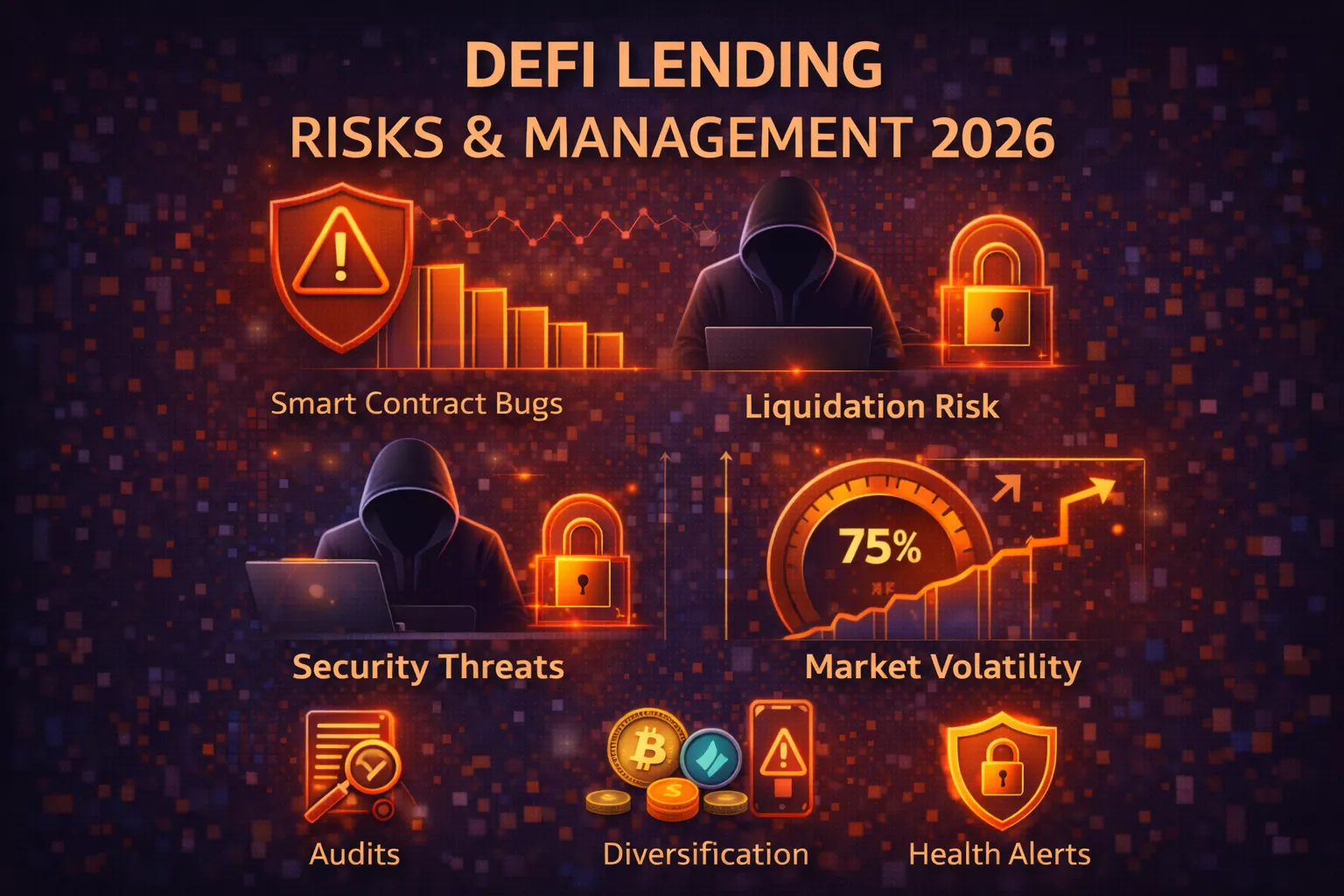
Liquidation Risk
Liquidation risk is the most immediate and common threat for DeFi borrowers. When your position safety drops below 1.0, liquidators can seize your collateral to repay your debt—and you lose more value than the debt itself due to liquidation penalties.
How Liquidation Works
Your collateral health is calculated as:
Health Factor = (Collateral Value × Liquidation Threshold) / Borrowed Value
For example, if you supply $10,000 ETH (80% liquidation threshold) and borrow $6,000 USDC:
- Health Factor = ($10,000 × 0.80) / $6,000 = 1.33
- If ETH drops 20% to $8,000: Health Factor = ($8,000 × 0.80) / $6,000 = 1.07 (still safe)
- If ETH drops 25% to $7,500: Health Factor = ($7,500 × 0.80) / $6,000 = 1.00 (liquidation threshold)
- If ETH drops 30% to $7,000: Health Factor = ($7,000 × 0.80) / $6,000 = 0.93 (liquidation triggered)
Once liquidation is triggered, liquidators can repay up to 50% of your debt ($3,000) and receive your collateral worth $3,000 plus a 5-15% liquidation bonus ($150-450). You lose $3,150-3,450 of collateral to repay $3,000 of debt.
Real-World Liquidation Events
May 2021 Crash: When ETH dropped 50% in 24 hours, over $1 billion in collateral was liquidated across DeFi protocols. Many borrowers with collateral ratios of 1.2-1.5 were liquidated because they couldn't add collateral fast enough during network congestion.
November 2022 FTX Collapse: Cascading liquidations as crypto prices plummeted. Borrowers who maintained safety margins above 2.0 survived; those below 1.5 were liquidated.
March 2023 USDC Depeg: When USDC temporarily lost its $1.00 peg, borrowers using USDC as collateral faced unexpected liquidations as oracles reported the depeg.
Liquidation Risk Mitigation Strategies
1. Maintain High Health Factors
- Minimum: 2.0 collateral ratio (survives 50% collateral drop)
- Recommended: 2.5-3.0 collateral ratio (survives 60-67% drop)
- Conservative: 4.0+ collateral ratio (survives 75% drop)
Example: If you supply $10,000 ETH (80% LTV), borrow only $2,000-2,500 instead of the maximum $8,000. This gives you a safety margin of 3.2-4.0.
2. Use Stablecoin Collateral
Supplying stablecoins (USDC, DAI) as collateral eliminates price volatility risk. You can safely maintain a 1.5-2.0 collateral ratio because stablecoins don't experience 50% crashes. This strategy works well for borrowing other stablecoins or volatile assets for short-term trading.
3. Set Up Automated Monitoring
- DeFi Saver: Automated position monitoring with email/Telegram alerts
- Instadapp: Automated collateral top-ups when position safety drops below threshold
- Aave Mobile App: Push notifications for position health changes
4. Keep Emergency Funds Ready
Maintain 10-20% of your collateral value in liquid assets (stablecoins, ETH) in your wallet to quickly add collateral if needed. During the May 2021 crash, borrowers who could add collateral within hours survived; those who couldn't were liquidated.
5. Use E-Mode for Correlated Assets
Aave's E-Mode allows up to 97% LTV for correlated assets (e.g., ETH/stETH, USDC/DAI). This reduces liquidation risk because correlated assets move together. If you supply stETH and borrow ETH, both assets move in tandem, maintaining your position safety even during volatility.
6. Avoid Borrowing During High Volatility
During major market events (Fed announcements, exchange collapses, regulatory news), liquidation risk spikes. If you must borrow during these periods, maintain a 3.0 or higher safety margin and monitor your position hourly.
Smart Contract Risk
Smart contract risk refers to vulnerabilities in the code that governs DeFi protocols. A single bug can result in complete loss of funds—and unlike traditional finance, there's no insurance or recourse.
Historical Smart Contract Exploits
The DAO Hack (2016): $60 million stolen due to a reentrancy vulnerability. This led to Ethereum's hard fork and established the importance of security audits.
bZx Flash Loan Attacks (2020): $1 million stolen through oracle manipulation combined with flash loans. Demonstrated that even audited protocols can have complex attack vectors.
Cream Finance Exploit (2021): $130 million stolen through a reentrancy attack. The protocol had been audited, but the vulnerability was in a newly added feature.
Euler Finance Hack (2023): $197 million stolen through a donation attack exploiting a flaw in the protocol's liquidation logic. The attacker returned the funds after negotiations, but it highlighted risks even in established protocols.
Types of Smart Contract Vulnerabilities
1. Reentrancy Attacks
An attacker calls a function that makes an external call before updating the state, allowing them to recursively call the function and drain funds. Modern protocols use reentrancy guards and checks-effects-interactions patterns to prevent this.
2. Oracle Manipulation
Attackers manipulate price oracles to borrow more than they should or trigger unfair liquidations. Protocols now use time-weighted average prices (TWAP) and multiple oracle sources to mitigate this.
3. Flash Loan Attacks
Attackers borrow massive amounts via flash loans to manipulate markets or exploit protocol logic. Whilst flash loans themselves aren't vulnerabilities, they amplify the impact of other bugs.
4. Governance Attacks
Attackers accumulate governance tokens to pass malicious proposals. Protocols use timelocks (24-48 hours) and multi-sig requirements to prevent this.
Smart Contract Risk Mitigation Strategies
1. Use Only Well-Established Protocols
Stick to protocols with:
- Years of operation: Aave (2020), Compound (2018), MakerDAO (2017)
- High TVL: $1 billion+ indicates market confidence
- Multiple audits: From reputable firms like Trail of Bits, OpenZeppelin, Consensys Diligence
- Bug bounty programmes: Aave offers up to $250,000 for critical bugs
2. Check Audit Reports
Before using any protocol, review audit reports:
- Aave V3: Audited by ABDK, OpenZeppelin, Trail of Bits, Certora, Peckshield, SigmaPrime
- Compound V3: Audited by OpenZeppelin, ChainSecurity, Trail of Bits
- MakerDAO: Audited by Trail of Bits, PeckShield, ChainSecurity
Look for:
- Critical or high-severity issues (should be fixed)
- Audit date (recent audits are better)
- Auditor reputation (top firms are more thorough)
3. Diversify Across Protocols
Don't put all your capital in one protocol. Spread across 2-3 established platforms:
- 40% in Aave (largest, most audited)
- 30% in Compound (simpler, lower complexity)
- 30% in MakerDAO (oldest, most battle-tested)
This way, if one protocol is exploited, you don't lose everything.
4. Start Small and Test
Before committing significant capital:
- Supply $100-500 to test the protocol
- Practise depositing and withdrawing
- Verify that interest accrues correctly
- Test the user interface and monitoring tools
Only after you're comfortable should you increase your position.
5. Avoid Newly Launched Protocols
New protocols are highest risk:
- Code hasn't been battle-tested
- Audits may be incomplete or rushed
- Team may lack experience
- Governance may not be decentralised
Wait at least 6-12 months after launch before using new protocols. Let others test it first.
6. Monitor Protocol Governance
Follow protocol governance forums and proposals:
- Aave: governance.aave.com
- Compound: compound.finance/governance
- MakerDAO: vote.makerdao.com
Watch for:
- Proposals to change risk parameters
- Upgrades to smart contracts
- Addition of new assets (higher risk)
- Changes to liquidation logic
7. Consider Insurance
DeFi insurance protocols like Nexus Mutual and InsurAce offer coverage against smart contract exploits:
- Cost: 2-5% annually
- Coverage: Up to 100% of your position
- Claims: Paid if protocol is exploited
For positions over $50,000, insurance may be worth the cost. For smaller positions, the premium may exceed your returns.
Oracle Risk
DeFi protocols rely on price oracles to determine collateral values and trigger liquidations. If oracles fail or report incorrect prices, it can cause mass liquidations or allow manipulation.
How Oracles Work
Price oracles aggregate data from multiple sources (exchanges, DEXs, market makers) to provide reliable price feeds. Most DeFi protocols use Chainlink oracles, which:
- Aggregate prices from 7-31 data sources
- Update prices every 0.5-1% deviation or 1-24 hours
- Use decentralised node operators
- Implement circuit breakers for extreme price movements
Historical Oracle Failures
May 2021 Flash Crash: During ETH's 50% drop in 24 hours, some oracles experienced delays updating prices. This led to unfair liquidations, as borrowers couldn't add collateral quickly during network congestion.
March 2020 Black Thursday: Ethereum network congestion prevented oracle updates, causing MakerDAO to liquidate positions at $0 due to a lack of price data. The protocol lost $8.32 million in bad debt.
November 2020 Compound Oracle Exploit: An attacker manipulated Coinbase Pro's DAI price by placing large orders, causing Compound's oracle to report incorrect prices. This allowed them to borrow more than they should have.
Types of Oracle Risks
1. Oracle Manipulation
Attackers manipulate price sources to trigger unfair liquidations or borrow more than allowed. Modern protocols use multiple data sources and TWAP (time-weighted average price) to prevent this.
2. Oracle Delays
During network congestion or extreme volatility, oracles may not update prices quickly enough. This can lead to liquidations at stale prices or to borrowing at outdated rates.
3. Oracle Failures
If Oracle nodes go offline or data sources become unavailable, protocols may not have accurate price data. This can freeze liquidations or cause incorrect valuations.
4. Centralisation Risk
If a protocol relies on a single oracle provider or data source, that becomes a single point of failure. Chainlink's decentralised network mitigates this, but some protocols still use centralised oracles.
Oracle Risk Mitigation Strategies
1. Use Protocols with Robust Oracles
Choose protocols that use:
- Chainlink Price Feeds: Industry standard with 7-31 data sources
- Multiple Oracle Providers: Protocols using both Chainlink and Uniswap TWAP
- Circuit Breakers: Automatic pauses if prices move more than 20% in short periods
- Fallback Oracles: Secondary price sources if primary fails
Aave and Compound both use Chainlink with circuit breakers and fallback mechanisms.
2. Maintain Extra Collateral Buffer
Oracle delays can cause temporary price discrepancies. Maintain a safety margin of 2.5-3.0 to survive oracle issues:
- If Oracle reports 10% lower collateral value, you still have 2.25-2.7 safety margin
- If Oracle delays 30 minutes during a crash, you have time to add collateral
- If Oracle fails completely, you have sufficient buffer to close the position manually
3. Avoid Borrowing During High Volatility
Oracle risk spikes during extreme market movements:
- Network congestion delays oracle updates
- Price discrepancies between exchanges widen
- Liquidation cascades can overwhelm oracles
If you must borrow during volatility, maintain a 3.0 or higher safety margin and monitor your position constantly.
4. Use Stablecoin Collateral
Stablecoins have minimal oracle risk because their prices don't fluctuate significantly. If you supply USDC as collateral, oracle delays or failures have minimal impact on your position safety.
5. Monitor Oracle Health
Check oracle status before borrowing:
- Chainlink Data Feeds: data.chain.link (shows last update time, deviation)
- Aave Oracle Dashboard: Shows price sources and update frequency
- Compound Oracle: compound.finance/governance (oracle proposals)
If oracles haven't updated in more than 1 hour or show unusual price movements, wait before borrowing.
6. Understand Protocol Oracle Logic
Different protocols handle oracles differently:
- Aave: Uses Chainlink with 0.5% deviation threshold and 24-hour heartbeat
- Compound: Uses Chainlink with 1% deviation threshold and 1-hour heartbeat
- MakerDAO: Uses OSM (Oracle Security Module) with a 1-hour delay for governance
Understand how your protocol's oracles work and what safeguards are in place.
Systemic Risk and Market Contagion
Systemic risk refers to risks that affect the entire DeFi ecosystem rather than individual protocols. These risks can trigger cascading failures across multiple platforms, making diversification less effective as a mitigation strategy.
Types of Systemic Risks
1. Stablecoin Depegging
If major stablecoins lose their $1.00 peg, it can trigger mass liquidations and protocol failures across DeFi:
- USDC Depeg (March 2023): When Silicon Valley Bank collapsed, USDC temporarily lost its peg, dropping to $0.88. This triggered liquidations for users with USDC collateral and caused panic across DeFi.
- UST Collapse (May 2022): Terra's algorithmic stablecoin UST lost its peg completely, dropping to $0.10. This destroyed $40 billion in value and caused contagion across DeFi protocols that accepted UST.
- DAI Stress (March 2020): During Black Thursday, DAI traded at $1.05-1.10 due to high demand for stablecoins, causing issues for protocols using DAI as collateral.
Mitigation:
- Diversify stablecoin exposure (USDC, DAI, USDT)
- Avoid algorithmic stablecoins (UST, FRAX) for large positions
- Monitor stablecoin backing and reserves regularly
- Maintain higher safety margins when using stablecoin collateral
2. Liquidity Crises
During market crashes, liquidity can dry up across DeFi, making it difficult to exit positions or add collateral:
- May 2021 Crash: Ethereum gas fees spiked to 1,000+ gwei, making it prohibitively expensive to add collateral or exit positions. Many users were liquidated because they couldn't afford the gas fees to save their positions.
- March 2020 Black Thursday: Network congestion prevented users from adding collateral, leading to $8.32 million in bad debt for MakerDAO.
- FTX Collapse (November 2022): Liquidity dried up across centralised and decentralised exchanges, causing price discrepancies and liquidation cascades.
Mitigation:
- Maintain emergency funds on Layer 2 solutions (Polygon, Arbitrum) for lower gas fees
- Keep safety margin at 3.0 or higher during high volatility to avoid needing emergency actions
- Use protocols on multiple chains to diversify liquidity risk
- Avoid borrowing during known high-volatility events (Fed announcements, major protocol launches)
3. Regulatory Risk
Government regulations can impact DeFi protocols and user access:
- OFAC Sanctions (August 2022): Tornado Cash was sanctioned, raising concerns about DeFi protocol censorship. Some protocols began blocking sanctioned addresses.
- SEC Actions: Regulatory uncertainty around whether DeFi tokens are securities affects protocol governance and token values.
- Geographic Restrictions: Some protocols restrict access from certain countries (US, China) due to regulatory concerns.
Mitigation:
- Use protocols with decentralised governance and no admin keys
- Diversify across protocols with different regulatory approaches
- Stay informed about regulatory developments in your jurisdiction
- Consider using protocols on censorship-resistant chains
4. Interconnected Protocol Risk
DeFi protocols are highly interconnected, meaning failure in one can cascade to others:
- Curve 3pool Dominance: Many stablecoin protocols rely on Curve's 3pool for liquidity. If Curve were exploited, it would affect dozens of dependent protocols.
- Chainlink Oracle Dependency: Most DeFi protocols use Chainlink oracles. If Chainlink fails, it affects the entire ecosystem.
- Wrapped Asset Risk: Protocols using wrapped BTC (WBTC) or wrapped ETH (stETH) depend on the wrapper's security and solvency.
Mitigation:
- Understand protocol dependencies (oracles, liquidity sources, wrapped assets)
- Diversify across protocols with different infrastructure dependencies
- Monitor health of critical infrastructure (Chainlink, Curve, Lido)
- Avoid protocols with excessive dependencies on single points of failure
Historical Systemic Events
Black Thursday (March 12, 2020):
- ETH dropped 50% in 24 hours
- Network congestion prevented Oracle updates and collateral additions
- MakerDAO suffered $8.32 million in bad debt from $0 liquidations
- Lesson: Maintain high safety margins and emergency funds on Layer 2
May 2021 Crash:
- Crypto market cap dropped $1 trillion in days
- Over $1 billion in DeFi liquidations
- Gas fees spiked to 1,000+ gwei, preventing emergency actions
- Lesson: Use Layer 2 solutions and maintain 3.0 or higher safety margins during volatility
Terra/Luna Collapse (May 2022):
- $40 billion in value destroyed
- Contagion affected protocols accepting UST
- Three Arrows Capital and other institutions collapsed
- Lesson: Avoid algorithmic stablecoins and over-leveraged positions
FTX Collapse (November 2022):
- $8 billion in customer funds lost
- Cascading liquidations across DeFi as prices crashed
- Liquidity crisis across centralised and decentralised exchanges
- Lesson: DeFi protocols proved more resilient than centralised platforms
Systemic Risk Mitigation Framework
1. Diversification Across Dimensions
- Protocols: Use 2-3 different lending protocols (Aave, Compound, MakerDAO)
- Chains: Spread across Ethereum, Polygon, Arbitrum, Optimism
- Collateral Types: Mix volatile assets (ETH, BTC) and stablecoins (USDC, DAI)
- CeFi/DeFi Mix: Consider 70% DeFi, 30% CeFi (Nexo) for additional diversification
2. Conservative Position Sizing
- Never allocate more than 20% of crypto portfolio to DeFi lending
- Maintain 3.0 or higher safety margin during normal markets
- Increase to 4.0+ during high volatility or systemic stress
- Keep 20-30% of position value in liquid assets for emergencies
3. Monitoring Systemic Indicators
- Stablecoin Pegs: Monitor USDC, DAI, USDT prices daily
- Gas Fees: Rising gas fees indicate network stress
- Protocol TVL: Sudden TVL drops indicate capital flight
- Funding Rates: Extreme funding rates indicate over-leverage
- Liquidation Volume: High liquidation volume indicates systemic stress
4. Emergency Exit Strategy
Have a clear plan for exiting positions during systemic crises:
- Know how to quickly repay debt and withdraw collateral
- Have funds ready on Layer 2 for lower gas fees
- Understand which assets you can exit quickly (high liquidity)
- Set trigger points for reducing or exiting positions (e.g., if USDC depegs more than 2%)
Comprehensive Risk Mitigation Strategies
Whilst individual risk categories require specific mitigation strategies, a comprehensive approach combines multiple layers of protection to minimise overall risk exposure.
The 5-Layer Risk Management Framework
Layer 1: Protocol Selection
- Use only protocols with 2+ years of operation
- Require $1 billion+ TVL
- Verify multiple security audits from reputable firms
- Check for active bug bounty programmes
- Review governance structure and decentralisation
Recommended Protocols:
- Aave: $6-8B TVL, 6+ audits, 5+ years operation
- Compound: $2-3B TVL, 5+ audits, 6+ years operation
- MakerDAO: $5-7B TVL, 7+ audits, 7+ years operation
Layer 2: Position Sizing
- Never allocate more than 20% of your crypto portfolio to DeFi lending
- Start with $100-500 to test protocols
- Scale up gradually as you gain experience
- Maintain emergency funds (10-20% of position) for adding collateral
Layer 3: Diversification
- Spread capital across 2-3 protocols (40/30/30 split)
- Use different collateral types (ETH, stablecoins, BTC)
- Diversify across chains (Ethereum, Polygon, Arbitrum)
- Mix DeFi and CeFi (70% DeFi, 30% Nexo for insurance)
Layer 4: Conservative Parameters
- Maintain 2.5-3.0 safety margin minimum (not 1.5)
- Borrow only 30-40% of maximum capacity
- Use stablecoin collateral when possible
- Avoid borrowing during high volatility periods
Layer 5: Active Monitoring
- Check position safety daily (minimum)
- Set up automated alerts (DeFi Saver, Instadapp)
- Monitor protocol governance proposals
- Follow security researchers on Twitter
- Join protocol Discord/Telegram for real-time updates
Risk Management Checklist
Before Supplying Assets:
- Verify protocol has multiple audits from reputable firms
- Check TVL is $1 billion+ and stable
- Review recent governance proposals for risk changes
- Test with a small amount ($100-500) first
- Understand withdrawal process and any lock-up periods
Before Borrowing:
- Calculate maximum safe borrow amount (30-40% of max)
- Verify safety margin will be 2.5+ after borrowing
- Set up automated monitoring and alerts
- Prepare emergency funds for adding collateral
- Understand liquidation penalties and process
Ongoing Monitoring:
- Check position safety daily (minimum)
- Monitor collateral and borrowed asset prices
- Review protocol governance proposals weekly
- Follow security researchers for exploit warnings
- Rebalance position if position safety drops below 2.0
Emergency Response Plan
If Health Factor Drops Below 2.0:
- Add collateral immediately (don't wait)
- Or repay portion of debt to increase safety margin
- Monitor position hourly until safety margin recovers to 2.5+
If Protocol Exploit is Announced:
- Withdraw all assets immediately if possible
- If withdrawals are paused, monitor official channels for updates
- Document your position (screenshots, transaction hashes)
- Follow the protocol's recovery plan if announced
If You're Liquidated:
- Review transaction to understand what happened
- Calculate total loss (collateral lost vs debt repaid)
- Analyse what went wrong (insufficient safety margin, oracle delay, etc.)
- Adjust strategy before borrowing again
Advanced Risk Management Techniques
1. Hedging with Options
Use options to hedge liquidation risk:
- Buy put options on your collateral asset
- If collateral drops, put options gain value
- Use gains to add collateral or repay debt
- Cost: 2-5% of position value
2. Automated Collateral Management
Use DeFi Saver or Instadapp for automated position management:
- Set target safety margin (e.g., 2.5)
- System automatically adds collateral if the position safety drops below 2.0
- Or automatically repays debt to maintain a safety margin
- Cost: 0.25-0.5% per rebalance
3. Yield Farming with Borrowed Assets
If you borrow assets to yield farm, ensure:
- Yield farm APY > borrowing cost + liquidation risk
- Farm has been audited and has high TVL
- You can exit the farm quickly if the position safety drops
- You maintain a 3.0 or higher safety margin to account for both risks
4. Insurance Coverage
For positions over $50,000, consider insurance:
- Nexus Mutual: 2-5% annual premium, covers smart contract exploits
- InsurAce: 2-4% annual premium, covers protocol hacks
- Nexo Built-in Insurance: $375M coverage for CeFi lending
Calculate whether premium cost justifies protection for your risk tolerance.
Conclusion: Building a Sustainable Risk Management Framework
DeFi lending offers attractive returns, but these returns come with real risks that require active management. Liquidation risk, smart contract vulnerabilities, oracle failures, and systemic risks can all result in significant losses if not properly mitigated. However, understanding that risk exists is only the first step—the real challenge lies in building a comprehensive risk management framework that allows you to participate in DeFi lending whilst maintaining acceptable risk levels.
The key to successful DeFi lending is not avoiding risk entirely—that's impossible—but managing it through a comprehensive, multi-layered approach. By using only well-established protocols, maintaining conservative safety margins, diversifying across platforms, and actively monitoring your positions, you can significantly reduce your risk exposure whilst still earning attractive yields. This approach has allowed countless users to participate in DeFi lending successfully through multiple market cycles, including the 2022 bear market and various protocol exploits.
The DeFi lending landscape in 2026 is significantly more mature than in previous years. Leading protocols like Aave and Compound have demonstrated remarkable resilience through market crashes, exploit attempts, and regulatory uncertainty. Security practices have evolved, with multiple audits becoming standard, bug bounty programmes offering substantial rewards, and insurance products providing additional protection. Monitoring tools have become more sophisticated, making it easier to track positions and respond to threats. This maturity doesn't eliminate risk, but it makes risk more manageable and predictable.
Key Takeaways for Sustainable DeFi Lending:
- Protocol Selection: Use only protocols with 2+ years of operation, $1B+ TVL, multiple audits from reputable firms, and active bug bounty programmes. Aave, Compound, and MakerDAO represent the gold standard.
- Health Factor Management: Maintain 2.5-3.0 minimum to survive 60-67% collateral drops. During high volatility, increase to 3.5-4.0. Never borrow more than 50% of available credit.
- Diversification Strategy: Spread capital across 2-3 protocols and different collateral types. Use both volatile assets (ETH, BTC) and stablecoins (USDC, DAI) to balance risk and return.
- Active Monitoring: Check position safety daily during normal markets, hourly during volatility. Set up automated alerts at 1.5 (warning) and 1.2 (critical) safety margin levels.
- Emergency Preparedness: Keep 10-20% of position value liquid for adding collateral. Know how to quickly exit positions if protocol issues arise. Have a clear action plan for different risk scenarios.
- Continuous Education: Follow protocol governance, security researchers, and community discussions. Stay informed about new risks, exploits, and best practices as they emerge.
- Position Sizing: Never invest more than you can afford to lose. Start with small positions (under $1,000) to learn the mechanics before scaling up.
- Insurance Consideration: For positions over $50,000, consider DeFi insurance from Nexus Mutual or InsurAce. The 2-5% annual cost may be worthwhile for peace of mind.
Risk Controls You Should Keep in Writing
You should define how blockchain congestion affects your liquidation response time so emergency actions stay realistic.
You should separate staking collateral from short-term borrow positions because staking unlock delays can block fast repayments.
If consensus reliability drops on your target network, you should reduce leverage until finality and oracle updates stabilise.
You should track validator concentration and mining-related congestion signals during volatile periods because both can increase settlement risk.
You should protect every position with hardware signing and an encrypted private key recovery plan that your team can execute.
You should review governance and tokenomics proposals before size changes because collateral and reserve updates can alter risk overnight.
You should enforce slippage limits for every rebalance and treat repeated slippage breaches as a risk-off signal.
If your strategy includes AMM exposure, you should model impermanent loss separately from lending APY and borrowing APR.
You should treat niche collateral, including NFT-backed wrappers, as high-volatility capital and size it conservatively.
Remember: DeFi lending is not passive income—it requires active management and continuous education. The most successful DeFi participants treat it as an active investment strategy, not a set-and-forget savings account. They monitor their positions regularly, adjust their strategies based on market conditions, and stay informed about protocol developments and security threats. This active approach is what separates successful long-term participants from those who suffer losses.
The DeFi ecosystem continues to evolve rapidly and dynamically, with new protocols, innovative features, and emerging risks appearing regularly across the landscape. What works today may not work tomorrow, and yesterday's best practices may become obsolete quickly. Stay informed by following protocol governance forums, security researchers on Twitter, and community discussions on Discord and Reddit. Your vigilance and willingness to adapt are your best protection against emerging risks.
Start small with minimal amounts, test protocols thoroughly through multiple transactions, and scale up gradually as you gain practical experience and confidence in the systems. Use testnets to practise depositing, borrowing, and managing positions before committing real funds to production environments. Learn from others' mistakes by studying historical exploits and liquidation events in detail. Build your risk management framework incrementally, adding new strategies and tools as you become more comfortable with the ecosystem dynamics.
By understanding these risks comprehensively and implementing the mitigation strategies outlined in this guide systematically, you can participate in DeFi lending confidently and safely, positioning yourself to benefit from the financial innovation whilst protecting your capital effectively. The opportunities in DeFi lending are substantial—earning 3-5% on stablecoins, accessing liquidity without selling assets, and participating in the future of finance. With proper risk management, these opportunities are accessible while maintaining acceptable risk levels.
The future of DeFi lending looks promising, with continued innovation in security tools, insurance products, and protocol design improvements. As the ecosystem matures and evolves, risks become more manageable and best practices become more established through community experience. By participating responsibly and maintaining disciplined risk management approaches, you can be part of this financial revolution whilst protecting your assets from the pitfalls that have affected less careful participants in the past.
Sources & References
This comprehensive risk management guide draws on security research, historical exploit analysis, protocol documentation, and industry best practices to provide accurate, actionable information about DeFi lending risks in 2026.
- Aave Risk Framework - Official Aave risk management documentation
- Compound V3 Risk Parameters - Compound protocol risk documentation
- OpenZeppelin Security Audits - Comprehensive audit reports for major DeFi protocols
- Rekt News - Analysis of DeFi exploits and hacks
- Chainlink Oracle Documentation - How price oracles work in DeFi
- DeFi Saver - Automated position management and monitoring
- Nexus Mutual - DeFi insurance coverage options
- DeFi Lending Complete Guide 2026 - Comprehensive DeFi lending fundamentals
- Overcollateralised vs Undercollateralised Lending - Understanding lending models
- DeFi Interest Rate Models Explained - How protocols calculate rates
- Aave Protocol Review 2026 - Detailed Aave security analysis
- Compound Protocol Review 2026 - Comprehensive Compound review
- Aave vs Compound Comparison - Side-by-side security comparison
Disclaimer: Cryptocurrency lending involves significant risk, including potential loss of principal. This guide is for educational purposes only and does not constitute financial advice. Always conduct your own research, understand the risks, and consult with qualified financial advisors before making investment decisions. Past performance does not guarantee future results.
Frequently Asked Questions
- What is the biggest risk in DeFi lending?
- Liquidation risk is the most common and immediate threat for borrowers. If your collateral value drops or the value of the borrowed asset rises, your position safety can fall below 1.0, triggering liquidation. You lose your collateral plus a liquidation penalty (5-15%). To mitigate this, maintain a collateral ratio above 2.0, use stablecoin collateral when possible, and monitor your position daily.
- Can I lose money as a lender in DeFi?
- Yes, though it's less common than borrower losses. Main risks include smart contract exploits (rare but possible), protocol insolvency if bad debt accumulates, and opportunity cost if rates drop. However, established protocols such as Aave and Compound have strong security records, with multiple audits and years of operation. Start with small amounts and use well-established protocols to minimise risk.
- How do I protect against smart contract risk?
- Use only well-established protocols with multiple security audits (Aave, Compound, MakerDAO). Check audit reports from reputable firms such as Trail of Bits, OpenZeppelin, and ConsenSys Diligence. Diversify across multiple protocols rather than focusing on a single one. Start with small amounts to test the protocol. Never use unaudited or newly launched protocols with your significant capital.
- What happens during an Oracle failure?
- If price oracles fail or report incorrect prices, it can trigger mass liquidations or allow manipulation. Protocols use Chainlink oracles with multiple data sources and circuit breakers to prevent this. During the May 2021 crash, some protocols experienced oracle delays, causing unfair liquidations. Modern protocols have improved safeguards, but oracle risk remains. Maintain an extra collateral buffer (safety margin 2.5+) to survive temporary oracle issues.
- Should I use insurance for DeFi lending?
- Insurance can protect against smart contract exploits, but typically costs 2-5% annually, significantly reducing your returns. For positions under $10,000, insurance may not be cost-effective. For larger positions ($50,000+), consider protocols with built-in insurance (Nexo) or purchase coverage from Nexus Mutual or InsurAce. Evaluate whether the premium cost justifies the protection for your risk tolerance.
- How often should I check my position safety?
- Check your position safety at least once daily, more frequently during volatile markets. Set up automated alerts in DeFi Saver, Instadapp, or the protocol's mobile app to notify you if your position safety drops below 2.0. During extreme volatility (daily moves over 10%), check hourly and be prepared to add collateral or repay debt immediately.
- What's a safe collateral ratio to maintain?
- Minimum safe collateral ratio is 2.0, which allows you to survive a 50% collateral drop. Recommended safety margin is 2.5-3.0 (survives 60-67% drop). Conservative borrowers maintain a 4.0 safety margin or higher (survives 75% drop). During high-volatility periods, increase your safety margin to 3.0 or higher as a buffer. Never let your position safety drop below 1.5 under any circumstances.
- Is DeFi lending safer than CeFi lending?
- DeFi offers transparency and self-custody but requires technical knowledge and active management. CeFi (like Nexo) offers simplicity and insurance but requires trusting a centralised entity. DeFi has smart contract risk; CeFi has counterparty risk. Many users employ a hybrid approach: 70% in DeFi for transparency, 30% in CeFi for insurance and simplicity. Choose based on your technical expertise and risk tolerance.
← Back to Crypto Investing Blog Index
Financial Disclaimer
This content is not financial advice. All information provided is for educational purposes only. Cryptocurrency investments carry significant investment risk, and past performance does not guarantee future results. Always do your own research and consult a qualified financial advisor before making investment decisions.