What is DeFi? Complete Guide 2025
Comprehensive guide to understanding and using DeFi ecosystem protocols
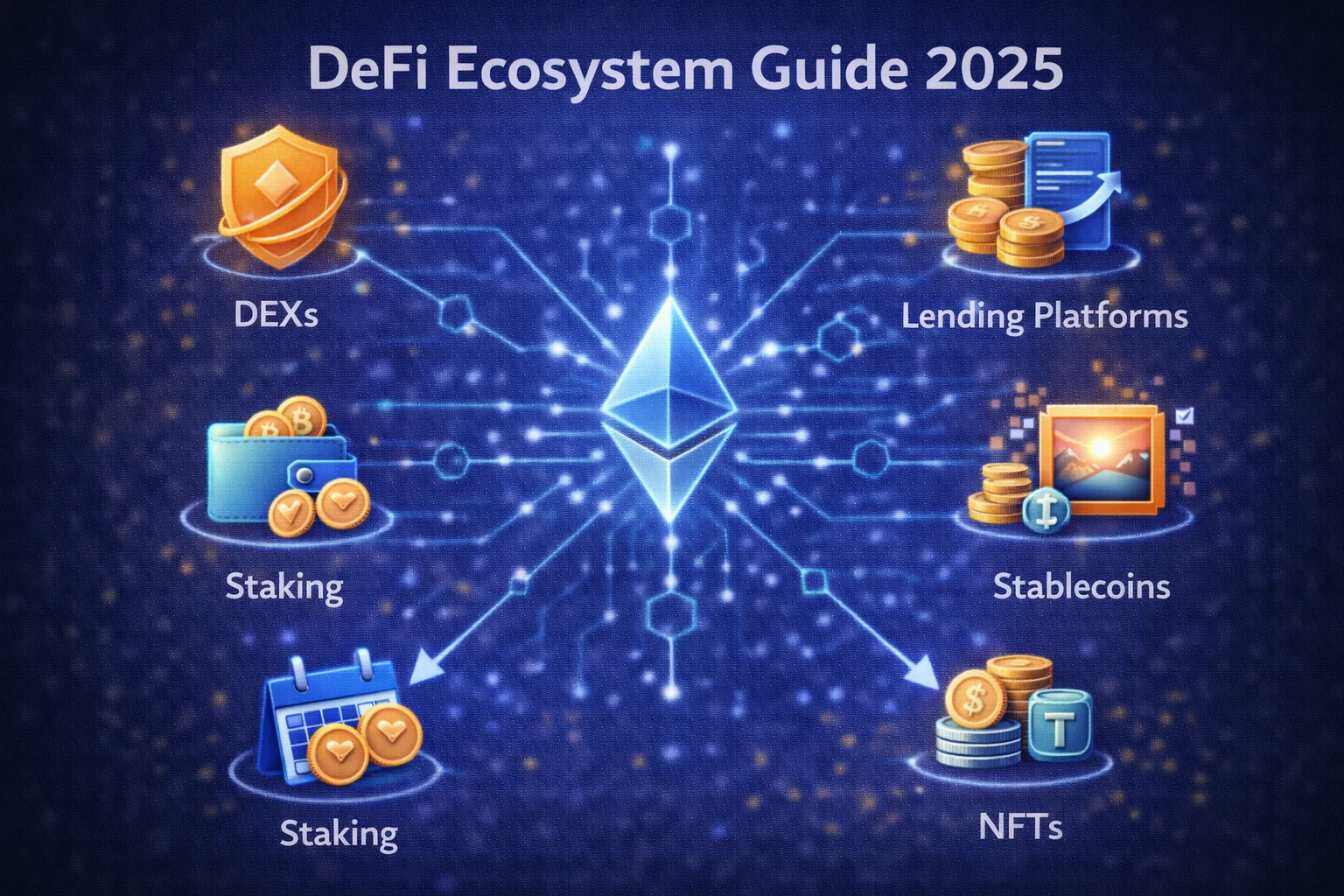
Introduction
Decentralised Finance, abbreviated as DeFi, is a revolutionary financial ecosystem built on distributed ledger technology that operates without traditional intermediaries like banks, brokers, or exchanges. Instead of relying on centralised institutions, this innovative system uses automated protocols on distributed ledgers like Ethereum to create financial services that are open, transparent, and accessible to anyone with an internet connection.
Think of DeFi as recreating traditional banking services - lending, borrowing, trading, insurance, and more - but in a decentralised, permissionless manner where you maintain full control of your digital assets. This paradigm shift represents one of the most significant innovations in finance since the invention of banking itself, offering unprecedented access to financial services regardless of geographic location, economic status, or institutional relationships.
The DeFi ecosystem has experienced explosive growth since its inception, with total value locked (TVL) reaching over $100 billion at its peak. This growth reflects the compelling value proposition of decentralised finance: financial services that are more accessible, transparent, and often more cost-effective than their traditional counterparts. Unlike traditional finance, which operates during business hours and requires extensive documentation and approval processes, DeFi protocols operate 24/7 and are accessible to anyone with a crypto wallet.
The philosophical foundation of DeFi rests on the principles of financial sovereignty and inclusivity. Traditional financial systems exclude billions of people worldwide due to a lack of documentation, minimum balance requirements, or geographic restrictions. DeFi protocols, by contrast, are permissionless and borderless, requiring only an internet connection and a compatible wallet to access sophisticated financial services that were previously available only to wealthy individuals and institutions.
Smart contracts serve as the backbone of DeFi, replacing human intermediaries with code that automatically executes financial agreements when predetermined conditions are met. This automation eliminates counterparty risk, reduces costs, and enables complex financial products that would be impossible or prohibitively expensive in traditional finance. The composability of DeFi protocols—their ability to interact and build upon each other—has created an interconnected ecosystem where innovation compounds rapidly.
The transparency inherent in distributed ledger technology means that all DeFi transactions and protocol operations are publicly auditable, creating unprecedented visibility into financial operations. This transparency, combined with the open-source nature of most DeFi protocols, enables continuous security auditing and rapid innovation as developers can build upon existing protocols and identify potential improvements or vulnerabilities.
However, DeFi's revolutionary potential comes with significant risks and challenges. The nascent nature of the technology means that smart contract bugs, economic exploits, and regulatory uncertainty pose real threats to users. Understanding these risks and learning to navigate them safely is essential for anyone looking to participate in the DeFi ecosystem. This guide will provide you with the knowledge needed to explore DeFi opportunities while effectively managing the associated risks.
The DeFi landscape in 2025 has matured significantly from its early experimental phase, with battle-tested protocols, improved security practices, and clearer regulatory frameworks emerging. However, the space continues to evolve rapidly, with innovations in areas like cross-chain interoperability, privacy-preserving protocols, and institutional-grade infrastructure expanding the possibilities for decentralised finance. Understanding both the current state and future trajectory of DeFi is crucial for making informed decisions about participation in this revolutionary financial ecosystem.
How DeFi Protocols Work
Smart Contracts
Decentralised applications run on automated protocols - self-executing agreements with terms directly written into code. These protocols automatically execute transactions when predetermined conditions are met, eliminating the need for intermediaries.
Distributed Ledger Infrastructure
Most decentralised platforms operate on the Ethereum distributed ledger, though other networks like Binance Smart Chain, Polygon, and Solana also host these applications. The distributed ledger provides:
- Transparency: All transactions are publicly visible
- Immutability: Transactions cannot be altered once confirmed
- decentralisation: No single point of control or failure
- Programmability: Complex monetary logic can be coded
Capital Pools
Instead of traditional order books, many decentralised platforms use capital pools - smart agreements containing funds that participants can trade against. Capital providers earn fees for supplying funds to these reserves.

Key DeFi Services
1. Decentralised Exchanges (DEXs)
DEXs allow users to trade digital assets directly with each other without a centralised exchange:
- Uniswap - Leading Ethereum DEX with automated market making
- Curve - specialised in stablecoin and similar asset trading
- SushiSwap - Community-driven DEX with additional features
- PancakeSwap - Popular DEX on Binance Smart Chain
2. Lending and Borrowing
Peer-to-peer lending platforms allow users to lend their digital assets to earn interest or borrow against their holdings:
- Aave - Leading lending platform with innovative features
- Compound - Pioneer in decentralised lending with algorithmic interest rates
- MakerDAO - Decentralised lending platform that issues DAI stablecoin
3. Yield Farming
Yield farming involves providing liquidity to protocols in exchange for rewards, often in the form of governance tokens. Popular liquidity mining platforms include:
- Yearn Finance - Automated return optimisation
- Convex Finance - Boosted Curve rewards
- Pendle - Return trading and fixed-rate products
4. Staking and Liquid Staking
Blockchain networks offer various staking opportunities:
- Lido - Liquid delegation for Ethereum and other networks
- Rocket Pool - decentralised Ethereum delegation
- Frax Finance - Stablecoin platform with delegation rewards
5. Derivatives and Synthetic Assets
DeFi protocols enable complex monetary instruments:
- GMX - decentralised perpetual exchange
- Synthetix - Synthetic asset platform
- dYdX - decentralised derivatives trading
DeFi vs Traditional Banking
| Aspect | Traditional Banking | DeFi Protocols |
|---|---|---|
| Access | Requires bank account, credit check | Open to anyone with digital wallet |
| Control | Banks control your funds | You control your funds |
| Transparency | Limited visibility into operations | Fully transparent on distributed ledger |
| Operating Hours | Business hours, holidays | 24/7/365 |
| Geographic Limits | Country-specific regulations | Global access |
| Intermediaries | Banks, brokers, clearinghouses | Smart agreements |
Benefits of DeFi
1. Financial Inclusion
Open finance provides financial services to anyone with an internet connection, regardless of location, credit history, or economic status.
2. Transparency
All transactions and smart agreement code are publicly visible on the distributed ledger, enabling unprecedented transparency in monetary operations.
3. Composability
Decentralised platforms can be combined like "money legos" to create complex monetary strategies and new products.
4. Higher Returns
DeFi protocols often offer higher returns than traditional savings accounts due to reduced overhead and direct peer-to-peer interactions.
5. Innovation Speed
New monetary products can be developed and deployed much faster than in traditional banking.
6. Self-Custody
Participants maintain control of their private keys and funds, reducing counterparty risk.
Risks and Challenges of DeFi
1. Smart Agreement Risk
Bugs or vulnerabilities in smart agreement code can lead to loss of funds. Even audited agreements can have undiscovered flaws.
2. Impermanent Loss
Capital providers may experience impermanent loss when asset prices change relative to each other.
3. High Gas Costs
Ethereum network congestion can lead to expensive transaction costs, making small transactions uneconomical.
4. Regulatory Uncertainty
Evolving regulations could impact decentralised platforms and participant access in different jurisdictions.
5. Participant Experience Complexity
DeFi protocols can be complex for newcomers, with risks of sending funds to the wrong addresses or interacting with malicious agreements.
6. Liquidation Risk
Borrowers can face liquidation if collateral values drop below the required thresholds.
How to Get Started with DeFi
Step 1: Set Up a Web3 Storage Solution
You'll need a digital asset storage solution that supports DeFi interactions:
- MetaMask - Most popular browser extension storage solution
- Trust Wallet - Mobile storage solution with DeFi support
- WalletConnect - System for connecting various storage solutions to decentralised applications
Step 2: Buy Ethereum (ETH)
Most decentralised platforms run on Ethereum, so you'll need ETH for:
- Gas costs for transactions
- Participating in platforms
- Swapping for other assets
Buy ETH on exchanges like Kraken or Coinbase, then transfer to your storage solution.
Step 3: Start with Simple Platforms
Begin with established, well-audited platforms:
- Uniswap: Try swapping assets
- Aave: Supply assets to earn interest
- Compound: Lend stablecoins for steady returns
Step 4: Learn About Gas Optimisation
minimise transaction costs by:
- Transacting during low-traffic periods
- Using Layer 2 solutions like Polygon
- Batching multiple operations
- Using gas tracking tools
Popular DeFi Platforms in 2025
Lending Platforms
- Aave: Flash loans, credit delegation, rate switching
- Compound: Algorithmic money markets
- MakerDAO: decentralised stablecoin (DAI) creation
DEX Platforms
- Uniswap V4: Customizable capital reserves
- Curve: Efficient stablecoin trading
- Balancer: Automated portfolio management
Return Platforms
- Yearn Finance: Automated return strategies
- Convex: Boosted Curve rewards
- Pendle: Yield tokenization and trading
For a comprehensive comparison of leading DeFi protocols, see our DeFi protocols comparison guide.
Derivatives
- GMX: decentralised perpetual trading
- Synthetix: Synthetic asset creation
- dYdX: Advanced derivatives trading
DeFi Security Best Practices
Research Before Investing
- Check protocol audits and security reports
- Understand the tokenomics and governance
- Review the team and community
- Start with small amounts
Use Hardware Wallets
For significant amounts, use hardware wallets like Ledger for enhanced security.
Verify Contract Addresses
- Always verify contract addresses from official sources
- Beware of fake tokens and phishing sites
- Use reputable DeFi aggregators
Understand Risks
- Smart contract risk
- Impermanent loss
- Liquidation risk
- Governance risk
Wallet Security
- Hardware Wallets: Use for large amounts
- Hot Wallet Limits: Keep minimal funds in hot wallets
- Multiple Wallets: Separate wallets for different purposes
- Regular Backups: Secure seed phrase storage
Transaction Security
- Contract Verification: Always verify contract addresses
- Simulation Tools: Use transaction simulators
- Slippage Settings: Set appropriate slippage tolerance
- Gas Price Monitoring: Avoid overpaying for gas
Protocol Due Diligence
- Audit Reports: Read security audit findings
- Team Background: Research development team
- Community Sentiment: Monitor social media and forums
- Code Review: Check open-source code if possible
DeFi vs CeFi: Making the Choice
Learn more about the differences in our detailed CeFi vs DeFi comparison.
Choose DeFi if you:
- Want full control of your funds
- Prefer transparency and decentralisation
- Are comfortable with technical complexity
- Want access to innovative financial products
Choose CeFi if you:
- Prefer simplicity and customer support
- Want insurance coverage
- Need fiat currency integration
- Are new to cryptocurrency
The Future of DeFi
Layer 2 Solutions
Scaling solutions like Arbitrum, Optimism, and Polygon are making DeFi more accessible with lower fees.
Cross-Chain DeFi
Protocols are expanding to multiple blockchains, enabling cross-chain liquidity and composability.
Institutional Adoption
Traditional financial institutions are beginning to integrate DeFi protocols and offer DeFi services.
Regulatory Clarity
Clearer regulations will likely increase institutional participation and mainstream adoption.
Common DeFi Strategies
1. Liquidity Provision
Provide liquidity to DEX pools to earn trading fees and rewards.
2. Yield Farming
Move funds between protocols to maximise yield, often involving governance tokens.
3. Stablecoin Farming
Focus on stablecoin strategies to minimise impermanent loss while earning yield.
4. Leveraged Strategies
Use borrowing to amplify positions, but with increased risk.
DeFi Tools and Resources
Portfolio Tracking
- DeBank - DeFi portfolio tracker
- Zapper - DeFi dashboard and portfolio management
- DeFi Pulse - DeFi analytics and rankings
Yield optimisation
- Yearn Finance - Automated yield strategies
- Beefy Finance - Multi-chain yield optimiser
- Harvest Finance - Yield farming automation
Analytics
- DeFiLlama - TVL and protocol analytics
- Dune Analytics - Custom DeFi dashboards
- Token Terminal - DeFi financial metrics
DeFi Yield Strategies Deep Dive
Liquidity Mining Explained
Liquidity mining involves providing assets to DeFi protocols in exchange for rewards:
- Mechanism: Deposit tokens into liquidity pools
- Rewards: Earn trading fees + governance tokens
- Risks: Impermanent loss, smart contract risk
- Popular Pools: ETH/USDC, WBTC/ETH, stablecoin pairs
Yield Farming Strategies
Conservative Strategies (Lower Risk)
- Stablecoin Lending: Lend USDC/USDT on Aave/Compound
- Stablecoin Pools: Provide liquidity to stablecoin pairs
- Blue-chip Staking: Stake ETH, MATIC, or other major tokens
- Expected Returns: 3-8% APY
Moderate Strategies (Medium Risk)
- ETH/Stablecoin Pairs: Balanced exposure to ETH price
- Leveraged Staking: Borrow against staked assets
- Cross-chain Farming: utilise multiple blockchains
- Expected Returns: 8-15% APY
Aggressive Strategies (High Risk)
- New Protocol Farming: Early participation in new projects
- Leveraged Yield Farming: Amplify positions with borrowed funds
- Exotic Pairs: High-volatility token combinations
- Expected Returns: 15-100%+ APY (with high risk)
DeFi Risk Management Framework
Smart Contract Risk Assessment
- Audit History: Check for professional security audits
- Code Verification: Ensure contracts are verified on Etherscan
- Time in Market: Prefer protocols with longer track records
- TVL Analysis: Higher TVL often indicates more trust
- Bug Bounty Programs: Active security incentives
Liquidity Risk Management
- Pool Depth: Ensure sufficient liquidity for exits
- Slippage Tolerance: Set appropriate slippage limits
- Exit Strategy: Plan for various market scenarios
- Diversification: Spread risk across multiple protocols
Impermanent Loss Mitigation
- Correlated Assets: Use assets that move together
- Stablecoin Pairs: minimise price divergence risk
- IL Protection: Some protocols offer impermanent loss insurance
- Monitoring Tools: Track IL in real-time
Advanced DeFi Concepts
Flash Loans
Uncollateralized loans that must be repaid within the same transaction:
- Use Cases: Arbitrage, liquidations, collateral swapping
- Platforms: Aave, dYdX, Balancer
- Requirements: Technical knowledge, smart contract development
- Risks: Failed transactions, gas costs
Automated Market Makers (AMMs)
Mathematical formulas that determine asset prices:
- Constant Product (x*y=k): Used by Uniswap V2
- Stable Swap: optimised for similar-priced assets (Curve)
- Weighted Pools: Custom asset ratios (Balancer)
- Concentrated Liquidity: Capital efficiency (Uniswap V3)
Governance Tokens and DAOs
- Voting Rights: Participate in protocol decisions
- Proposal Creation: Submit improvement proposals
- Treasury Management: Control protocol funds
- Fee Distribution: Share in protocol revenues
DeFi on Different Blockchains
Ethereum DeFi Ecosystem
- Advantages: Largest ecosystem, most liquidity, battle-tested
- Disadvantages: High gas fees, network congestion
- Key Protocols: Uniswap, Aave, Compound, MakerDAO
- Best For: Large transactions, maximum security
Binance Smart Chain (BSC)
- Advantages: Low fees, fast transactions, Ethereum compatibility
- Disadvantages: More centralised, fewer protocols
- Key Protocols: PancakeSwap, Venus, Alpaca Finance
- Best For: Small transactions, liquidity mining
Polygon (MATIC)
- Advantages: Low fees, Ethereum security, growing ecosystem
- Disadvantages: Bridge risks, smaller liquidity
- Key Protocols: QuickSwap, Aave (Polygon), SushiSwap
- Best For: Ethereum users seeking lower fees
Solana DeFi
- Advantages: Very fast, very cheap, growing ecosystem
- Disadvantages: Network outages, different programming model
- Key Protocols: Raydium, Serum, Marinade
- Best For: High-frequency trading, new DeFi experiments
DeFi Investment Strategies by Risk Profile
Conservative DeFi Portfolio (Low Risk)
- Allocation: 70% stablecoins, 30% blue-chip crypto
- Strategies: Lending on Aave/Compound, stablecoin LPs
- Expected Return: 4-8% APY
- Risk Level: Low to moderate
Balanced DeFi Portfolio (Medium Risk)
- Allocation: 40% stablecoins, 40% ETH/BTC, 20% altcoins
- Strategies: Mixed lending/LP, some liquidity mining
- Expected Return: 8-15% APY
- Risk Level: Moderate
Aggressive DeFi Portfolio (High Risk)
- Allocation: 20% stablecoins, 30% ETH/BTC, 50% altcoins
- Strategies: Active liquidity mining, new protocols, leverage
- Expected Return: 15-50%+ APY
- Risk Level: High
DeFi Tax Implications
Taxable Events in DeFi
- Token Swaps: Each swap is a taxable event
- Yield Farming Rewards: Income at fair market value
- Liquidity Mining: Rewards taxed as income
- Impermanent Loss: May create capital losses
Record Keeping Best Practices
- Transaction Tracking: Record all DeFi interactions
- Price Documentation: Fair market value at transaction time
- Gas Fee Records: Deductible as transaction costs
- Professional Help: Consider crypto tax software or CPAs
Future of DeFi
Emerging Trends
- Real World Assets (RWAs): Tokenizing traditional assets
- Cross-chain Interoperability: Seamless multi-chain DeFi
- Institutional DeFi: Enterprise-grade DeFi solutions
- Regulatory Compliance: KYC/AML compliant DeFi protocols
Technology Developments
- Layer 2 Scaling: Cheaper and faster transactions
- Zero-Knowledge Proofs: Privacy-preserving DeFi
- Account Abstraction: Improved user experience
- AI Integration: Automated yield optimisation
Regulatory Evolution
- Clearer Guidelines: More specific DeFi regulations
- Compliance Tools: Built-in regulatory compliance
- Institutional Adoption: Traditional finance integration
- Consumer Protection: Enhanced user safeguards
Getting Started: Your DeFi Action Plan
Phase 1: Education and Setup (Week 1-2)
- Learn DeFi basics and key concepts
- Set up MetaMask wallet and secure seed phrase
- Buy ETH on a centralised exchange
- Transfer a small amount to MetaMask for testing
Phase 2: First DeFi Interactions (Week 3-4)
- Try simple token swaps on Uniswap
- Lend stablecoins on Aave or Compound
- Provide liquidity to a stablecoin pair
- Monitor positions and understand gas costs
Phase 3: Advanced Strategies (Month 2+)
- Explore liquidity mining opportunities
- Try multichain DeFi on Polygon or BSC
- Participate in governance voting
- Develop risk oversight strategies
DeFi Resources and Tools
Essential DeFi Tools
- DeFiPulse: Protocol rankings and TVL data
- DeFiLlama: Multi-chain DeFi analytics
- Zapper: Portfolio management and DeFi interactions
- DeBank: Wallet tracking and DeFi portfolio
- APY.vision: Liquidity pool analytics
Educational Resources
- DeFi Pulse Blog: Industry insights and analysis
- Bankless: DeFi education and news
- Finematics: DeFi explainer videos
- DeFi Dad: Beginner-friendly tutorials
- Messari: Research and protocol analysis
Community and Support
- Discord Communities: Protocol-specific support
- Reddit r/DeFi: General DeFi discussions
- Twitter: Real-time updates and alpha
- Telegram Groups: Community support and tips
Institutional DeFi Adoption and Professional Implementation Strategies
Enterprise DeFi Integration and Corporate Treasury Management
Professional DeFi adoption requires sophisticated strategies that leverage DeFi ecosystem protocols for corporate treasury optimisation, systematic yield generation, and comprehensive risk oversight frameworks while maintaining regulatory compliance and operational security standards. Enterprise applications include systematic DeFi protocol integration, comprehensive multi-protocol yield strategies, and advanced risk assessment procedures that enable institutional users to benefit from DeFi innovation while maintaining appropriate oversight and compliance requirements for professional crypto operations and corporate treasury management across evolving regulatory frameworks and institutional security standards.
Advanced institutional DeFi strategies require a comprehensive understanding of protocol mechanics, governance systems, and smart contract risks that enable sophisticated DeFi operations while maintaining fiduciary responsibilities and institutional risk oversight standards. Professional users implement systematic protocol evaluation procedures, comprehensive due diligence frameworks, and advanced operational controls that ensure appropriate DeFi adoption whilstmaximising yield generation and maintaining regulatory compliance for institutional crypto operations and professional digital asset management across multiple DeFi protocols and blockchain networks.
Corporate DeFi integration requires sophisticated compliance frameworks that address regulatory requirements, audit trail management, and fiduciary responsibilities whilstleveraging DeFi benefits for professional crypto operations. Professional users implement comprehensive compliance monitoring systems, systematic reporting procedures, and advanced legal frameworks that ensure appropriate institutional DeFi adoption while maintaining operational efficiency and regulatory compliance across multiple jurisdictions and evolving regulatory requirements for professional DeFi operations and institutional digital asset management.
Advanced DeFi Portfolio Management and Risk Optimisation
Professional DeFi portfolio management requires sophisticated strategies that optimise allocation across multiple protocols while managing smart contract risks, market volatility, and operational complexity for institutional digital currency operations. Advanced users implement systematic diversification strategies, comprehensive performance monitoring, and sophisticated risk assessment procedures that maximise risk-adjusted returns while maintaining appropriate security standards and regulatory compliance for institutional DeFi participation and professional digital currency portfolio management across evolving protocol landscapes and market conditions.
Risk optimisation strategies include comprehensive smart contract analysis, systematic protocol evaluation, and advanced contingency planning that ensures appropriate protection against various DeFi-specific risks while maintaining optimal yield generation. Professional users implement comprehensive insurance strategies, systematic backup procedures, and advanced monitoring systems that provide early warning of potential issues while maintaining operational efficiency and regulatory compliance for institutional DeFi operations and professional digital currency management across multiple protocols and market scenarios.
Portfolio optimisation requires systematic analysis of DeFi yield opportunities, comprehensive correlation assessment, and advanced allocation techniques that balance yield potential with risk oversight for professional digital currency operations. Professional users implement automated rebalancing systems, comprehensive performance attribution analysis, and systematic optimisation procedures that ensure consistent DeFi portfolio performance while maintaining appropriate risk oversight and operational efficiency for institutional digital currency operations and professional digital asset management across evolving DeFi ecosystems and market conditions.
Regulatory Compliance and Institutional DeFi Frameworks
Institutional DeFi adoption requires comprehensive regulatory compliance frameworks that address DeFi-specific regulatory considerations, tax implications, and reporting requirements whilstleveraging DeFi ecosystem benefits for professional digital currency operations. Professional users implement systematic compliance monitoring, comprehensive audit trail management, and advanced reporting systems that ensure appropriate regulatory compliance whilstmaximising DeFi benefits and maintaining operational efficiency for institutional digital currency operations and professional digital asset management across multiple jurisdictions and evolving regulatory frameworks.
Compliance strategies include systematic tax optimisation, comprehensive custody analysis, and advanced legal frameworks that meet institutional standards while enabling efficient DeFi operations. Professional users implement sophisticated compliance procedures, systematic documentation requirements, and comprehensive risk oversight protocols that ensure appropriate institutional DeFi adoption while maintaining regulatory compliance and operational excellence for professional digital currency operations and institutional digital asset management across complex regulatory environments and evolving compliance requirements for professional DeFi participation.
Technology Integration and Operational Excellence
Professional DeFi implementation requires sophisticated technology integration that enables efficient protocol interaction, comprehensive monitoring, and systematic risk oversight while maintaining institutional security standards and operational efficiency. Advanced users implement comprehensive API integration, automated monitoring systems, and sophisticated analytics platforms that provide real-time visibility into DeFi operations while maintaining appropriate security measures and regulatory compliance for institutional digital currency operations and professional digital asset management across multiple DeFi protocols and blockchain networks.
Operational excellence strategies include systematic workflow optimisation, comprehensive staff training, and advanced security protocols that ensure efficient DeFi operations while maintaining institutional standards and regulatory compliance. Professional users implement comprehensive operational procedures, systematic quality control measures, and advanced performance monitoring that ensures consistent DeFi operational excellence while maintaining appropriate risk oversight and security standards for institutional digital currency operations and professional digital asset management across evolving DeFi landscapes and operational requirements.
Advanced DeFi Concepts and Emerging Technologies
Layer 2 Scaling Solutions and Cross-Chain Interoperability
Ethereum's high transaction fees and network congestion have driven innovation in Layer 2 scaling solutions. Optimistic rollups like Arbitrum and Optimism process transactions off-chain while maintaining Ethereum's security guarantees through fraud proofs. Zero-knowledge rollups such as Polygon zkEVM and zkSync Era offer instant finality and enhanced privacy through cryptographic proofs that verify transaction validity without revealing underlying data.
Cross-chain bridges enable asset transfers between different blockchain networks, expanding DeFi opportunities beyond single-chain limitations. Protocols like Wormhole, Multichain, and LayerZero facilitate seamless movement of tokens across Ethereum, Binance Smart Chain, Avalanche, and Solana ecosystems. However, bridge security remains a critical concern, with several high-profile exploits highlighting the importance of thorough due diligence before using cross-chain infrastructure.
Algorithmic Trading and MEV (Maximal Extractable Value)
Sophisticated traders employ algorithmic strategies to capitalise on DeFi market inefficiencies. Arbitrage bots identify price discrepancies across different exchanges, whilstliquidation bots monitor lending protocols for undercollateralized positions. Flashloan arbitrage enables traders to profit from price differences without requiring initial capital, borrowing assets within a single transaction to execute complex trading strategies.
Maximal Extractable Value represents the additional profit miners or validators can extract by reordering, including, or excluding transactions within blocks. MEV strategies include sandwich attacks around large trades, front-running profitable transactions, and back-running liquidations. Whilst MEV extraction can be profitable for sophisticated actors, it often comes at the expense of regular users through increased slippage and transaction costs.
decentralised Autonomous Organizations (DAOs) and Governance
DAOs represent a revolutionary approach to organisational governance, enabling decentralised decision-making through token-based voting mechanisms. MakerDAO pioneered DeFi governance, allowing MKR token holders to vote on stability fees, collateral types, and protocol parameters. Compound's governance token COMP enables community members to propose and vote on protocol upgrades, interest rate models, and risk parameters.
Governance participation requires understanding of proposal mechanisms, voting procedures, and delegation options. Many protocols implement time-locked execution periods, allowing community review before implementing approved changes. Quadratic voting and conviction voting represent emerging governance models that aim to reduce plutocratic tendencies and encourage broader community participation in protocol decision-making.
Institutional DeFi Adoption and Regulatory Developments
Traditional financial institutions increasingly recognise DeFi's potential for improving efficiency, reducing costs, and accessing new revenue streams. Investment banks explore DeFi protocols for treasury management, whilstasset managers investigate yield farming strategies for enhanced portfolio returns. Institutional adoption requires sophisticated risk management frameworks, comprehensive compliance procedures, and robust security measures that meet fiduciary responsibilities and regulatory requirements.
Regulatory clarity remains crucial for widespread institutional adoption. The European Union's Markets in Crypto-Assets (MiCA) regulation provides framework for cryptocurrency operations, whilstthe United States continues developing comprehensive DeFi oversight through SEC and CFTC guidance. Regulatory sandboxes in jurisdictions like Singapore and Switzerland enable controlled experimentation with DeFi protocols under regulatory supervision, fostering innovation whilstprotecting consumers.
Privacy-Preserving DeFi and Zero-Knowledge Technologies
Privacy concerns in public blockchain environments drive development of privacy-preserving DeFi solutions. Zero-knowledge proofs enable transaction verification without revealing sensitive information, protecting user privacy while maintaining protocol transparency. Tornado Cash pioneered cryptocurrency mixing services, though regulatory scrutiny highlights ongoing tensions between privacy rights and compliance requirements in decentralised finance applications.
Advanced cryptographic techniques like zk-SNARKs and zk-STARKs enable private smart contract execution, protecting trading strategies, portfolio compositions, and transaction histories from public observation. Privacy-focused protocols like Aztec Network and Secret Network implement confidential smart contracts that enable private DeFi operations while maintaining auditability for compliance purposes through selective disclosure mechanisms.
Sustainable DeFi and Environmental Considerations
Environmental sustainability becomes increasingly important as DeFi protocols address energy consumption concerns. Ethereum's transition to Proof-of-Stake consensus reduces network energy consumption by over 99%, making DeFi operations significantly more environmentally sustainable. Alternative blockchain networks like Solana, Avalanche, and Polygon implement energy-efficient consensus mechanisms from inception, attracting environmentally conscious users and institutions.
Carbon-neutral DeFi initiatives include protocol-level carbon offset mechanisms, renewable energy-powered validator operations, and environmental impact tracking for DeFi activities. Some protocols integrate carbon credits as collateral assets, enabling users to offset their environmental impact whilstparticipating in decentralised finance. Regenerative finance (ReFi) represents an emerging movement that leverages DeFi mechanisms to fund environmental restoration and sustainability projects through tokenised carbon credits and impact investing protocols.
Traditional financial institutions increasingly recognise DeFi's potential, with major banks exploring blockchain integration and cryptocurrency custody services. JPMorgan's JPM Coin, Goldman Sachs' digital asset trading desk, and Visa's cryptocurrency settlement capabilities demonstrate institutional acceptance of blockchain technology. Regulatory clarity continues evolving, with frameworks like the EU's Markets in Crypto-Assets (MiCA) regulation providing guidelines for DeFi protocol compliance.
Institutional DeFi platforms like Aave Arc and Compound Treasury offer permissioned access to DeFi protocols while maintaining compliance with traditional finance regulations. These platforms provide institutional-grade custody, reporting, and risk management tools that bridge the gap between traditional finance and decentralised protocols. As regulatory frameworks mature, expect increased institutional participation in DeFi markets.
Privacy-Preserving Technologies and Zero-Knowledge Proofs
Privacy remains a significant concern in DeFi, where all transactions are publicly visible on blockchain networks. Zero-knowledge proof technologies enable private transactions while maintaining network security and auditability. Tornado Cash pioneered cryptocurrency mixing services using zk-SNARKs, allowing users to break transaction linkability and enhance financial privacy.
Emerging privacy protocols like Aztec Network and Penumbra implement programmable privacy for DeFi applications. These platforms enable private lending, trading, and yield farming while preserving transaction confidentiality. However, privacy-preserving technologies face regulatory scrutiny, with authorities concerned about potential money laundering and tax evasion applications.
Sustainable Finance and Environmental Considerations
Environmental sustainability has become increasingly important in DeFi development, with many protocols transitioning from energy-intensive Proof-of-Work to more efficient Proof-of-Stake consensus mechanisms. Ethereum's transition to Proof-of-Stake reduced network energy consumption by over 99%, making DeFi applications significantly more environmentally friendly.
Carbon-neutral and carbon-negative DeFi protocols are emerging, with platforms like KlimaDAO focusing on carbon credit tokenization and environmental impact reduction. Regenerative finance (ReFi) represents a growing movement that aims to use DeFi mechanisms to address climate change and environmental degradation through innovative tokenomics and incentive structures.
Technical Architecture and Smart Contract Innovation
Modern DeFi protocols utilise sophisticated smart contract architectures including proxy patterns, diamond standards, and modular designs that enable upgradability while maintaining security. OpenZeppelin's upgradeable contracts framework provides battle-tested implementations of common patterns, whilstprotocols like Compound V3 demonstrate innovative approaches to gas optimisation and user experience enhancement.
Automated market maker innovations continue evolving beyond simple constant product formulas. Balancer's weighted pools support custom asset ratios, whilstCurve's StableSwap algorithm optimises trading between correlated assets. Uniswap V4's hook system enables unlimited customisation of pool behavior, opening possibilities for dynamic fees, custom oracles, and sophisticated trading strategies.
Oracle networks provide critical price feeds and external data to DeFi protocols. Chainlink's decentralised oracle network aggregates data from multiple sources, whilstprotocols like Band Protocol and API3 offer alternative approaches to secure data delivery. Oracle manipulation attacks remain a significant risk, requiring robust price feed validation and circuit breaker mechanisms.
Risk Management and Security Best Practices
Professional DeFi participation requires comprehensive risk management strategies including position sizing, diversification, and continuous monitoring of protocol health metrics. Smart contract audits by firms like ConsenSys Diligence, Trail of Bits, and OpenZeppelin provide security assessments, though audits cannot guarantee complete safety from all potential vulnerabilities.
Insurance protocols like Nexus Mutual and InsurAce offer coverage against smart contract failures, though coverage terms and claim processes require careful evaluation. Self-insurance through position limits and diversification often provides more reliable protection than third-party insurance products with complex terms and potential coverage gaps.
Hardware wallet integration with DeFi protocols enables secure transaction signing while maintaining private key custody. Ledger and Trezor devices support major DeFi applications through WalletConnect integration, providing enhanced security compared to browser-based hot wallets. Multi-signature wallets like Gnosis Safe offer additional security layers for institutional DeFi participation, requiring multiple signatures for transaction execution and providing comprehensive audit trails for compliance purposes. Advanced security practices include transaction simulation, contract verification, and systematic monitoring of protocol governance proposals to identify potential risks before they impact user funds. Professional risk management encompasses diversification strategies, position sizing methodologies, and continuous assessment of protocol fundamentals to ensure sustainable long-term participation in decentralised finance ecosystems with optimal security and performance outcomes through systematic implementation excellence and operational reliability standards excellence.
Conclusion
DeFi represents the most significant innovation in finance since the invention of banking itself. It offers unprecedented opportunities for financial inclusion, innovation, and yield generation, but it also presents unique risks and complexities that require careful consideration and ongoing learning.
The key to success in DeFi lies in starting small, learning continuously, and prioritising security above all else. Begin with established protocols like Aave and Uniswap, understand the risks involved, and never invest more than you can afford to lose.
As the DeFi ecosystem continues to evolve, new opportunities and challenges will emerge. Stay informed about regulatory developments, technological advancements, and best security practices. The future of finance is being built today, and DeFi is at the forefront of this transformation.
Remember that DeFi is still experimental technology. Whilst the potential rewards are significant, so are the risks. Approach DeFi with curiosity, caution, and a commitment to continuous learning. Start your journey by setting up a MetaMask wallet, buying some ETH on Binance, and taking your first steps into the decentralised financial future.
The revolution in finance has begun, and with proper education, security practices, and risk oversight, you can be part of building and benefiting from this new financial paradigm. Welcome to the future of finance – welcome to DeFi.
Looking ahead, the DeFi ecosystem will continue to mature with improved user interfaces, enhanced security measures, and clearer regulatory frameworks. The integration of traditional finance with decentralised protocols is already beginning, with major financial institutions exploring DeFi applications and central banks developing digital currencies that may interact with DeFi protocols.
The technological innovations emerging from DeFi extend far beyond finance, influencing areas like governance, identity management, and digital ownership. As these technologies mature, they will likely reshape not just how we handle money, but how we organise and coordinate economic activity in the digital age. The composability of DeFi protocols—their ability to work together like financial building blocks—creates possibilities for innovation that we're only beginning to explore.
For those ready to embark on their DeFi journey, remember that patience and continuous learning are your greatest assets. The landscape changes rapidly, with new protocols, opportunities, and risks emerging regularly. Stay connected with the community, follow reputable sources for updates, and always prioritise security over potential returns. The future of finance is being written today, and by understanding and participating in DeFi, you're positioning yourself at the forefront of this financial revolution.
Sources & References
- Ethereum Foundation. (2025). Ethereum DeFi Guide. Official DeFi documentation and resources.
- Aave. (2025). Aave Documentation. DeFi lending protocol whitepaper and guides.
- Uniswap. (2025). Uniswap Documentation. Decentralised exchange protocol documentation.
Frequently Asked Questions
- What is DeFi in simple terms?
- DeFi (Decentralised Finance) is a financial system built on distributed ledger technology that operates without traditional intermediaries like banks. It allows you to lend, borrow, trade, and earn interest on digital currency through automated protocols that execute automatically without human intervention.
- Is DeFi safe to use?
- DeFi carries risks including smart contract bugs, impermanent loss, and market volatility. However, established protocols with multiple audits and proven track records are generally safer. Always start with small amounts, use reputable protocols, and never invest more than you can afford to lose.
- How do I start using DeFi?
- Start by setting up a non-custodial wallet like MetaMask, buying some ETH on a centralised exchange, and transferring it to your wallet. Begin with simple activities like token swaps on Uniswap or lending stablecoins on Aave before exploring more complex strategies.
- Why are DeFi gas fees so high?
- Gas fees on Ethereum can be expensive during network congestion because users compete for limited block space. Consider using Layer 2 solutions like Polygon or Arbitrum for lower fees, or time your transactions during off-peak hours when network usage is lower.
- What is impermanent loss in DeFi?
- Impermanent loss occurs when providing liquidity to automated market makers (AMMs) and the price ratio of your deposited tokens changes compared to simply holding them. The loss becomes "permanent" when you withdraw your liquidity. It's called "impermanent" because it can be recovered if prices return to original ratios.
- What is liquidity mining?
- Yield farming involves providing liquidity to DeFi protocols in exchange for rewards, typically in the form of additional tokens. Farmers move their assets between different protocols to maximise returns, but this strategy requires active management and carries higher risks than simple lending or staking.
- How do automated protocols work in DeFi?
- Smart contracts are self-executing programs on the blockchain that automatically enforce agreement terms without intermediaries. In DeFi, they handle lending, borrowing, trading, and other financial functions automatically when predetermined conditions are met, eliminating the need for traditional financial institutions.
- What's the difference between DeFi and CeFi?
- DeFi (decentralised Finance) operates without central authorities using automated protocols, giving users full control of their assets but requiring more technical knowledge. CeFi (centralised Finance) uses traditional intermediaries like exchanges and banks, offering easier user experiences but requiring trust in third parties.
- What are governance tokens?
- Governance tokens give holders voting rights in DeFi protocol decisions, including parameter changes, upgrades, and treasury management. Examples include UNI (Uniswap), AAVE (Aave), and COMP (Compound). Holding these tokens often provides additional benefits like fee discounts or validation rewards.
- Is there insurance for DeFi?
- Yes, DeFi insurance protocols like Nexus Mutual and Cover Protocol offer protection against smart contract failures, exchange hacks, and other risks. However, coverage is limited and expensive compared to traditional insurance. Many protocols also maintain insurance funds or treasury reserves for emergency situations.
- How much money do I need to start with DeFi?
- You can start with as little as $50-100, but consider Ethereum gas fees, which can be $5-50 per transaction. For cost-effective learning, consider using Layer 2 solutions like Polygon or Arbitrum where fees are much lower (under $1).
- How do people earn money in DeFi?
- People earn through lending (earning interest on deposits), liquidity provision (earning fees from trades), liquidity mining (earning token rewards), and staking (earning rewards for securing networks). Returns vary from 2-20%+ annually depending on strategy and risk level.
- What are the main risks in DeFi?
- Main risks include smart contract vulnerabilities, impermanent loss in liquidity pools, rug pulls and scams, regulatory uncertainty, and market volatility. Mitigate risks through diversification, using established protocols, and thorough research before investing.
Financial Disclaimer
This content is not financial advice. All information provided is for educational purposes only. Cryptocurrency investments carry significant investment risk, and past performance does not guarantee future results. Always do your own research and consult a qualified financial advisor before making investment decisions.