Crypto Glossary: Terms Explained 2025
Master cryptocurrency terminology with this comprehensive glossary. From basic concepts like Bitcoin and blockchain to advanced topics like DeFi, NFTs, and smart contracts—everything explained in simple language with practical examples.
Introduction
The cryptocurrency ecosystem has developed its own extensive vocabulary that can be overwhelming for newcomers and even experienced investors encountering new concepts.
This comprehensive glossary provides clear, practical definitions of over 150 essential cryptocurrency terms.
Our coverage spans from basic concepts such as wallets and addresses to advanced topics such as yield farming and layer-2 scaling solutions.
These technologies are transforming the digital asset landscape in 2025.
Understanding cryptocurrency terminology is crucial for making informed investment decisions, participating in discussions, and navigating the rapidly evolving digital asset landscape.
Each term in this glossary includes not only a definition but also practical context and real-world examples.
Important safety considerations are integrated throughout to help you apply this knowledge effectively whilstavoiding common pitfalls that can result in financial losses.
The cryptocurrency industry evolves at an unprecedented pace, with new technologies, protocols, and concepts emerging regularly. This requires investors to continuously expand their knowledge base.
This glossary serves as both an educational resource for beginners and a reference guide for experienced users who need to stay current with evolving terminology and emerging trends in the digital asset space.
Proper understanding of cryptocurrency terminology extends beyond simple definitions to encompass the underlying concepts, risks, and practical applications that determine successful participation in the digital asset ecosystem.
This comprehensive approach ensures that readers not only learn what terms mean but also understand how to apply this knowledge safely and effectively in real-world cryptocurrency activities.
The terms included in this glossary have been carefully selected based on their relevance to modern cryptocurrency investing, trading, and participation in decentralised finance protocols.
Each definition reflects current industry usage and best practices, ensuring that readers receive accurate and up-to-date information that will serve them well in their cryptocurrency journey.
Cryptocurrency terminology often involves technical concepts from computer science, economics, and finance that require clear explanation to be accessible to general audiences.
This glossary bridges the gap between technical accuracy and practical understanding, providing definitions that are both precise and comprehensible to readers with varying levels of technical background.
The organisation of this glossary follows logical categories that group related terms together, making it easier to understand how different concepts relate to each other within the broader cryptocurrency ecosystem. This structured approach helps readers build comprehensive understanding rather than learning isolated definitions without context.
Safety and security considerations are integrated throughout this glossary, as understanding terminology alone is insufficient without awareness of the risks and best practices associated with cryptocurrency activities. Each relevant term includes important warnings and recommendations to help readers avoid common mistakes and protect their digital assets.
The rapid evolution of cryptocurrency technology means that new terms and concepts emerge regularly, whilstexisting terms may evolve in meaning or usage over time. This glossary reflects the current state of cryptocurrency terminology as of 2025, incorporating recent developments in areas such as decentralised finance, non-fungible tokens, and layer-2 scaling solutions.
Whether you're a complete beginner taking your first steps into cryptocurrency or an experienced investor looking to expand your knowledge of emerging concepts, this glossary provides the foundation needed to navigate the complex and exciting world of digital assets with confidence and understanding.
The cryptocurrency space moves quickly, with new terms and concepts emerging regularly as technology advances and new use cases develop. This glossary focuses on the most important and widely used terms that every cryptocurrency participant should understand, whether you're a complete beginner or looking to expand your knowledge of specific areas like DeFi, NFTs, or blockchain technology.
We've organised these terms alphabetically for easy reference, with cross-references to related concepts where appropriate. Each definition is written in plain language, avoiding unnecessary jargon while maintaining technical accuracy. Where technical complexity is unavoidable, we provide clear explanations and practical examples to make the concepts accessible.
Security considerations are highlighted throughout this glossary, as understanding the risks associated with different cryptocurrency concepts is essential for protecting your investments. From recognising scam tactics to understanding the security implications of different wallet types, this glossary helps you navigate the cryptocurrency space safely.
The regulatory landscape for cryptocurrency continues to evolve, and many terms in this glossary have important legal and tax implications. Whilst this glossary provides general information about these considerations, always consult with qualified professionals for advice specific to your jurisdiction and circumstances.
Whether you're trying to understand a specific term you've encountered, preparing to make your first cryptocurrency investment, or looking to deepen your knowledge of advanced concepts, this glossary serves as a comprehensive reference that you can return to as your cryptocurrency journey progresses.
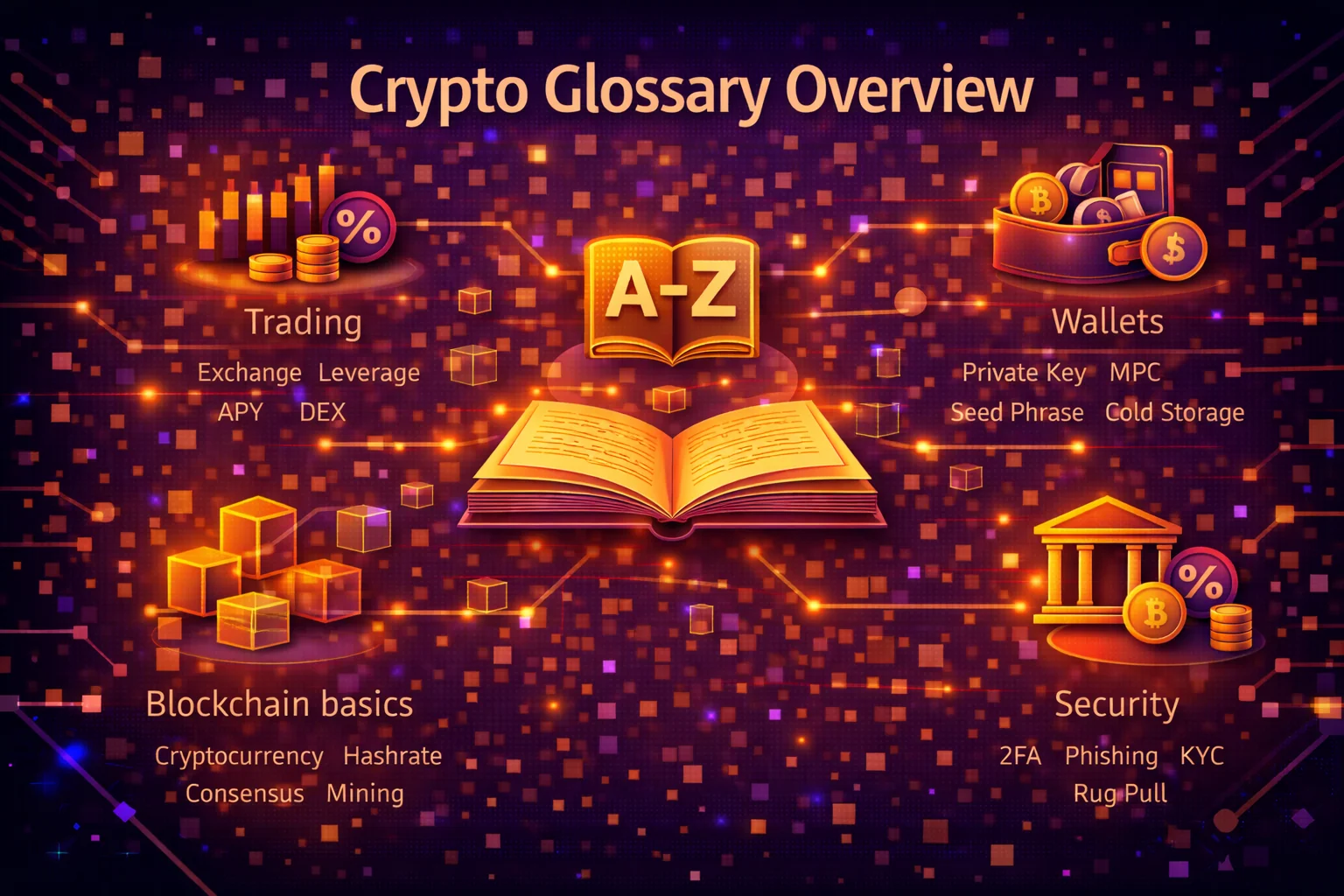
How to Use This Crypto Glossary
This glossary covers over 150 essential cryptocurrency and blockchain terms organised alphabetically. Each definition is written in plain English, accompanied by practical examples and real-world context to help beginners understand complex concepts.
Whether you're just starting your crypto journey or looking to deepen your understanding, this glossary serves as your comprehensive reference guide. Use the navigation below to jump to specific sections, or scroll through to discover new terms and expand your crypto knowledge.
What You'll Learn:
- 150+ Terms: From basic to advanced cryptocurrency concepts
- Practical Examples: Real-world applications and use cases
- Safety Tips: Security considerations for each concept
- Investment Context: How terms relate to crypto investing
Crypto Terms A-C
- Address
- A unique string of characters that identifies a cryptocurrency wallet, similar to a bank account number. Bitcoin addresses start with 1, 3, or bc1, while Ethereum addresses begin with 0x. You can share your address to receive payments, but never share your private key.
- Airdrop
- Free distribution of cryptocurrency tokens to wallet addresses, often used for marketing new projects or rewarding community members. Legitimate airdrops never ask for private keys or seed phrases. Be cautious of scam airdrops that request sensitive information—they're often phishing attempts.
- Algorithm
- A set of rules or instructions that computers follow to solve problems. In cryptocurrency, algorithms secure networks, validate transactions, and create new coins. Bitcoin uses the SHA-256 algorithm, while Ethereum uses Ethash (transitioning to Proof of Stake).
- Altcoin
- Any cryptocurrency other than Bitcoin. Short for "alternative coin." Examples include Ethereum (smart contracts), Cardano (academic approach), Solana (high speed), and thousands of others. Each altcoin typically aims to improve upon Bitcoin's limitations or serve specific use cases.
- AMM (Automated Market Maker)
- A decentralised exchange protocol that uses mathematical formulas to price assets instead of traditional order books. Users trade against liquidity pools rather than other traders. Popular AMMs include Uniswap, SushiSwap, and PancakeSwap.
- APR (Annual Percentage Rate)
- The yearly interest rate without compounding. In cryptocurrency, APR represents the simple interest earned from lending, staking, or liquidity provision. Always compare the APR (Annual Percentage Rate) vs. APY (Annual Percentage Yield) when evaluating investment opportunities.
- APY (Annual Percentage Yield)
- The yearly return on investment, including compound interest. Common in DeFi lending and staking protocols. APY is higher than APR because it accounts for compounding. A 10% APR becomes approximately 10.47% APY with daily compounding.
- Arbitrage
- Profiting from price differences of the same asset across different exchanges or markets. For example, buying Bitcoin on Exchange A for $40,000 and selling on Exchange B for $40,100. Arbitrage opportunities are usually short-lived due to market efficiency.
- ASIC (Application-Specific Integrated Circuit)
- Specialised computer hardware designed specifically for cryptocurrency mining, much more efficient than regular computers or GPUs. ASIC miners dominate Bitcoin mining, but have made it less accessible to individual miners due to the high costs and power requirements.
- ATH (All-Time High)
- The highest price a cryptocurrency has ever reached. Bitcoin's ATH was around $69,000 in November 2021. Tracking ATH helps investors understand market cycles and potential resistance levels. Many investors use ATH as a reference point for profit-taking strategies.
- Atomic Swap
- A peer-to-peer exchange of cryptocurrencies from different blockchains without using centralised exchanges. Uses smart contracts to ensure both parties fulfil their obligations, or the trade is cancelled. Enables trustless cross-chain trading.
- Bear Market
- A prolonged period of declining cryptocurrency prices, typically 20% or more from recent highs. Bear markets can last months or years and are characterised by pessimism, low trading volumes, and negative sentiment. Opposite of a bull market. Smart investors often accumulate during bear markets.
- Bitcoin (BTC)
- The first and most well-known cryptocurrency, created by the pseudonymous Satoshi Nakamoto in 2009. Often referred to as "digital gold" due to its store-of-value properties. Bitcoin has a maximum supply of 21 million coins and employs the Proof of Work consensus algorithm. It remains the largest cryptocurrency by market capitalisation.
- Block
- A collection of transactions bundled together and added to the blockchain. Bitcoin creates a new block approximately every 10 minutes, whereas Ethereum creates blocks every 12-15 seconds. Each block contains a timestamp, transaction data, and a reference to the previous block.
- Blockchain
- A distributed digital ledger that records transactions across multiple computers in a way that makes them extremely difficult to change or hack. The technology underlying all cryptocurrencies. Each "block" contains transaction data and is linked to previous blocks, forming a "chain" of transaction history.
- Bridge
- A protocol that connects different blockchains, allowing users to transfer assets between them. For example, moving Ethereum tokens to Binance Smart Chain. Bridges enable interoperability but can be security risks—several major bridge hacks have occurred.
- Bull Market
- A period of rising cryptocurrency prices and optimistic market sentiment. Bull markets are characterised by increased buying activity, positive news coverage, and FOMO (Fear of Missing Out). The 2020-2021 crypto bull market saw Bitcoin rise from $10,000 to nearly $70,000.
- Burn
- Permanently removing cryptocurrency tokens from circulation by sending them to an unrecoverable address. Token burns reduce supply, potentially increasing the value of remaining tokens. Many projects implement regular burns as a deflationary mechanism.
- CEX (centralised Exchange)
- A cryptocurrency exchange operated by a company that controls user funds and facilitates trading. Examples include Coinbase, Binance, and Kraken. CEXs offer user-friendly interfaces and customer support, but require trusting the exchange with your funds.
- Cold Storage/Cold Wallet
- Cryptocurrency storage that's not connected to the internet, making it more secure from hackers. Hardware wallets, such as Ledger and Trezor, are forms of cold storage. Paper wallets (private keys written on paper) are also cold storage. Essential for long-term crypto holdings.
- Consensus Mechanism
- The method a blockchain network uses to agree on valid transactions and maintain network security. Examples include Proof of Work (Bitcoin), Proof of Stake (Ethereum 2.0), and Delegated Proof of Stake (EOS). Different mechanisms have trade-offs between security, speed, and energy consumption.
- Cryptocurrency
- Digital money secured by cryptography and operating on blockchain networks. Unlike traditional currencies, cryptocurrencies are typically decentralised and not controlled by governments or central banks. Examples include Bitcoin, Ethereum, and thousands of others, each with unique features and use cases.
Crypto Terms D-F
- DAO (decentralised Autonomous organisation)
- An organisation governed by smart contracts and token holders rather than traditional management. Decisions are made through community voting using governance tokens. Examples include MakerDAO (manages DAI stablecoin) and Uniswap DAO (governs Uniswap protocol). DAOs represent a new form of collective decision-making.
- DApp (decentralised Application)
- An application that runs on a blockchain network rather than centralised servers. DApps are typically open-source, use smart contracts, and have their own tokens. Examples include Uniswap (a trading platform), OpenSea (an NFT marketplace), and Compound (a lending protocol). Users maintain control of their data and assets.
- DCA (Dollar-Cost Averaging)
- Investment strategy of buying fixed dollar amounts of cryptocurrency regularly, regardless of price. For example, buying $100 of Bitcoin every week. DCA helps mitigate volatility and removes emotion from the investment process. Popular strategy for long-term crypto investors.
- DeFi (decentralised Finance)
- Financial services built on blockchain networks without traditional intermediaries like banks. Includes lending (Aave), trading (Uniswap), insurance (Nexus Mutual), and derivatives (dYdX). DeFi offers global access, transparency, and programmability but requires technical knowledge and carries smart contract risks.
- Degen
- Short for "degenerate gambler," referring to crypto traders who make high-risk, speculative investments. Often used self-deprecatingly by traders who invest in memecoins or experimental DeFi protocols. Degen trading can result in substantial gains or losses.
- DEX (decentralised Exchange)
- A cryptocurrency exchange that operates without a central authority using smart contracts. Users trade directly with each other through automated market makers or order books. Examples include Uniswap, SushiSwap, and dYdX. DEXs offer more privacy and control but can be complex for beginners.
- Diamond Hands
- Slang for holding cryptocurrency through extreme price volatility without selling, showing strong conviction in long-term value. Originating from Reddit communities and becoming popular during the GameStop and crypto rallies. Opposite of "paper hands." Often associated with the "HODL" mentality.
- Difficulty
- A measure of how hard it is to mine a new block on a Proof of Work blockchain. Bitcoin's difficulty adjusts every 2,016 blocks (approximately two weeks) to maintain 10-minute block times. Greater difficulty means more computational power is needed to mine blocks.
- Double Spending
- The risk of spending the same cryptocurrency twice, which blockchain technology prevents through consensus mechanisms. This was a significant issue for digital currencies before Bitcoin was invented. Blockchain's distributed ledger ensures that each coin can be spent only once.
- DYOR (Do Your Own Research)
- Common advice in crypto communities emphasises the importance of researching projects before investing rather than following others' recommendations. DYOR includes reading whitepapers, checking team backgrounds, analysing tokenomics, and understanding risks. Essential for avoiding scams and making informed decisions.
- EIP (Ethereum Improvement Proposal)
- A design document providing information to the Ethereum community about new features or processes. Famous EIPs include EIP-1559 (fee-burning mechanism) and EIP-4844 (proto-danksharding). EIPs follow a formal process for proposing changes to Ethereum.
- ERC-20
- A technical standard for tokens on the Ethereum blockchain. ERC-20 tokens adhere to specific rules that enable them to be compatible with Ethereum wallets and exchanges. Most Ethereum-based tokens (like USDC, LINK, UNI) are ERC-20 tokens. This standardisation enables interoperability.
- Ethereum (ETH)
- The second-largest cryptocurrency and a programmable blockchain platform that enables smart contracts and decentralised applications. Created by Vitalik Buterin in 2015. Ethereum transitioned from Proof of Work to Proof of Stake in 2022, resulting in a 99.9% reduction in energy consumption.
- Exchange
- A platform where you can buy, sell, and trade cryptocurrencies. Centralised exchanges (Coinbase, Binance, Kraken) are company-operated, while decentralised exchanges (Uniswap, SushiSwap) use smart contracts. Choose exchanges based on security, fees, supported assets, and regulatory compliance.
- Fiat Currency
- Government-issued currency like USD, EUR, or GBP. Not backed by physical commodities but by government decree and public trust. Most people enter the crypto world by converting fiat currency to cryptocurrency through exchanges. Stablecoins often peg their value to a specific fiat currency.
- Flippening
- A hypothetical scenario where Ethereum's market capitalisation surpasses Bitcoin's, making ETH the largest cryptocurrency. The term reflects the ongoing debate about which cryptocurrency will ultimately dominate the long term. Various metrics track progress towards a potential flip.
- FOMO (Fear of Missing Out)
- The anxiety that drives people to buy cryptocurrency during price spikes often leads to buying at peaks and losing money. FOMO is a powerful psychological force in the cryptocurrency market. Successful investors learn to control FOMO and stick to their investment strategies.
- Fork
- A change to a blockchain's protocol rules. Hard forks introduce incompatible changes (e.g., Bitcoin Cash splitting from Bitcoin), while soft forks are backwards-compatible upgrades (e.g., Bitcoin's SegWit). Forks can be contentious when communities disagree on protocol changes.
- FUD (Fear, Uncertainty, and Doubt)
- Negative information or sentiment spreads to influence cryptocurrency prices downwards, sometimes based on misinformation or exaggerated concerns. FUD can come from the media, governments, or competing projects. Learning to distinguish legitimate concerns from FUD is crucial for investors.
- Futures
- Financial contracts to buy or sell cryptocurrency at a predetermined price on a future date. Crypto futures enable speculation on the price direction without requiring ownership of the underlying asset. Available on exchanges like CME, Binance Futures, and FTX. High-risk instruments suitable for experienced traders.
Crypto Terms G-L
- Gas
- The fee required to execute transactions and smart contracts on Ethereum, paid in ETH. Gas prices vary based on network congestion—higher demand means higher fees. During busy periods, simple transfers can incur gas fees of $ 50 or more. Layer 2 solutions, such as Polygon, offer significantly lower gas costs.
- Genesis Block
- The first block in a blockchain, hardcoded into the protocol. Satoshi Nakamoto mined Bitcoin's genesis block on January 3, 2009, including the message "The Times 03/Jan/2009 Chancellor on brink of second bailout for banks." The genesis block establishes the blockchain's initial point of origin.
- Governance Token
- Cryptocurrency tokens that give holders voting rights in protocol decisions. Examples include UNI (Uniswap), COMP (Compound), and MKR (MakerDAO). Governance tokens enable decentralised decision-making but often have low voter participation rates.
- GPU Mining
- Using graphics processing units to mine cryptocurrencies. GPUs are more accessible than ASIC miners and can mine a variety of coins. Ethereum mining was primarily GPU-based before transitioning to a Proof-of-Stake consensus mechanism. Many GPU miners switched to other coins like Ethereum Classic.
- Halving
- An event that cuts Bitcoin mining rewards in half, occurring approximately every four years (every 210,000 blocks). Designed to control inflation and increase scarcity. Previous halvings occurred in 2012, 2016, and 2020, often followed by significant price increases. Next halving expected in 2024.
- Hardware Wallet
- A physical device that stores cryptocurrency private keys offline, providing the highest security for crypto storage. Popular brands include Ledger Nano, Trezor, and KeepKey. Hardware wallets protect against malware and hacking, but can be lost or damaged. Essential for significant crypto holdings.
- Hash
- A unique digital fingerprint created by a mathematical function that converts input data into a fixed-length string. Used to secure blockchain transactions and link blocks together. Bitcoin uses SHA-256 hashing. Even the smallest changes in input can result in completely different hash outputs.
- Hash Rate
- The total computational power securing a Proof of Work blockchain, measured in hashes per second. Higher hash rates indicate stronger network security. Bitcoin's hash rate has grown exponentially, making the network increasingly secure against attacks.
- HODL
- Originally a misspelling of "hold" in a 2013 Bitcoin forum post, it now means holding cryptocurrency long-term regardless of price fluctuations. HODL has become a popular investment philosophy emphasising patience over trading. "HODLers" believe in crypto's long-term potential despite short-term volatility.
- Hot Wallet
- A cryptocurrency wallet connected to the internet, making it convenient for frequent transactions but less secure than cold storage. Examples include MetaMask, Trust Wallet, and exchange wallets. Hot wallets are suitable for small amounts and daily use but are vulnerable to hacking.
- ICO (Initial Coin Offering)
- A fundraising method where new cryptocurrency projects sell tokens to early investors, similar to IPOs in traditional finance. ICOs were popular in 2017-2018, but many turned out to be scams. Regulatory crackdowns led to the rise of STOs (Security Token Offerings) and IEOs (Initial Exchange Offerings).
- Impermanent Loss
- The temporary loss of funds experienced by liquidity providers in DeFi protocols when token prices change relative to each other. Called "impermanent" because losses can be recovered if prices return to original ratios. Major consideration for yield farming strategies.
- Inflation
- The rate at which new cryptocurrency tokens are created, increasing total supply. Bitcoin has predictable inflation that decreases over time through halvings. Many DeFi tokens have high inflation rates to incentivise early adoption. Inflation affects token values and investment returns.
- Interoperability
- The ability of different blockchain networks to communicate and share data. Projects like Polkadot, Cosmos, and bridges enable interoperability. Important for the future of crypto as it allows specialised blockchains to work together rather than competing in isolation.
- KYC (Know Your Customer)
- Identity verification process required by regulated exchanges and financial services to comply with anti-money laundering laws. KYC typically requires government ID, proof of address, and sometimes additional documentation. Decentralised exchanges often don't require KYC
- Layer 1
- The base blockchain protocol, like Bitcoin, Ethereum, or Solana. Layer 1 solutions modify the main blockchain to improve scalability, such as Ethereum's transition to Proof of Stake or Bitcoin's block size increases. Also called the "settlement layer."
- Layer 2
- Secondary protocols built on top of Layer 1 blockchains to improve speed and reduce costs without changing the base layer. Examples include Lightning Network (Bitcoin), Polygon (Ethereum), and Arbitrum (Ethereum). Layer 2s inherit security from Layer 1 while offering better performance.
- Liquidity
- How easily an asset can be bought or sold without significantly affecting its price. High liquidity means you can trade large amounts quickly with minimal price impact. Bitcoin and Ethereum have high liquidity, while smaller altcoins often have low liquidity.
- Liquidity Mining
- Earning rewards by providing liquidity to decentralised exchanges or lending protocols. Users deposit token pairs into liquidity pools and receive LP tokens representing their share. Rewards come from trading fees and additional token incentives.
- Liquidity Pool
- A collection of cryptocurrency funds locked in a smart contract to facilitate decentralised trading and lending. Users contribute equal values of two tokens (like ETH/USDC) to earn trading fees. Liquidity pools enable automated market makers to function without traditional order books.
Crypto Terms M-P
- Market Cap
- The total value of a cryptocurrency, calculated by multiplying the current price by the circulating supply. Used to rank and compare cryptocurrencies. Bitcoin typically has the highest market cap, followed by Ethereum. Market cap helps assess relative size but doesn't indicate future performance.
- Memecoin
- Cryptocurrencies created as jokes or memes, often with no serious utility beyond entertainment and speculation. Examples include Dogecoin (started as a joke but gained mainstream adoption) and Shiba Inu. Memecoins can be extremely volatile and risky investments.
- Merkle Tree
- A data structure that efficiently summarises all transactions in a block using cryptographic hashes. Allows quick verification of transaction inclusion without downloading the entire blockchain. Named after computer scientist Ralph Merkle, it's fundamental to blockchain scalability.
- Metaverse
- Virtual worlds where users can interact, own digital assets, and participate in virtual economies. Often involves NFTs for digital ownership and cryptocurrency for transactions. Examples include Decentraland, The Sandbox, and Axie Infinity. The metaverse concept gained popularity in 2021-2022.
- Mining
- The process of validating transactions and creating new blocks on Proof of Work blockchains like Bitcoin. Miners compete to solve mathematical puzzles using computational power, with winners receiving newly created cryptocurrency plus transaction fees. Mining secures the network but consumes significant energy.
- Mining Pool
- Groups of miners who combine their computational power to increase the chances of mining blocks and share rewards proportionally. Individual miners join pools because solo mining has become extremely difficult. Popular pools include Antpool, F2Pool, and Slush Pool.
- Moon/Mooning
- Slang for a cryptocurrency's price rising dramatically and rapidly. "To the moon" expresses extreme optimism about future price increases. Often used in social media and forums to express bullish sentiment, though it can indicate speculative bubbles.
- Multi-signature (Multisig)
- A security feature requiring multiple private keys to authorise a transaction, like requiring 2 out of 3 signatures. Provides additional security for large amounts of cryptocurrency and is commonly used by institutions and DAOs. Reduces single points of failure.
- NFT (Non-Fungible Token)
- Unique digital assets that represent ownership of specific items like art, music, or collectables. Each NFT has a unique identifier and cannot be replicated. Built on blockchains like Ethereum using standards like ERC-721. NFTs experienced a surge in popularity in 2021 but remain a subject of controversy.
- Node
- A computer that maintains a copy of the blockchain and helps validate transactions. Full nodes store the complete blockchain history, while light nodes store only recent data. More nodes make the network more decentralised and secure. Anyone can run a node to support their favourite blockchain.
- Nonce
- A number used once in cryptographic communications. In blockchain, miners adjust the nonce value when trying to find a valid hash for a new block. The nonce is incremented until a hash meeting the difficulty requirement is found.
- Oracle
- Services that provide external data to blockchain smart contracts. Since blockchains can't access outside information directly, oracles bridge this gap. Chainlink is the leading oracle network. Oracle reliability is crucial for DeFi protocols that depend on price feeds.
- Paper Hands
- Slang for selling cryptocurrency quickly during price drops, showing weak conviction or panic selling. Opposite of diamond hands. Often used mockingly in crypto communities to describe traders who sell at the first sign of trouble.
- Peer-to-Peer (P2P)
- Direct interaction between parties without intermediaries. Bitcoin enables peer-to-peer electronic cash, allowing direct transfers without the need for banks. P2P trading platforms, such as LocalBitcoins, connect buyers and sellers directly. P2P represents the decentralised ideal of cryptocurrency.
- Private Key
- A secret cryptographic code that proves ownership of cryptocurrency and allows spending it. Never share your private key—whoever has it controls your funds. Private keys are typically 256-bit numbers represented as 64-character hexadecimal strings. "Not your keys, not your coins."
- Proof of Stake (PoS)
- A consensus mechanism where validators are chosen to create new blocks based on their stake (ownership) in the network rather than computational power. More energy-efficient than Proof of Work. Ethereum transitioned to PoS in 2022. Validators can lose staked tokens for malicious behaviour.
- Proof of Work (PoW)
- A consensus mechanism where miners compete to solve computational puzzles to validate transactions and create new blocks. Used by Bitcoin and originally by Ethereum. PoW is secure but energy-intensive, leading some networks to adopt alternative consensus mechanisms.
- Public Key
- The public part of a cryptographic key pair, used to generate wallet addresses and verify digital signatures. Safe to share—others need your public key to send you cryptocurrency. Public keys are mathematically derived from private keys, but cannot be used to determine the private key.
- Pump and Dump
- A fraudulent scheme where the price of a cryptocurrency is artificially inflated (pumped) through coordinated buying and misleading promotion, then sold off (dumped) for profit, leaving other investors with losses. Common in low-cap altcoins and often organised through social media.
Crypto Terms Q-S
- QR Code
- Quick Response codes that encode cryptocurrency addresses for easy scanning with mobile wallets. QR codes eliminate typing errors when sending crypto and are commonly used for payments. Always verify the address after scanning to ensure accuracy.
- Rug Pull
- A scam where developers abandon a project and steal investors' funds, often by removing liquidity from decentralised exchanges. Common in DeFi projects with unlocked liquidity pools. Signs include anonymous teams, unlocked tokens, and unrealistic promises. Always research projects thoroughly.
- Satoshi
- The smallest unit of Bitcoin, equal to 0.00000001 BTC (one hundred millionth). Named after Bitcoin's creator, Satoshi Nakamoto. Allows for precise transactions even as Bitcoin's price increases. Often abbreviated as "sats." 100 million satoshis equal 1 Bitcoin.
- Satoshi Nakamoto
- The pseudonymous creator(s) of Bitcoin, whose true identity remains unknown. Published the Bitcoin whitepaper in 2008 and released the first Bitcoin software in 2009. Disappeared from public view in 2011. Estimated to own around 1 million Bitcoin that have never been moved.
- Scalability
- A blockchain's ability to handle increasing numbers of transactions efficiently. Bitcoin processes ~7 transactions per second, Ethereum ~15, while Visa handles ~65,000. Scalability solutions include Layer 2 networks, sharding, and alternative consensus mechanisms.
- Seed Phrase
- A series of 12-24 words that can restore access to your cryptocurrency wallet if lost or damaged. Also called a mnemonic phrase or recovery phrase. Write it down and store it securely offline—it's your backup if you lose your wallet. Never store seed phrases digitally or share them.
- Sharding
- A scaling solution that splits a blockchain into smaller pieces (shards) to process transactions in parallel, increasing overall throughput. Ethereum 2.0 plans to implement sharding to increase transaction capacity while maintaining decentralisation and security dramatically.
- Shitcoin
- Derogatory term for cryptocurrencies with no real utility, poor technology, or questionable value proposition. Often used for speculative projects, memecoins, or obvious scams. The term is subjective—one person's shitcoin might be another's promising investment.
- Slippage
- The difference between expected and actual transaction prices is especially common in decentralised exchanges with low liquidity. High slippage means you receive fewer tokens than expected. Can be minimised by trading smaller amounts or using limit orders instead of market orders.
- Smart Contract
- Self-executing contracts with terms written in code that automatically enforce agreements when conditions are met. Eliminate the need for intermediaries and enable complex financial applications. Ethereum pioneered smart contracts, enabling the entire DeFi ecosystem.
- Stablecoin
- Cryptocurrencies are designed to maintain stable value, usually pegged to fiat currencies like USD. Examples include USDC (backed by USD reserves), USDT (Tether), and DAI (an algorithmic stablecoin). Stablecoins offer crypto utility without volatility, which is essential for DeFi and payments.
- Staking
- Locking up cryptocurrency to support network operations and earn rewards in Proof of Stake networks. Stakers help validate transactions and secure the network. Rewards typically range from 4% to 20% annually. Staked tokens may have unbonding periods where they can't be withdrawn immediately.
- Swing Trading
- Trading strategy that involves holding positions for days to weeks to profit from price swings and market cycles. Between day trading (hours) and long-term investing (years). Requires technical analysis skills and market timing. More active than HODLing but less stressful than day trading.
Crypto Terms T-Z
- Token
- A digital asset created on an existing blockchain rather than having its own blockchain. Tokens utilise another blockchain's infrastructure (such as Ethereum) and adhere to specific standards (like ERC-20). Examples include USDC, LINK, and UNI. Tokens can represent a wide range of things, from currencies to voting rights.
- Tokenomics
- The economic model of a cryptocurrency, including supply mechanics, distribution, inflation rate, and utility. Good tokenomics align incentives between users, developers, and investors. Key factors include total supply, emission schedule, burn mechanisms, and token utility within the ecosystem.
- Transaction Fee
- The cost to send cryptocurrency transactions, paid to miners or validators for processing. Fees vary by network congestion and transaction complexity. Bitcoin fees typically range from $1 to $10, while Ethereum fees can range from $5 to $100 or more during busy periods. Layer 2 solutions offer much lower fees.
- TVL (Total Value Locked)
- The total amount of cryptocurrency deposited in DeFi protocols, measured in USD. Used to gauge the size and adoption of decentralised finance. Higher TVL generally indicates more trust and usage. DeFi TVL reached a peak of over $250 billion in 2021.
- Utility Token
- Cryptocurrencies that provide access to specific products or services within a blockchain ecosystem. Examples include BNB (Binance exchange fees), LINK (Chainlink oracle payments), and UNI (Uniswap governance). Utility tokens derive value from their use cases rather than solely from speculation.
- Validator
- Participants in Proof of Stake networks who validate transactions and create new blocks by staking tokens. Similar to miners but use economic stake instead of computational power. Validators earn rewards for honest behaviour and can be penalised (slashed) for malicious actions.
- Volatility
- The degree of price fluctuation in cryptocurrency markets. Cryptocurrency is known for its high volatility—Bitcoin can fluctuate by 10-20% in a single day. Volatility creates trading opportunities, but it also presents significant risks. Stablecoins were created to provide crypto utility without volatility.
- Wallet
- Software or hardware that stores your cryptocurrency private keys and allows you to send, receive, and manage digital assets. Wallets don't actually store crypto—they store keys that control blockchain addresses. Types include hot wallets (online), cold wallets (offline), and custodial vs noncustodial.
- Web3
- The vision of a decentralised internet built on blockchain technology, where users own their data and digital assets rather than tech companies. Web3 includes DeFi, NFTs, DAOs, and decentralised social networks. Represents a shift from centralised Web2 platforms to user-owned protocols.
- Whale
- An individual or entity that holds large amounts of cryptocurrency, capable of influencing market prices through their trading activities. Bitcoin whales typically hold 1,000+ BTC. Traders closely monitor whale movements, as they can signal market direction or trigger significant price swings.
- White paper
- A technical document that explains a cryptocurrency project's technology, use case, tokenomics, and roadmap. Bitcoin's white paper, published by Satoshi Nakamoto in 2008, is the foundational document of cryptocurrency. Always read white papers before investing in new projects.
- Yield Farming
- The practice of moving cryptocurrency between different DeFi protocols to maximise returns through lending, staking, and liquidity provision. Yield farmers chase the highest APYs but face risks, including impermanent loss, smart contract bugs, and token price volatility.
- Zero-Knowledge Proof
- A cryptographic method that allows one party to prove they know information without revealing the information itself. Used in privacy coins like Zcash and scaling solutions like zk-rollups. Enables privacy and scalability while maintaining blockchain security and verifiability.
Essential Terms for Beginners
If you're new to cryptocurrency, start with these fundamental terms:
Understanding these basic concepts will provide a solid foundation for exploring more advanced cryptocurrency topics. Each term builds upon others, creating a comprehensive understanding of how digital assets and blockchain technology work together.
Basic Concepts
- Bitcoin: The first cryptocurrency
- Blockchain: The technology behind crypto
- Wallet: Where you store your crypto
- Private Key: Your secret password
- Address: Your crypto account number
Buying & Storing
- Exchange: Where you buy crypto
- KYC: Identity verification
- Cold Storage: Secure offline storage
- Seed Phrase: Your backup recovery words
- Hardware Wallet: Physical security device
Market Terms
- Market Cap: Total value of a cryptocurrency
- Volatility: Price fluctuation
- Bull Market: Rising prices
- Bear Market: Falling prices
- HODL: Long-term holding strategy
Safety & Security
- Scam: Fraudulent schemes to steal crypto
- Rug Pull: When developers steal funds
- DYOR: Do Your Own Research
- Not Your Keys, Not Your Coins: Control your private keys
Terms by Category
Trading & Investment
ATH, Bear Market, Bull Market, DCA, FOMO, FUD, HODL, Market Cap, Moon
Paper Hands, Diamond Hands, Pump and Dump, Swing Trading, Volatility, Whale, Arbitrage, Futures, Slippage
Technology & Security
Blockchain, Consensus, Cryptography, Hash, Mining, Node, Private Key, Public Key, Seed Phrase, Smart Contract
Cold Storage, Hardware Wallet, Multi-Signature, Two-Factor Authentication, Encryption, Digital Signature, Merkle Tree, Proof of Work, Proof of Stake, Byzantine Fault Tolerance
Advanced Cryptocurrency Concepts and Professional Terminology
Professional cryptocurrency management requires understanding sophisticated terminology including institutional custody solutions, regulatory compliance frameworks, and advanced trading mechanisms. These concepts encompass enterprise-grade security protocols, institutional investment strategies, and professional risk management techniques essential for corporate cryptocurrency adoption and institutional digital asset management operations.
Advanced terminology includes sophisticated DeFi protocols, cross-chain interoperability solutions, and institutional-grade infrastructure components that enable professional cryptocurrency operations. Understanding these concepts is crucial for implementing enterprise cryptocurrency strategies and maintaining professional standards in digital asset management and institutional blockchain technology adoption.
Blockchain, Block, Hash, Node, Consensus Mechanism, Fork, Private Key, Public Key, Seed Phrase
Smart Contract, Multi-signature, Cold Storage, Hot Wallet, Hardware Wallet, Algorithm, Merkle Tree, Zero-Knowledge Proof
DeFi & Protocols
DeFi, DEX, DAO, DApp, Liquidity Pool, Yield Farming, Staking, TVL, Impermanent Loss
Gas, Layer 1, Layer 2, Validator, AMM, Oracle, Bridge, Governance Token, Liquidity Mining
Cryptocurrencies & Tokens
Bitcoin, Ethereum, Altcoin, Token, Stablecoin, NFT, Memecoin, Shitcoin
Tokenomics, ICO, Airdrop, ERC-20, Utility Token, Governance Token, Burn
Mining & Consensus
Mining, Proof of Work, Proof of Stake, ASIC, GPU Mining, Hash Rate
Difficulty, Halving, Mining Pool, Validator, Nonce, Genesis Block
General Concepts
Address, Exchange, Fiat Currency, KYC, Satoshi, Wallet, Web3, White paper
Metaverse, Rug Pull, Sharding, Interoperability, Scalability, QR Code
Regulatory & Legal
AML, Compliance, CBDC, Regulation, Tax Implications, Legal Framework
Securities Law, Money Laundering, Financial Crime, Reporting Requirements
Market Analysis
Technical Analysis, Fundamental Analysis, Market Sentiment, Price Action
Support, Resistance, Trend Lines, Moving Averages, Volume Analysis
Advanced Trading
Derivatives, Options, Perpetual Swaps, Margin Trading, Leverage
Risk Management, Position Sizing, Stop Loss, Take Profit, Portfolio Management
This comprehensive glossary covers the essential vocabulary needed to navigate the cryptocurrency ecosystem confidently. Regular updates ensure all definitions remain current with the rapidly evolving crypto landscape of 2025.
Advanced Cryptocurrency Terminology and Technical Concepts
Institutional and Professional Trading Terms
Professional cryptocurrency trading and institutional investment require an understanding of specialised terminology, including algorithmic trading concepts, market microstructure elements, and sophisticated risk management frameworks.
Advanced trading terminology encompasses order types, execution strategies, and market analysis techniques that enable professional participation in cryptocurrency markets while maintaining appropriate risk controls and operational efficiency for institutional-grade trading operations.
Institutional terminology includes custody solutions, regulatory compliance frameworks, and fiduciary standards that govern professional cryptocurrency investment and management.
Understanding these concepts enables effective communication with professional service providers, appropriate evaluation of institutional solutions, and informed decision-making regarding professional cryptocurrency investment strategies and operational requirements for sophisticated market participation and asset management excellence.
Emerging Technology and Innovation Terminology
Cryptocurrency innovation continues generating new terminology related to emerging technologies, protocol developments, and ecosystem evolution that requires ongoing education and understanding.
Innovation terminology includes concepts related to artificial intelligence integration, quantum computing implications, and cross-chain interoperability solutions that represent the cutting edge of cryptocurrency technology development and implementation across diverse blockchain networks and applications.
Future-oriented terminology encompasses concepts such as central bank digital currencies, regulatory technology solutions, and sustainable blockchain development that will shape the evolution of cryptocurrency ecosystems and mainstream adoption.
Understanding emerging terminology enables informed participation in cryptocurrency innovation, appropriate evaluation of new opportunities, and strategic positioning for future developments in cryptocurrency technology and market evolution through continuous learning and professional development.
Conclusion
Understanding cryptocurrency terminology is essential for successful participation in the digital asset ecosystem, whether you're making investment decisions, engaging with DeFi protocols, or simply following industry developments. This comprehensive glossary provides the foundation for navigating the complex world of cryptocurrency with confidence and clarity, enabling you to make informed decisions and avoid costly mistakes that often result from misunderstanding key concepts.
The cryptocurrency space continues evolving rapidly, with new terms and concepts emerging as technology advances and adoption grows. Staying current with terminology developments enables better decision-making, improved risk management, and more effective participation in the cryptocurrency community and investment opportunities that define the modern digital asset landscape.
Mastery of cryptocurrency terminology extends beyond memorising definitions to understanding the practical implications, risks, and opportunities associated with each concept. This deeper understanding enables more sophisticated investment strategies, better risk assessment, and improved ability to evaluate new projects and opportunities as they emerge in the rapidly evolving cryptocurrency ecosystem.
The interconnected nature of cryptocurrency concepts means that understanding individual terms is most valuable when combined with knowledge of how different elements work together within the broader ecosystem. This holistic understanding enables more effective navigation of complex protocols, better evaluation of investment opportunities, and improved ability to adapt to new developments and innovations.
As the cryptocurrency industry continues to mature and gain mainstream adoption, the importance of precise terminology and clear communication becomes increasingly critical for both individual investors and institutional participants. This glossary serves as a bridge between technical complexity and practical understanding, enabling effective participation regardless of technical background or experience level.
The future of cryptocurrency will undoubtedly bring new terms, concepts, and innovations that will require continuous learning and adaptation. By building a strong foundation in current terminology and maintaining awareness of emerging trends, investors and participants can position themselves to take advantage of new opportunities whilstavoiding the pitfalls that often accompany rapid technological change and market evolution.
As you continue your cryptocurrency journey, refer back to this glossary whenever you encounter unfamiliar terms or need clarification on specific concepts. Understanding the language of cryptocurrency is the first step towards becoming a knowledgeable and successful participant in this revolutionary financial ecosystem.
Sources & References
- Bitcoin.org. (2025). "Bitcoin Vocabulary". Official Bitcoin terminology and definitions.
- Ethereum.org. (2025). "Ethereum Glossary". Comprehensive Ethereum and blockchain terms.
- CoinDesk. (2025). "CoinDesk Learn". Cryptocurrency education and terminology guide.
Frequently Asked Questions
- What is the most important crypto term to know?
- Private key is the most critical term. It's the cryptographic code that gives you access to your cryptocurrency. Losing your private key means permanently losing access to your funds, with no recovery option.
- What's the difference between a coin and a token?
- A coin operates on its own blockchain (like Bitcoin or Ethereum), while a token is built on an existing blockchain (like USDT on Ethereum). Coins are native to their networks, tokens depend on other blockchains.
- What does HODL mean in crypto?
- HODL means "Hold On for Dear Life" and originated from a misspelt forum post. It refers to the strategy of holding cryptocurrency long-term, rather than panicking and selling during price drops.
- What is gas in cryptocurrency?
- Gas is the fee required to execute transactions or smart contracts on blockchain networks like Ethereum. It compensates validators for computational resources and prevents network spam. Gas fees vary based on network congestion.
- What's the difference between DeFi and CeFi?
- DeFi (Decentralised Finance) operates through smart contracts without intermediaries, offering transparency but requiring technical knowledge. CeFi (Centralised Finance) uses traditional companies with customer support but requires trust in the platform.
- What does APY mean in crypto staking?
- APY (Annual Percentage Yield) shows the yearly return on staked cryptocurrency, including compound interest. It differs from APR by accounting for reinvested rewards. Higher APY often indicates higher risk.