Crypto Storage Guide 2025: Complete Guide
Master crypto asset storage security with this comprehensive guide covering hot wallets, secure storage, hardware devices, multi-signature setups, and advanced security practices for protecting your digital assets.
Introduction
Cryptocurrency storage security is the foundation of successful digital asset management. With over $4 billion lost to hacks, scams, and user errors in 2024 alone, understanding how to secure your crypto holdings properly has never been more critical for investors at every level, from beginners making their first Bitcoin purchase to institutional investors managing multi-million dollar portfolios.
This comprehensive guide will equip you with the knowledge and tools needed to protect your digital assets in 2025. Whether you're a beginner with your first Bitcoin purchase or an experienced investor managing a diverse portfolio, proper storage practices are essential for long-term success in the rapidly evolving cryptocurrency landscape where new threats and security challenges emerge regularly.
The cryptocurrency storage landscape has evolved dramatically since Bitcoin's early days, when simple desktop wallets were sufficient for most users. Today's digital asset ecosystem encompasses multiple blockchain networks, diverse token standards, and complex DeFi protocols that require sophisticated storage solutions capable of managing multi-chain portfolios while maintaining the highest security standards against increasingly sophisticated attack vectors.
The cryptocurrency landscape has evolved dramatically since Bitcoin's early days, when storing crypto meant managing complex command-line wallets and manually backing up wallet.dat files. Today's storage ecosystem offers sophisticated solutions ranging from user-friendly mobile wallets to enterprise-grade multi-signature custody systems, each designed to balance security, convenience, and accessibility for different user needs and technical skill levels.
The fundamental principle of cryptocurrency storage remains unchanged: whoever controls the private keys controls the funds. This principle, often summarised as "not your keys, not your crypto," forms the basis of all security decisions in the digital asset space and determines the level of control and responsibility users have over their cryptocurrency holdings.
Understanding the different types of storage solutions available and their respective trade-offs is crucial for making informed decisions about your cryptocurrency security strategy. From hot wallets that provide instant access for trading to cold storage solutions that offer maximum security for long-term holdings, each approach serves specific use cases and risk profiles that must be carefully evaluated.
The rise of decentralised finance (DeFi) and non-fungible tokens (NFTs) has introduced new storage considerations and security challenges that go beyond traditional cryptocurrency holdings. Modern crypto users must navigate complex smart contract interactions, manage multiple token types across different blockchain networks, and understand the security implications of connecting wallets to various protocols and applications.
Regulatory developments across major jurisdictions have also influenced storage practices, with new compliance requirements for exchanges and custodial services creating improved consumer protections whilstintroducing new considerations for both individual and institutional storage strategies. These regulatory changes have enhanced the overall security landscape whilstrequiring users to understand their implications for different storage approaches.
This guide covers everything from basic wallet setup and backup procedures to advanced security practices like multi-signature configurations and hardware security modules. You'll learn how to assess your storage needs based on your portfolio size and usage patterns, implement appropriate security measures for your specific situation, and avoid common mistakes that lead to fund loss through practical examples and best practices.
By the end of this comprehensive guide, you'll know to implement a robust cryptocurrency storage strategy that protects your assets while providing the accessibility you need for your investment and trading activities, ensuring your digital assets remain secure while remaining accessible for your intended use cases.
Whether you're a beginner holding your first Bitcoin or an experienced investor managing a diverse portfolio worth millions, this guide covers everything you need to know about crypto storage. We'll explore the fundamental concepts of private keys and seed phrases, compare wallet types, examine advanced security practices, and provide actionable strategies tailored to portfolio size and risk profile.
The stakes have never been higher in crypto storage. Unlike traditional banking, where deposits are insured and transactions can be reversed, cryptocurrency transactions are irreversible, and self-custody means you are your own bank. A single mistake – losing your private keys, falling for a phishing attack, or using an insecure wallet – can result in permanent loss of funds with no recourse for recovery.
This guide will take you through proven storage strategies used by security experts, institutional investors, and crypto veterans who have successfully protected their assets through multiple market cycles. You'll learn about hardware wallets, multi-signature setups, secure backup procedures, and emerging technologies that are shaping the future of crypto storage.
By the end of this comprehensive guide, you'll have a thorough understanding of crypto storage best practices and be equipped to implement a security strategy that matches your needs, technical expertise, and risk tolerance. We'll provide step-by-step instructions, real-world examples, and practical tips that you can implement immediately to enhance your crypto security posture.
Digital Asset Storage Fundamentals
Understanding access keys
Digital asset storage is fundamentally about securing security keys - the cryptographic keys that prove ownership and allow spending of your digital assets. Unlike traditional banking, you are your own bank when it comes to crypto security.
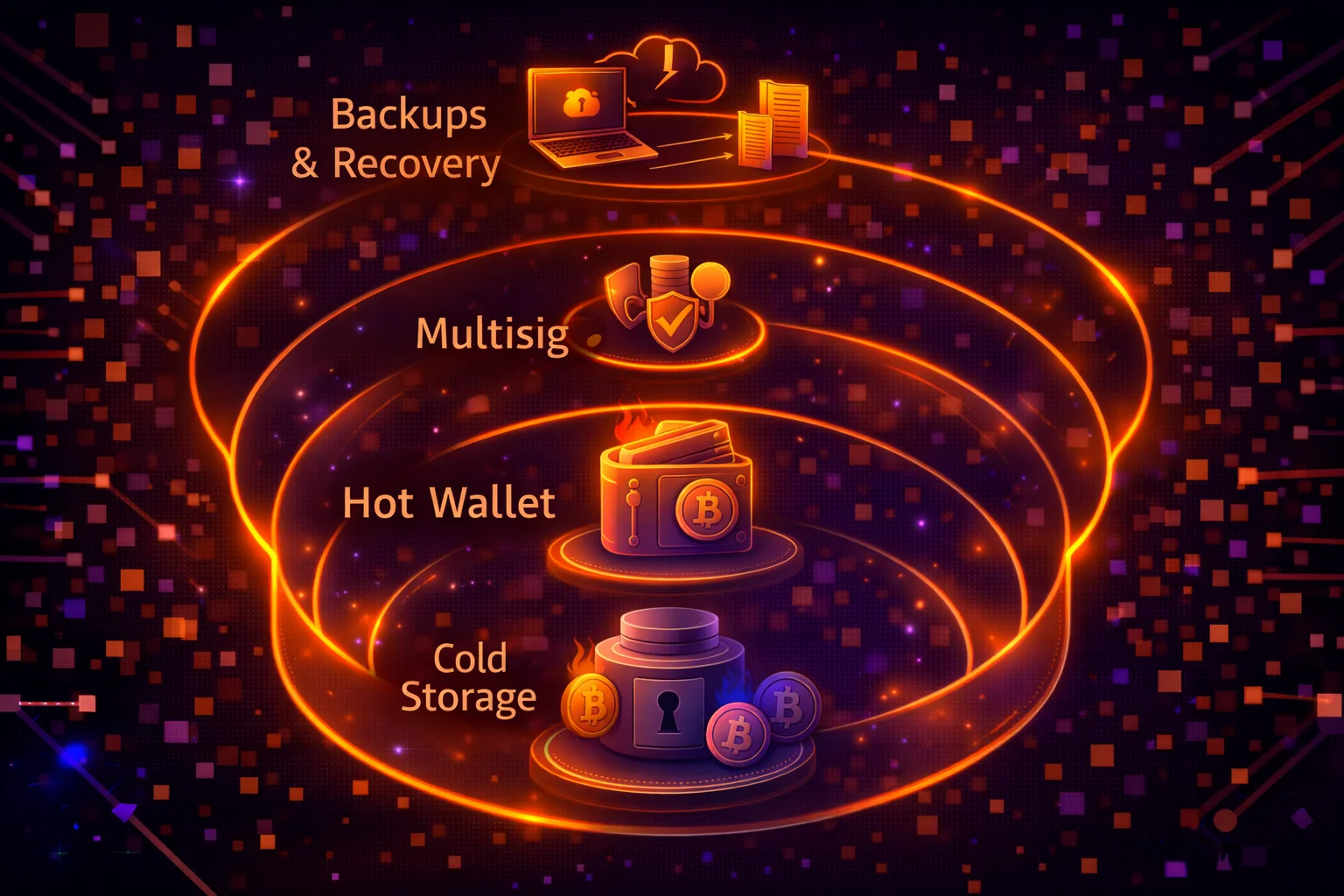
Key concepts:
- cryptographic keys: Secret numbers that control your cryptocurrency
- Public Keys: Derived from wallet keys, used to receive funds
- Wallet Addresses: Public identifiers for receiving cryptocurrency
- Seed Phrases: Human-readable backup of access keys
- Wallet Software: Applications that manage keys and transactions
The Security Spectrum
Wallet security exists on a spectrum between convenience and security. The most secure solutions are often the least convenient, while the most convenient options typically sacrifice some security. Understanding this trade-off is crucial for choosing the right storage method.
Security levels from lowest to highest:
- Exchange custody (lowest security, highest convenience)
- Hot wallets (mobile/desktop apps)
- air-gapped storage devices
- Air-gapped offline storage
- Multi-signature setups (highest security, lowest convenience)
Hot Storage vs offline storage
Hot Storage (Online Wallets)
Hot storage refers to cryptocurrency wallets that are connected to the internet. These include exchange wallets, mobile apps, desktop software, and web wallets. They offer convenience for frequent transactions but are more vulnerable to hacking attempts.
Hot storage advantages:
- Instant access for trading and transactions
- Easy to use for beginners
- Often free to set up and use
- Integrated with exchanges and DeFi protocols
- Automatic updates and backup features
Hot storage risks:
- Vulnerable to online attacks and malware
- Dependent on third-party security
- Risk of exchange hacks or shutdowns
- Potential for phishing attacks
- Less control over security keys
Offline Storage (Offline Wallets)
Offline storage keeps cryptographic keys completely offline, making them immune to online attacks. This includes crypto wallets, paper wallets, and air-gapped computers. Cold storage is the gold standard for long-term cryptocurrency security.
Offline storage advantages:
- Maximum security against online threats
- Complete control over wallet keys
- Protection from exchange failures
- Immune to malware and phishing
- Ideal for long-term holding
Offline storage challenges:
- Less convenient for frequent transactions
- Higher upfront costs for hardware
- Risk of physical loss or damage
- Requires technical knowledge
- Backup and recovery complexity
cold storage devices: The Gold Standard
How crypto wallets Work
hardware devices are specialised devices designed to store cryptocurrency cryptographic keys offline while still allowing secure transactions. They use secure elements and cryptographic chips to protect keys even when connected to potentially compromised computers.
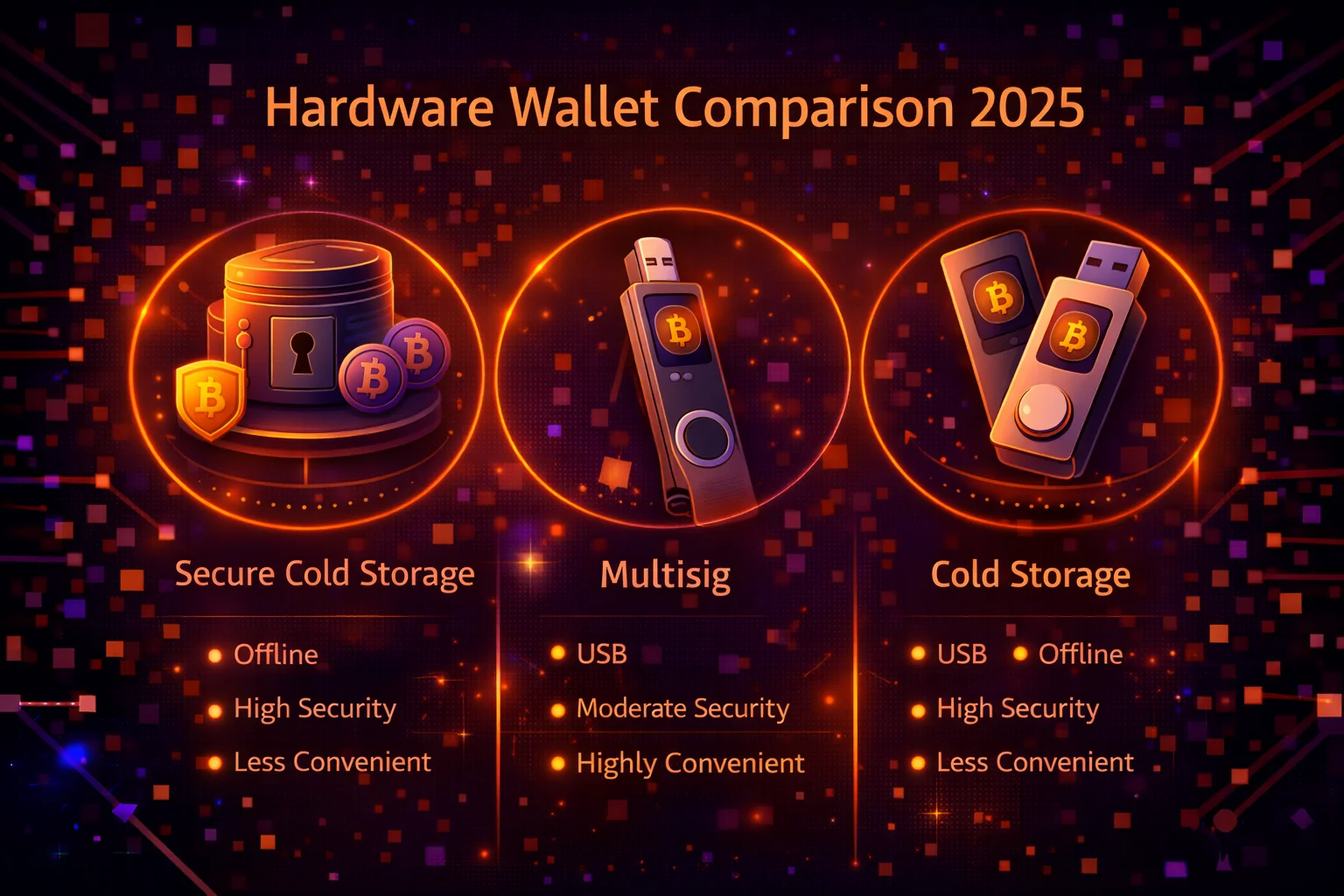
Key features:
- wallet keys never leave the device
- Secure element chips for key storage
- Physical buttons for transaction confirmation
- PIN protection and encryption
- Recovery wallet backup
Top crypto wallet Options
Ledger Series
Ledger offers the most popular security wallets with strong security features and broad cryptocurrency support. The Nano S Plus and Nano X are excellent choices for different needs and budgets.
Trezor Devices
Trezor pioneered cold storage devices and continues to offer open-source solutions with excellent security. The Model One and Model T provide different feature sets and price points.
Alternative Options
- BitBox02: Swiss-made with strong privacy focus
- ColdCard: Bitcoin-only with advanced security features
- KeepKey: Large screen with ShapeShift integration
- Tangem: Card-format hardware device for portability
Security wallet Best Practices
- Buy directly from manufacturers, never second-hand
- Verify device authenticity upon receipt
- Generate new seed phrases, never use pre-generated ones
- Store seed phrases securely offline
- Use strong PINs and enable additional security features
- Keep firmware updated
- Test recovery process with small amounts
Software Wallets: Balancing Security and Convenience
Desktop Wallets
Desktop wallets offer more security than web wallets while maintaining reasonable convenience. They store access keys on your computer, giving you full control over your funds.
Recommended desktop wallets:
- Electrum: Bitcoin-focused with advanced features
- Exodus: Multi-currency with user-friendly interface
- Atomic Wallet: Supports many cryptocurrencies and staking
- Wasabi: Privacy-focused Bitcoin wallet
Mobile Wallets
Mobile wallets provide the ultimate convenience for daily cryptocurrency use. Modern smartphones offer hardware security features that can protect security keys from malware.
Top mobile wallet options:
- Trust Wallet: Multi-chain support with DeFi integration
- MetaMask: Ethereum and EVM-compatible chains
- Coinbase Wallet: User-friendly with broad support
- BlueWallet: Bitcoin and Lightning Network focus
Web Wallets
Web wallets run in browsers and offer maximum convenience, but require careful security considerations. They're best used for small amounts and frequent transactions.
Security tips for web wallets:
- Use only reputable, well-established services
- Enable all available security features
- Use strong, unique passwords
- Enable two-factor authentication
- Keep browser and extensions updated
- Be cautious of phishing attempts
Multi-Signature Security
Understanding Multi-Sig
Multi-signature (multi-sig) wallets require multiple cryptographic keys to authorise transactions, providing enhanced security through distributed control. This eliminates single points of failure and can protect against both external attacks and internal mistakes.
Common multi-sig configurations:
- 2-of-3: Requires 2 signatures from 3 possible keys
- 3-of-5: Requires 3 signatures from 5 possible keys
- 2-of-2: Requires both signatures (shared custody)
- Custom: Any M-of-N configuration as needed
Multi-Sig Use Cases
Personal Security
- Protect against single device failure or loss
- Distribute keys across multiple locations
- Add family member or trusted friend as co-signer
- Create inheritance planning solutions
Business Applications
- Require multiple executives for large transactions
- Separate operational and security responsibilities
- Create audit trails for corporate governance
- Protect against insider threats
Multi-Sig Wallet Options
- Gnosis Safe: Popular Ethereum multi-sig solution
- Casa: User-friendly multi-sig service
- Unchained Capital: Bitcoin-focused multi-sig
- BitGo: Enterprise multi-sig solutions
- Electrum: DIY multi-sig wallet creation
Advanced Security Practices
Recovery phrase Security
Your mnemonic phrase is the master key to your cryptocurrency. Proper backup words security is crucial for long-term asset protection and recovery capabilities.
recovery phrase best practices:
- Never store seed phrases digitally or online
- Use metal backup plates for fire/water resistance
- Consider splitting phrases across multiple locations
- Use passphrases for additional security layers
- Test recovery process regularly
- Never share seed phrases with anyone
Operational Security (OpSec)
Good operational security practices protect against social engineering, physical attacks, and other non-technical threats to your cryptocurrency holdings.
OpSec guidelines:
- Don't discuss cryptocurrency holdings publicly
- Use pseudonyms for crypto-related activities
- Avoid posting wallet addresses or transaction details
- Be cautious of social media and public Wi-Fi
- Use VPNs for additional privacy
- Regularly update all software and devices
Estate Planning and Inheritance
Planning for cryptocurrency inheritance ensures that beneficiaries can recover your assets while maintaining security during your lifetime.
Inheritance planning options:
- Multi-sig wallets with trusted family members
- Time-locked transactions for automatic inheritance
- Professional custody services with inheritance features
- Detailed instructions stored with legal documents
- Regular updates to reflect portfolio changes
Storage Strategies by Portfolio Size
Small Portfolio ($100 - $1,000)
For smaller cryptocurrency holdings, focus on learning proper security practices while keeping costs reasonable. Mobile wallets and reputable exchanges can be appropriate.
Recommended approach:
- Use a reputable mobile wallet for small amounts
- Keep larger amounts on established exchanges
- Enable all available security features
- Learn about crypto wallets for future use
- Practice with mnemonic phrase backups
Medium Portfolio ($1,000 - $10,000)
Medium-sized portfolios justify investing in hardware devices and more sophisticated security practices. This is where the security-convenience trade-off becomes important.
Recommended approach:
- cold storage device for long-term holdings
- Hot wallet for trading and DeFi activities
- Proper backup words backup with metal plates
- Consider basic multi-sig setups
- Regular security audits and updates
Large Portfolio ($10,000+)
Large cryptocurrency portfolios require institutional-grade security practices. Consider professional custody services, advanced multi-sig setups, and comprehensive estate planning.
Recommended approach:
- Multi-sig wallets for primary holdings
- Geographic distribution of keys
- Professional custody for portion of assets
- Comprehensive insurance coverage
- Detailed inheritance and estate planning
- Regular security audits by professionals
2025 Crypto Storage Trends and Innovations
Institutional-Grade Security for Retail
2025 has seen the democratisation of institutional-grade security features for retail users. Multi-party computation (MPC) wallets, threshold signatures, and hardware security modules (HSMs) are becoming accessible to individual investors.
Biometric Authentication Integration
Modern security wallets now integrate biometric authentication, including fingerprint scanners and facial recognition. This adds convenience while maintaining security, reducing reliance on PINs and passwords.
Quantum-Resistant Cryptography
With quantum computing advances, cryptocurrency storage solutions are implementing post-quantum cryptographic algorithms. Leading crypto wallet manufacturers have begun rolling out quantum-resistant firmware updates.
Social Recovery Mechanisms
Social recovery allows trusted contacts to help recover wallets without exposing cryptographic keys. This innovation bridges the gap between security and usability, making crypto storage more accessible to mainstream users.
| Innovation | Availability | Security Impact | Usability Impact |
|---|---|---|---|
| MPC Wallets | Limited (2025) | High | Medium |
| Biometric Auth | Widespread | Medium | High |
| Quantum-Resistant | Early Adoption | Critical (Future) | Low |
| Social Recovery | Growing | Medium | High |
Common Storage Mistakes to Avoid
Critical Security Errors
- Storing seed phrases digitally: Never save seed phrases in photos, documents, or cloud storage
- Using exchange wallets long-term: Exchanges are for trading, not storage
- Sharing wallet keys: Never give anyone access to your access keys or seed phrases
- Skipping backups: Always create and test recovery backups
- Using public Wi-Fi: Avoid accessing wallets on unsecured networks
Operational Mistakes
- Not testing recovery: Test wallet recovery with small amounts first
- Ignoring updates: Keep wallet software and firmware updated
- Poor password hygiene: Use strong, unique passwords for all accounts
- Mixing hot and offline storage: Keep clear separation between trading and holding funds
- Overcomplicating security: Start simple and gradually increase security measures
Recovery and Backup Errors
- Not verifying wallet backup accuracy during setup
- Storing all backups in the same location
- Using low-quality materials for physical backups
- Forgetting passphrases or additional security layers
- Not updating backups when adding new wallets
Professional Storage Implementation and Best Practices
Comprehensive Security Assessment and Planning
Professional cryptocurrency storage implementation begins with a thorough security assessment that evaluates current holdings, risk tolerance, technical expertise, and operational requirements to develop customised storage strategies. This systematic approach ensures that security measures align with individual needs while providing scalable frameworks for portfolio growth and evolving security requirements through comprehensive planning and professional implementation procedures.
Security assessment encompasses threat modelling, risk analysis, and operational evaluation that identifies potential vulnerabilities and appropriate countermeasures for specific storage scenarios. Professional assessment includes evaluation of physical security, operational security, technical security, and recovery procedures that ensure comprehensive protection while maintaining operational efficiency and accessibility for legitimate cryptocurrency operations and investment activities.
Multi-Layered Security Architecture Implementation
Advanced cryptocurrency storage requires sophisticated multi-layered security architectures that combine multiple security technologies and operational procedures to create comprehensive protection against various threat vectors. Professional implementation includes hardware security modules, multi-signature configurations, geographic distribution, and comprehensive backup procedures that provide institutional-level security while maintaining operational flexibility and accessibility for authorized users and legitimate cryptocurrency operations.
Multi-layered security encompasses physical security measures, technical security controls, operational security procedures, and recovery mechanisms that work together to provide comprehensive protection against both external threats and internal risks. Professional security architecture includes redundant systems, comprehensive monitoring, and systematic testing procedures that ensure ongoing security effectiveness while maintaining operational capabilities and user accessibility through systematic security implementation and professional security management designed for optimal cryptocurrency storage protection.
Enterprise and Institutional Storage Solutions
Institutional Custody Services
Large organisations and institutions require specialised digital asset storage solutions that provide institutional-grade security, compliance features, and insurance coverage. These services offer professional custody with multi-signature security, hardware security modules (HSMs), and comprehensive audit trails.
Leading institutional custody providers include Coinbase Custody, BitGo, and Fidelity Digital Assets, each offering different features like insurance coverage, regulatory compliance, and integration with traditional financial systems. These services typically require minimum balances and charge percentage-based fees for their enhanced security and compliance features.
Corporate Treasury Management
Companies holding cryptocurrency as treasury assets need robust storage solutions that integrate with existing financial controls and reporting systems. Corporate storage strategies often involve multiple custody providers, geographic distribution, and sophisticated access controls that align with corporate governance requirements.
Corporate crypto storage must address regulatory compliance, accounting standards, and fiduciary responsibilities while maintaining operational efficiency. Many companies use a combination of self-custody and third-party custody solutions to balance security, compliance, and operational requirements.
Multi-Jurisdictional Considerations
International organisations must navigate varying regulatory requirements across different jurisdictions when implementing digital asset storage solutions. Different countries have distinct rules regarding custody, reporting, and operational requirements that affect storage strategy decisions.
Cross-border storage strategies require understanding local regulations, tax implications, and compliance requirements in each jurisdiction where cryptocurrency is held. Professional legal and compliance advice is essential for organisations operating across multiple regulatory environments.
Regulatory Compliance and Legal Considerations
Know Your Customer (KYC) and Anti-Money Laundering (AML)
Crypto storage providers, particularly custodial services, must comply with KYC and AML regulations that require customer identification, transaction monitoring, and suspicious activity reporting. These requirements affect how users can access and use various storage solutions.
Self-custody solutions generally have fewer regulatory requirements, but users must still comply with tax reporting obligations and may face restrictions when interacting with regulated financial services. Understanding these requirements helps in choosing appropriate storage solutions that align with compliance needs.
Tax Implications of Storage Choices
Different storage methods can have varying tax implications depending on jurisdiction and specific circumstances. Custodial services may provide tax reporting assistance, while self-custody requires users to maintain detailed records for tax compliance purposes.
Storage decisions can affect tax treatment of cryptocurrency transactions, particularly regarding staking rewards, lending activities, and cross-border transfers. Professional tax advice is recommended for significant cryptocurrency holdings to ensure compliance and optimise tax efficiency.
Insurance and Legal Protection
Insurance coverage varies significantly between different storage methods, with custodial services often providing comprehensive coverage while self-custody relies on personal insurance or risk acceptance. Understanding insurance options helps in making informed storage decisions based on risk tolerance and asset values.
Legal protections for cryptocurrency vary by jurisdiction and storage method, with custodial services generally providing stronger legal recourse in case of theft or loss. Self-custody provides complete control but also complete responsibility for security and recovery.
Future Storage Technologies and Innovations
Quantum-Resistant Cryptography
As quantum computing advances, digital asset storage systems must evolve to resist quantum attacks that could compromise current cryptographic methods. Post-quantum cryptography research is developing new algorithms that will protect cryptocurrency storage against future quantum threats.
The transition to quantum-resistant storage will require updates to wallet software, hardware devices, and blockchain protocols. Users should stay informed about quantum-resistant developments and be prepared to migrate to new storage technologies as they become available and necessary.
Biometric Authentication Integration
Advanced biometric authentication methods are being integrated into crypto storage solutions to provide enhanced security while maintaining user convenience. These technologies include fingerprint scanning, facial recognition, and voice authentication that can replace or supplement traditional password-based security.
Biometric storage solutions must balance security with privacy concerns, ensuring that biometric data is stored securely and cannot be compromised or misused. The integration of biometrics with cold storage devices and mobile applications is making crypto storage more accessible to mainstream users.
decentralised Storage Networks
Emerging decentralised storage networks are exploring new approaches to digital asset storage that distribute risk across multiple nodes while maintaining user control. These systems could provide enhanced security through redundancy while reducing reliance on centralised custody providers.
Decentralised storage innovations include threshold cryptography, distributed key generation, and social recovery mechanisms that could revolutionise how users store and recover cryptocurrency. These technologies are still experimental but show promise for improving storage security and accessibility.
Integration with Traditional Finance
The future of crypto storage will likely involve deeper integration with traditional financial systems, enabling seamless movement between cryptocurrency and traditional assets while maintaining appropriate security and compliance standards.
This integration will require new storage solutions that can bridge the gap between cryptocurrency and traditional finance while meeting the security and regulatory requirements of both systems. The development of central bank digital currencies (CBDCs) will also influence how crypto storage evolves.
Advanced Storage Strategies and Professional Implementation
Multi-Signature Security Architecture
Professional cryptocurrency storage requires sophisticated multi-signature implementations that distribute key control across multiple parties, devices, and geographic locations to eliminate single points of failure while maintaining operational efficiency. Advanced multi-sig configurations include time-locked transactions, hierarchical access controls, and sophisticated key management protocols that provide institutional-level security for high-value cryptocurrency holdings through systematic risk distribution and comprehensive access management frameworks.
Enterprise multi-signature systems encompass hardware security modules, geographically distributed key storage, and comprehensive audit trails that ensure maximum security while maintaining operational flexibility for complex organisational structures. Professional implementations include automated compliance monitoring, sophisticated access controls, and comprehensive backup procedures that protect against both external threats and internal risks through systematic security architecture and operational procedures designed for institutional cryptocurrency storage and treasury management.
Cold Storage Infrastructure and Air-Gapped Systems
Professional cold storage requires comprehensive air-gapped systems that maintain complete isolation from internet-connected networks while providing secure transaction signing capabilities through sophisticated offline procedures. Advanced cold storage implementations include dedicated hardware systems, comprehensive physical security measures, and sophisticated key generation procedures that ensure maximum security while maintaining operational efficiency for large-scale cryptocurrency storage and institutional treasury management operations.
Air-gapped security systems encompass specialised hardware configurations, comprehensive electromagnetic shielding, and sophisticated operational procedures that prevent any form of electronic communication while maintaining the ability to securely sign transactions and manage cryptocurrency holdings. Professional air-gapped implementations include comprehensive verification procedures, sophisticated backup systems, and advanced monitoring capabilities that ensure ongoing security effectiveness while maintaining operational capabilities for institutional cryptocurrency storage and professional treasury management.
Hierarchical Deterministic Wallet Architecture
Advanced cryptocurrency storage utilises hierarchical deterministic (HD) wallet architectures that enable sophisticated key management, comprehensive address generation, and systematic organisation of cryptocurrency holdings across multiple accounts and purposes. Professional HD implementations include comprehensive derivation path strategies, sophisticated account segregation, and advanced privacy features that enable efficient cryptocurrency management while maintaining security and operational organisation through systematic wallet architecture and professional key management procedures.
HD wallet optimisation encompasses comprehensive seed phrase management, sophisticated derivation strategies, and advanced backup procedures that ensure reliable access to cryptocurrency holdings while maintaining security and privacy standards. Professional HD implementations include automated address generation, comprehensive transaction organisation, and sophisticated privacy enhancement techniques that enable efficient cryptocurrency operations while maintaining appropriate security controls and operational excellence through systematic wallet management and professional implementation procedures.
Enterprise Custody Solutions and Institutional Storage
Institutional cryptocurrency storage requires comprehensive custody solutions that meet fiduciary standards, regulatory compliance requirements, and operational efficiency needs while maintaining the highest levels of security and risk management. Professional custody implementations include multi-signature technology, comprehensive insurance coverage, and sophisticated access controls that provide institutional-level protection while enabling efficient cryptocurrency operations and treasury management through professional custody services and institutional security frameworks.
Enterprise custody solutions encompass comprehensive compliance monitoring, sophisticated audit capabilities, and advanced reporting systems that meet institutional requirements while maintaining operational flexibility and security effectiveness. Professional custody services include dedicated relationship management, comprehensive risk assessment, and sophisticated operational procedures that ensure optimal custody outcomes while maintaining appropriate fiduciary standards and regulatory compliance through institutional custody excellence and professional security management designed for enterprise cryptocurrency storage and institutional treasury operations.
Disaster Recovery and Business Continuity Planning
Professional cryptocurrency storage requires comprehensive disaster recovery frameworks that address various failure scenarios while maintaining access to cryptocurrency holdings and operational capabilities under adverse conditions. Advanced disaster recovery includes geographically distributed backup systems, comprehensive recovery procedures, and sophisticated testing protocols that ensure reliable access to cryptocurrency assets while maintaining security standards and operational continuity through systematic disaster recovery planning and professional implementation procedures.
Business continuity planning encompasses comprehensive risk assessment, systematic recovery procedures, and advanced monitoring systems that enable rapid response to various disaster scenarios while maintaining cryptocurrency access and operational capabilities. Professional continuity planning includes comprehensive documentation, systematic testing procedures, and advanced recovery protocols that ensure business operations can continue under various adverse conditions while maintaining security standards and operational excellence through systematic disaster recovery and professional business continuity management designed for institutional cryptocurrency operations.
Regulatory Compliance and Legal Framework Integration
Professional cryptocurrency storage must address comprehensive regulatory requirements, legal obligations, and compliance frameworks that vary across jurisdictions while maintaining operational efficiency and security effectiveness. Advanced compliance implementations include systematic documentation procedures, comprehensive audit trails, and sophisticated reporting capabilities that ensure regulatory compliance while maintaining security standards and operational flexibility through professional compliance management and regulatory excellence designed for institutional cryptocurrency storage operations.
Legal framework integration encompasses comprehensive risk assessment, systematic compliance monitoring, and advanced documentation procedures that ensure appropriate legal protection while maintaining operational efficiency and security effectiveness. Professional legal integration includes comprehensive policy development, systematic training programs, and advanced monitoring systems that ensure ongoing compliance while maintaining security standards and operational excellence through systematic legal framework implementation and professional compliance management designed for institutional cryptocurrency storage and professional treasury operations that require comprehensive regulatory compliance and legal protection.
Technology Evolution and Future-Proofing Strategies
Professional cryptocurrency storage must adapt to emerging technologies, evolving security threats, and changing regulatory landscapes through systematic technology evaluation and strategic implementation planning. Advanced future-proofing includes comprehensive technology assessment, systematic upgrade procedures, and sophisticated integration strategies that ensure long-term storage security while maintaining compatibility with evolving cryptocurrency protocols and security standards through professional technology management and strategic implementation designed for institutional cryptocurrency storage excellence.
Technology evolution strategies encompass comprehensive research and development, systematic evaluation procedures, and advanced implementation planning that ensures successful adoption of emerging storage technologies while maintaining security effectiveness and operational continuity. Professional future-proofing includes comprehensive risk assessment, systematic testing procedures, and advanced optimisation strategies that ensure long-term storage success while adapting to changing technological and regulatory environments through systematic innovation and strategic technology management designed for institutional cryptocurrency storage and professional security excellence that supports long-term operational success and security effectiveness.
Storage Innovation
New storage solutions continue improving security and accessibility through advanced cryptographic methods and user-friendly interfaces that enhance protection. Modern cryptocurrency storage technologies incorporate multi-signature capabilities, hardware security modules, and biometric authentication systems that provide institutional-grade security for individual users and professional investors seeking enhanced asset protection through innovative storage solutions and comprehensive security frameworks.
Future Trends in Cryptocurrency Storage
The cryptocurrency storage landscape continues evolving with emerging technologies that promise enhanced security, improved user experience, and greater accessibility. Quantum-resistant cryptography development addresses long-term security concerns, while biometric authentication integration provides convenient yet secure access methods for everyday users.
Decentralised storage solutions and distributed key management systems offer alternatives to traditional single-point-of-failure approaches. These innovations enable social recovery mechanisms, threshold signatures, and programmable security policies that adapt to changing user needs and threat environments while maintaining the self-sovereign principles that define cryptocurrency ownership.
Integration with traditional financial infrastructure through regulated custody services and institutional-grade security solutions bridges the gap between cryptocurrency innovation and established financial practices. These developments enable broader adoption while maintaining the security standards required for institutional participation and regulatory compliance.
Mobile-first security solutions and hardware security module integration in consumer devices democratize access to enterprise-grade security features. These trends suggest that secure cryptocurrency storage will become increasingly accessible to mainstream users while maintaining the robust security properties required for long-term asset protection.
Artificial intelligence and machine learning applications in security monitoring provide proactive threat detection and automated response capabilities. These systems can identify unusual access patterns, detect potential security breaches, and implement protective measures before assets are compromised, representing a significant advancement in cryptocurrency security infrastructure.
Practical Implementation Guidelines
Cryptocurrency storage security requires a comprehensive understanding of wallet technologies, private key management, and backup procedures that protect digital assets from theft and loss. Effective storage strategies combine multiple security layers with practical accessibility to ensure long-term asset protection while maintaining convenient access for legitimate transactions.
Step-by-Step Execution Framework
Strategic storage implementation begins with comprehensive planning that includes wallet selection, backup creation, and access control procedures. Professional holders establish clear protocols for key management, backup verification, and recovery testing schedules that maintain consistency while allowing flexibility for storage upgrades and changing security conditions.
Security and Operational Procedures
Comprehensive storage security frameworks encompass multi-signature protection, hardware isolation, and secure backup procedures that protect against both technical failures and physical security breaches. Professional holders implement comprehensive operational security protocols including access verification procedures, backup integrity systems, and emergency recovery plans.
Performance Tracking and optimisation
Secure storage evaluation requires a systematic assessment of hardware wallets, multi-signature solutions, and custody options that protect cryptocurrency assets. Regular security audits enable risk mitigation and protocol updates while maintaining alignment with best practices and evolving threat landscapes.
Conclusion
Cryptocurrency storage security is not just about protecting your current holdings – it's about building a foundation for long-term financial sovereignty in the digital age. As we've explored throughout this comprehensive guide, the landscape of crypto storage has evolved from simple desktop wallets to sophisticated multi-layered security systems that rival traditional banking infrastructure.
The key to successful crypto storage lies in understanding that security is not a destination but a continuous journey. The threat landscape constantly evolves, new attack vectors emerge, and storage technologies advance. What remains constant is the need for vigilance, education, and adherence to proven security principles.
Essential Takeaways
Remember these fundamental principles as you implement your crypto storage strategy: never store large amounts on exchanges or hot wallets, always maintain multiple backups of your seed phrases in secure locations, use hardware wallets for significant holdings, implement multi-signature security for substantial portfolios, and stay informed about emerging threats and security best practices.
The investment in proper storage security – whether it's purchasing a hardware wallet, setting up a multi-signature system, or implementing enterprise-grade custody solutions – is minimal compared to the potential losses from inadequate security. In the crypto world, you are your own bank, and with that freedom comes the responsibility to protect your assets with the same diligence as any financial institution.
Looking forwards
As we move through 2025 and beyond, crypto storage will continue to evolve with innovations in hardware security, biometric authentication, quantum-resistant cryptography, and user experience improvements. However, the fundamental principles of private key management, secure backup procedures, and defence-in-depth strategies will remain the cornerstone of crypto security.
Whether you're securing your first Bitcoin purchase or managing a multi-million dollar portfolio, the strategies and practices outlined in this guide provide a solid foundation for protecting your digital assets. Start with the basics, gradually implement more advanced security measures as your holdings grow, and never stop learning about new developments in crypto security.
Your crypto storage strategy should evolve with your needs, risk tolerance, and the changing technological landscape. By following the principles and practices outlined in this guide, you'll be well-equipped to navigate the challenges and opportunities of cryptocurrency storage in 2025 and beyond.
Sources & References
Frequently Asked Questions
- What's the difference between hot and cold storage?
- Hot storage refers to wallets connected to the internet for easy access, while cold storage keeps private keys offline for maximum security.
- Are hardware wallets worth it for small amounts?
- Hardware wallets are recommended for any amount you can't afford to lose, typically $500+ in crypto assets, due to superior security.
- Can I lose my crypto if my hardware device breaks?
- No, as long as you have your recovery phrase backed up, you can recover your funds in any compatible wallet, even if the hardware device is damaged.
- Is it safe to keep crypto on exchanges?
- Exchanges are convenient for trading but not recommended for long-term storage due to hacking risks and lack of private key control.
- What happens if I forget my recovery phrase?
- Without your mnemonic phrase or private keys, your cryptocurrency is permanently lost. This is why secure backup storage is crucial.
- Should I use a passphrase with my backup words?
- Yes, adding a passphrase (25th word) provides an additional security layer. Even if someone finds your wallet backup, they can't access funds without the passphrase.
- How often should I update my wallet software?
- Update wallet software and hardware firmware as soon as updates are available. Security patches and new features are regularly released to address vulnerabilities.
- Can I use the same seed phrase for multiple wallets?
- Whilst technically possible, it's not recommended for security reasons. Use separate seed phrases for different purposes (e.g., trading vs. long-term storage).
- What's the best way to test my backup recovery?
- Create a test wallet with a small amount, write down the seed phrase, wipe the wallet, and restore it. This ensures your backup process works correctly.
- Are paper wallets still secure in 2025?
- Paper wallets are secure for offline storage but have usability issues. Hardware wallets provide better security with easier transaction signing and backup management.
← Back to Crypto Investing Blog Index
Financial Disclaimer
This content is not financial advice. All information provided is for educational purposes only. Cryptocurrency investments carry significant investment risk, and past performance does not guarantee future results. Always do your own research and consult a qualified financial advisor before making investment decisions.