Tangem vs Ledger 2025 Comparison
Cold storage is essential for crypto security - but which solution works best for you in 2025? We compare Tangem and Ledger across all key factors to help you make an informed decision about your crypto storage needs.
Hardware devices have become the gold standard for cryptocurrency security, but the market offers two very different approaches. Tangem revolutionises cold storage with its card-based design, while Ledger continues to dominate with traditional USB-style devices. Both offer excellent security, but they serve different user needs plus preferences.
Introduction
The cryptocurrency hardware wallet market has evolved significantly since its inception, with two distinct approaches emerging as leaders in cold storage security: Tangem's innovative card-based design and Ledger's traditional USB-style devices. Both solutions address the fundamental need for secure cryptocurrency storage by keeping private keys offline, but they represent fundamentally different philosophies in user experience, security implementation, and practical usability. Understanding these differences is crucial for making an informed decision about protecting your digital assets in 2025's increasingly complex cryptocurrency landscape.
Tangem has revolutionised the hardware wallet space with its credit card-sized devices that eliminate the need for screens, buttons, or USB connections, instead relying on NFC technology and smartphone integration for all operations. This approach offers unprecedented portability and durability while maintaining bank-grade security through certified secure elements and biometric authentication. The card-based design appeals to users who prioritise convenience, discretion, and simplicity without compromising on security standards that meet institutional requirements.
Ledger, as the established market leader, continues to dominate with its comprehensive ecosystem of USB-connected devices that feature physical screens, buttons, and extensive cryptocurrency support. The company's approach emphasises user control through physical confirmation of transactions, extensive third-party integrations, and a mature software ecosystem that supports thousands of cryptocurrencies and DeFi applications. Ledger's devices appeal to users who prefer traditional hardware interfaces and require extensive cryptocurrency compatibility for complex portfolio management.
This comprehensive comparison examines every aspect of both hardware wallet solutions, from security architecture and supported cryptocurrencies to user experience, pricing, and long-term value proposition. We analyse real-world usage scenarios, evaluate the strengths and limitations of each approach, and provide practical guidance for choosing the hardware wallet that best aligns with your security needs, technical preferences, and cryptocurrency management requirements in 2025.
The choice between Tangem and Ledger extends beyond simple feature comparisons to encompass different security models, user experience philosophies, and practical considerations, including price, durability, and long-term support. This comprehensive comparison examines every aspect of both solutions, from security architecture and supported cryptocurrencies to user experience and customer support, providing the detailed analysis needed to choose the optimal hardware wallet for your specific needs and preferences in the evolving cryptocurrency ecosystem of 2025.
The hardware wallet market in 2025 has matured considerably, with both Tangem and Ledger implementing advanced security measures that meet institutional standards while serving retail users. The regulatory environment has also evolved, with both companies maintaining compliance with international security standards and data protection regulations. Understanding how each approach addresses modern security challenges, from sophisticated phishing attacks to supply chain vulnerabilities, is essential for making an informed decision about protecting your cryptocurrency investments.
This detailed comparison will help you understand which hardware wallet solution aligns best with your security requirements, technical expertise, and usage patterns, ensuring you choose a device that not only protects your assets today but continues to meet your needs as the cryptocurrency ecosystem evolves and your investment strategy becomes more sophisticated.
Both Tangem and Ledger have established themselves as trusted brands in the cryptocurrency security space, with millions of users worldwide relying on their solutions to protect digital assets worth billions of dollars. The competition between these two approaches has driven innovation in hardware wallet design, resulting in increasingly sophisticated security features, improved user experiences, and broader cryptocurrency support that benefits the entire ecosystem.
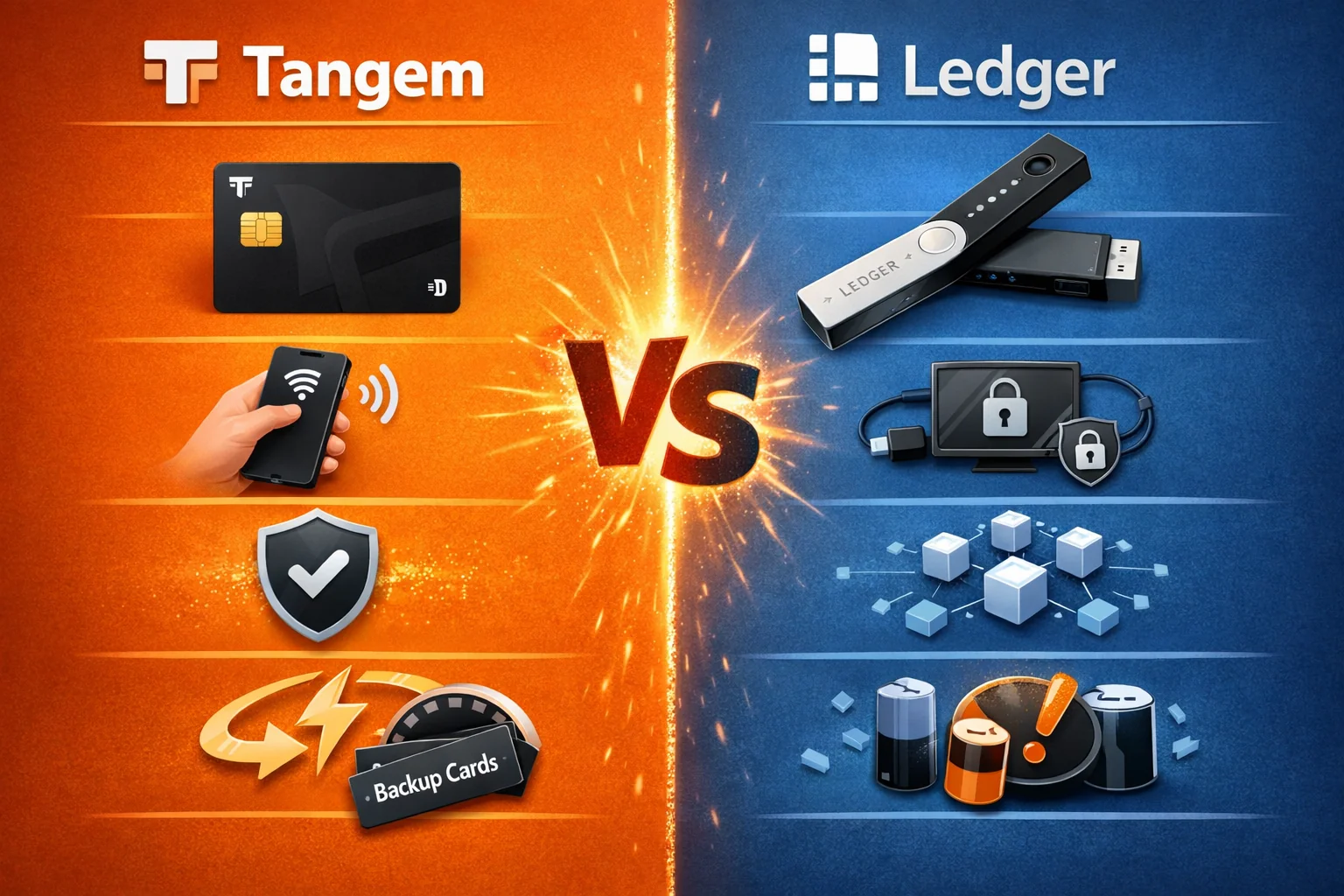
Product Overview
Tangem Device
Tangem is a revolutionary smart card device that looks plus feels like a credit card. It uses NFC to communicate with your smartphone, eliminating the need for cables, apps, or complex setup. The private key is generated plus stored directly on the card's secure element using advanced cryptographic algorithms, making it impossible to extract or duplicate.
Key Features:
- Credit card form factor with NFC connectivity and ECDSA signature support
- No seed phrase required - uses backup card system with multi-signature architecture
- Waterproof and virtually indestructible with tamper-resistant design
- Works with iOS and Android via NFC for DeFi protocol interactions
- Supports major cryptocurrencies, EVM tokens, and smart contract execution
- Compatible with Web3 applications and decentralised exchanges (DEXs)
- Supports staking, yield farming, and liquidity provision on supported networks
Ledger Device
Ledger is the market leader in hardware devices, offering USB-connected solutions with secure elements plus comprehensive software support. Ledger devices employ a traditional approach, utilising BIP39 seed phrases for recovery, plus offer the most extensive cryptocurrency support in the industry, including advanced DeFi protocols plus Layer 2 solutions.
Key Features:
- USB connectivity with secure element chip and HSM-grade security
- BIP39 24-word recovery phrase system with HD derivation
- Comprehensive Ledger Live software with portfolio analytics plus yield tracking
- Supports 5,000+ cryptocurrencies, tokens, NFTs, plus DeFi protocols
- Extensive DeFi capabilities: AMMs, lending protocols, yield farming, and governance
- Native staking for PoS networks plus liquid staking derivatives
- Multiple device options with different security levels plus features
- WalletConnect integration for seamless dApp interactions
Quick Comparison Table
| Feature | Tangem | Ledger |
|---|---|---|
| Form Factor | Credit card size | USB device |
| Price Range | $40-50 | $79-149+ |
| Setup Time | 2 minutes | 15-30 minutes |
| Supported Assets | 1,000+ tokens | 5,000+ tokens |
| Recovery Method | Backup cards | 24-word seed phrase |
| DeFi Support | Limited | Extensive |
Security Comparison
Tangem Security Model
Tangem uses a unique security approach where the private key is generated directly on the card's secure element using true random number generation (TRNG) and never leaves the device. The card uses the same secure element technology found in payment cards and passports, and is certified to the Common Criteria EAL6+ standard with advanced cryptographic protection.
Security Features:
- Secure Element Comparison: Tangem card chips vs Ledger security modules
- No Seed Phrase: Eliminates BIP39 mnemonic risks and social engineering attacks
- Multi-Signature Backup: Uses 2-3 backup cards with threshold signature schemes
- Tamper Resistance: Physical attacks trigger secure deletion of cryptographic keys
- Immutable Firmware: Reduces attack surface and prevents malicious updates
- ECDSA Signatures: Industry-standard elliptic curve cryptography for transaction signing
- Anti-Cloning Protection: Unique chip identifiers prevent card duplication
Ledger Security Model
Ledger solutions use a dual-chip architecture with a secure element for cryptographic key storage plus a general-purpose MCU for communication plus user interface. The BIP39 24-word recovery phrase allows for hierarchical deterministic (HD) restoration on any compatible device using standardised derivation paths.
Security Features:
- Secure Element: ST33 or CC EAL5+ certified chips with hardware security modules
- PIN Protection: Device locks after failed attempts with exponential backoff
- BIP39 Recovery: Industry-standard mnemonic phrases with PBKDF2 key derivation
- HD Support: BIP32/BIP44 hierarchical deterministic key generation
- Open Source Verification: Apps and firmware components auditable by security researchers
- Secure Boot: Cryptographic verification of firmware integrity
- Side-Channel Resistance: Protection against timing and power analysis attacks
- Regular Security Updates: Patches for emerging threats and protocol upgrades
Security Verdict
Both devices offer excellent security, but with different trade-offs. Tangem eliminates seed-phrase risks but requires careful management of backup cards. Ledger offers more flexibility with recovery phrases but requires secure storage of the seed phrase. For most users, both approaches are equally secure when used correctly.
Ease of Use
Tangem User Experience
Tangem excels in simplicity and speed. The setup process takes just 2-3 minutes, and daily use is as simple as tapping the card on your phone. There's no need to install desktop software or remember PINs.
Setup Process:
- Download Tangem app on your smartphone
- Tap card to phone to activate
- Set up backup cards (recommended)
- Start using immediately
Daily Usage:
- Tap card to phone to access wallet
- Confirm transactions with another tap
- No cables or desktop software required
- Works anywhere with NFC-enabled phone
Ledger User Experience
Ledger offers more features but requires more setup time and technical knowledge. The Ledger Live software provides comprehensive portfolio management and staking options.
Setup Process:
- Install Ledger Live on a computer or mobile
- Connect device via USB or Bluetooth
- Generate and securely store 24-word seed phrase
- Set up PIN and install cryptocurrency apps
- Verify addresses and start using
Daily Usage:
- Connect device to computer or phone
- Enter PIN to unlock device
- Navigate menus to confirm transactions
- Use Ledger Live for portfolio management
For comprehensive hardware wallet comparisons and security guides, explore our hardware wallet comparison.
Usability Verdict
Tangem wins for simplicity and speed, making it ideal for beginners and mobile-first users. Ledger offers more control and features but requires more technical knowledge and setup time.
Features and Capabilities
Cryptocurrency Support
Tangem: Supports 1,000+ cryptocurrencies, including Bitcoin (BTC), Ethereum (ETH), and most EVM-compatible tokens. Major supported networks include Ethereum mainnet, Polygon (MATIC), Binance Smart Chain (BSC), Avalanche (AVAX), Fantom (FTM), and other Layer 1 blockchains with smart contract functionality.
Ledger: Supports 5,000+ cryptocurrencies across 100+ blockchains, including Layer 1 networks, Layer 2 scaling solutions, and sidechains. Comprehensive support for Bitcoin, Ethereum, Cardano (ADA), Solana (SOL), Polkadot (DOT), Cosmos (ATOM), and emerging DeFi protocols on various networks.
DeFi and Staking
Tangem: Limited DeFi support through WalletConnect integration with major protocols like Uniswap, SushiSwap, and Compound. Native staking available for Proof-of-Stake networks like Cardano (ADA), Tezos (XTZ), and Cosmos (ATOM) through the Tangem app with automatic reward distribution.
Ledger: Extensive DeFi ecosystem support through Ledger Live plus WalletConnect integrations. Native staking for 15+ PoS cryptocurrencies with real-time yield tracking, plus comprehensive support for AMMs, lending protocols, yield farming strategies, governance voting, plus liquid staking derivatives like stETH plus rETH.
NFT Support
Tangem: Basic NFT viewing and transfer capabilities through the mobile app.
Ledger: Comprehensive NFT support with viewing, sending, and receiving capabilities in Ledger Live. Works with OpenSea and other major NFT marketplaces.
Mobile vs Desktop
Tangem: Mobile-only solution that works exclusively with smartphones via NFC. No desktop software available.
Ledger: Works with both desktop (Ledger Live) and mobile applications. Nano X offers Bluetooth connectivity for mobile use.
Pricing and Value
Tangem Pricing
- Tangem Device (2-card set): $49.90
- Tangem Device (3-card set): $69.90
- No additional software costs
- Free mobile app
Ledger Pricing
- Ledger Nano S Plus: $79
- Ledger Nano X: $149
- Ledger Stax: $279
- Free Ledger Live software
- Optional Ledger Recover service: $9.99/month
Value Analysis
Tangem offers excellent value for users who want simple, secure storage without advanced features. The 2-card set provides redundancy at a lower cost than most devices.
Ledger devices cost more upfront but offer significantly more features, cryptocurrency support, and ecosystem integrations. For active traders and DeFi users, the additional cost is justified by the expanded capabilities.
Pros and Cons
Tangem Advantages
- Extremely simple setup and daily use
- No seed phrase to manage or lose
- Highly portable credit card form factor
- Waterproof and durable design
- Lower cost than most devices
- Works with any NFC-enabled smartphone
- No cables or desktop software required
Tangem Disadvantages
- Limited cryptocurrency support compared to Ledger
- Minimal DeFi and staking capabilities
- Mobile-only solution (no desktop support)
- Backup cards required for recovery
- Newer technology with smaller ecosystem
- No firmware updates or new features
Ledger Advantages
- Supports 5,000+ cryptocurrencies
- Extensive DeFi and staking capabilities
- Comprehensive Ledger Live software
- Industry-standard recovery phrase system
- Regular firmware updates and new features
- Strong ecosystem and third-party integrations
- Multiple device options for different needs
Ledger Disadvantages
- More complex setup and daily use
- Requires secure seed phrase storage
- Higher cost, especially for advanced models
- Requires cables or Bluetooth connectivity
- Past data breaches (customer information, not funds)
- Steeper learning curve for beginners
Best Use Cases
Choose Tangem If You:
- Want the simplest possible crypto storage solution
- Primarily use mobile devices and avoid desktop software
- Hold major cryptocurrencies (BTC, ETH, ADA, SOL)
- Prefer not to manage seed phrases
- Value portability and durability
- Are new to cryptocurrency and want minimal complexity
- Need a backup device for travel or daily spending
Choose Ledger If You:
- Hold diverse cryptocurrency portfolios
- Actively use DeFi protocols and staking
- Want comprehensive portfolio management tools
- Prefer desktop software and advanced features
- Need support for obscure or new cryptocurrencies
- Want regular firmware updates and new features
- Are comfortable with traditional seed phrase recovery
Security Best Practices
Tangem Security Tips
- Always order backup cards: Without backups, losing your card means losing your crypto
- Store backup cards separately: Keep them in different secure locations
- Verify authenticity: Only buy from official Tangem website or authorized retailers
- Test before large transfers: Send small amounts first to verify everything works
- Keep cards safe: Treat them like cash - they can't be recovered if lost
Ledger Security Tips
- Secure seed phrase storage: Write it down and store in multiple secure locations
- Never share your seed phrase: Legitimate services will never ask for it
- Verify addresses: Always confirm addresses on the device screen
- Keep firmware updated: Install security updates promptly
- Use strong PIN: Choose a PIN that's not easily guessed
- Buy from official sources: Avoid third-party sellers to prevent tampering
Advanced Technical Features
Cryptographic Standards and Protocols
Tangem: Implements ECDSA (Elliptic Curve Digital Signature Algorithm) with secp256k1 curve for Bitcoin plus secp256r1 for other cryptocurrencies. Uses AES-256 encryption for secure communication plus supports BIP32 hierarchical deterministic key derivation for multi-currency storage.
Ledger: Supports multiple cryptographic standards including ECDSA, EdDSA (Ed25519), plus RSA signatures. Implements BIP32/BIP44/BIP49/BIP84 standards for HD derivation, PBKDF2 for seed phrase processing, plus advanced cryptographic protocols for emerging blockchain networks.
Smart Contract and DApp Integration
Tangem: Limited smart contract interaction through mobile Web3 browser integration. Supports basic ERC-20 token transfers, simple DeFi operations, and NFT management through the WalletConnect protocol with popular dApps.
Ledger: Comprehensive smart contract support with transaction parsing, gas optimisation, and security warnings. Advanced dApp integration through Ledger Live's Web3 features, including complex DeFi strategies, multi-signature operations, and governance participation across multiple blockchain networks.
Network and Protocol Support
Tangem: Supports major EVM-compatible networks with plans for non-EVM chains. Current focus on Ethereum mainnet, Layer 2 solutions like Polygon and Arbitrum, and popular sidechains with active DeFi ecosystems.
Ledger: Extensive multi-chain support including Bitcoin, Ethereum, Cosmos ecosystem, Polkadot parachains, Solana programs, Cardano native tokens, and emerging Layer 1 blockchains. Regular updates add support for new protocols and network upgrades.
Future-Proofing Your Investment
When choosing between Tangem and Ledger, consider the long-term trajectory of your cryptocurrency journey. Both devices offer different paths for growth and adaptation to evolving market conditions.
Tangem's Roadmap
Tangem continues expanding its ecosystem with planned support for additional blockchains, enhanced DeFi integrations, and improved mobile app functionality. The company focuses on maintaining simplicity while gradually adding advanced features for growing user needs. Future updates may include multi-signature support, hardware-based 2FA, and integration with institutional custody solutions.
Ledger's Evolution
Ledger maintains its position as the feature leader through continuous innovation. Upcoming developments include enhanced staking interfaces, improved DeFi connectivity, and expanded institutional services. The platform's modular architecture allows for rapid adaptation to new blockchain technologies and regulatory requirements.
Market Trends Impact
Consider how emerging trends might affect your choice. The growth of Layer 2 solutions favours devices with strong support for the Ethereum ecosystem. Increasing institutional adoption benefits platforms with enterprise-grade features. Regulatory developments may prioritise devices with comprehensive compliance tools and audit trails.
Technology Evolution Considerations
The cryptocurrency hardware wallet industry continues evolving rapidly with new security standards, blockchain protocols, and user interface innovations. Tangem's card-based approach represents a unique form factor that may become more prevalent as NFC technology improves and mobile-first crypto adoption increases. Meanwhilst, Ledger's traditional hardware wallet design continues advancing with better screens, faster processors, and enhanced security chips.
Ecosystem Integration Trends
Future wallet success increasingly depends on ecosystem integration rather than standalone functionality. Tangem's partnership strategy focuses on mobile wallet integrations and simplified user experiences, while Ledger emphasises comprehensive DeFi protocol support and institutional service partnerships. Consider which ecosystem alignment better matches your long-term cryptocurrency usage patterns and investment strategies.
Regulatory Compliance Evolution
Evolving cryptocurrency regulations worldwide may impact hardware wallet features and requirements. Devices with better transaction tracking, reporting capabilities, and compliance tools may become more valuable in regulated markets. Both Tangem and Ledger are adapting to these requirements, but their approaches differ based on their target user segments and geographic focus areas.
User Experience Innovation
The next generation of hardware wallets will likely emphasise improved user experiences, reduced complexity, and better integration with everyday financial activities. Tangem's card-based design already addresses many usability concerns, while Ledger continues improving its software interfaces and adding consumer-friendly features. Consider which approach better aligns with your comfort level and usage preferences.
Additional Considerations for 2025
Future-Proofing Your Investment
When choosing between Tangem and Ledger, consider your long-term cryptocurrency strategy. If you plan to explore DeFi protocols, NFT marketplaces, or advanced trading features, Ledger's extensive ecosystem support provides more flexibility. However, if your primary goal is secure long-term storage with minimal complexity, Tangem's simplicity ensures you'll maintain good security practices without the learning curve.
Multi-Device Strategy
Many experienced cryptocurrency holders use multiple devices for different purposes. You might use Tangem for daily spending plus quick access to smaller amounts, while keeping your long-term holdings on a Ledger device with additional security measures. This approach combines the convenience of Tangem with the advanced features of Ledger, providing both flexibility plus security.
Backup and Recovery Planning
Consider your backup strategy carefully. Tangem's card-based backup system is intuitive but requires purchasing multiple cards upfront. Ledger's seed phrase backup is free but requires secure storage of your recovery words. Think about your personal situation: do you have a safe place to store physical cards, or would you prefer the flexibility of a written seed phrase that can be stored in multiple secure locations?
Ready to Choose?
→ Check out Tangem Wallet for simplicity or to explore the full Ledger family of devices for advanced features.
Conclusion
The choice between Tangem and Ledger ultimately depends on your specific needs, preferences, and cryptocurrency usage patterns. Tangem excels in portability, durability, and user-friendly design, making it ideal for users who prioritise convenience and simplicity without compromising security. The card-based format offers unmatched discretion and ease of use, particularly for users who frequently travel or prefer minimalist solutions. However, Tangem's newer market presence and limited cryptocurrency support may concern users with diverse portfolios or those requiring extensive DeFi integration.
Ledger remains the gold standard for users who require comprehensive cryptocurrency support, extensive third-party integrations, and proven long-term reliability. The traditional hardware wallet format with physical screens and buttons provides familiar user experience and maximum compatibility with the broader cryptocurrency ecosystem. Ledger's established market position, extensive documentation, and mature software ecosystem make it the preferred choice for serious cryptocurrency investors and institutions requiring maximum functionality and proven security track records.
Advanced Security Architecture Comparison
The fundamental security architectures of Tangem and Ledger represent different philosophical approaches to cryptocurrency protection. Tangem's card-based system utilises contactless NFC communication combined with proprietary cryptographic protocols that eliminate the need for traditional seed phrases, creating a unique security model that reduces human error risks while maintaining cryptographic integrity. The card's tamper-resistant design incorporates advanced anti-counterfeiting measures and secure element technology that provides bank-grade security in an ultra-portable form factor.
Ledger's security architecture builds upon proven hardware security module (HSM) technology with dedicated secure elements that isolate private key operations from potentially compromised host devices. The device's dual-chip architecture separates general computing functions from security-critical operations, ensuring that private keys never leave the secure environment even during transaction signing processes. This established security model has undergone extensive third-party auditing and real-world testing, providing confidence through transparency and community verification.
Ecosystem Integration and Developer Support
Ledger's extensive ecosystem integration encompasses partnerships with major cryptocurrency exchanges, DeFi protocols, and institutional custody providers that enable seamless integration with professional trading and investment workflows. The platform's comprehensive API documentation, software development kits, and developer resources facilitate custom integrations and enterprise deployments that require specific functionality or compliance requirements. This mature ecosystem provides users with access to cutting-edge DeFi protocols, NFT marketplaces, and emerging blockchain networks through trusted third-party applications.
Tangem's ecosystem strategy focuses on strategic partnerships with major cryptocurrency platforms and simplified integration approaches that prioritise user experience over comprehensive functionality. The company's developer resources emphasize ease of implementation and user-friendly interfaces that reduce technical barriers for mainstream adoption. Whilst Tangem's ecosystem is smaller than Ledger's, the focused approach ensures that supported integrations maintain the platform's core values of simplicity and security without compromising user experience.
Long-term Viability and Market Position
The long-term viability of hardware wallet investments depends on factors including company stability, ongoing development resources, and market positioning within the evolving cryptocurrency landscape. Ledger's established market leadership, substantial funding, and proven business model provide confidence in the platform's continued development and support over extended time horizons. The company's institutional partnerships and regulatory compliance initiatives position it well for mainstream adoption and enterprise deployment scenarios.
Tangem's innovative approach and growing market presence demonstrate strong potential for long-term success, particularly as cryptocurrency adoption expands beyond technical enthusiasts to mainstream consumers seeking simple, secure solutions. The company's focus on user experience innovation and strategic partnerships with major cryptocurrency platforms creates opportunities for rapid growth and market expansion. However, the newer market presence requires careful consideration of long-term support commitments and platform evolution strategies.
Cost-Benefit Analysis and Value Proposition
Comprehensive cost-benefit analysis must consider not only initial purchase prices but also long-term value propositions including security benefits, convenience factors, and potential opportunity costs associated with different wallet choices. Tangem's higher upfront cost for backup cards may be offset by the convenience and security benefits of the card-based system, particularly for users who value portability and discretion. The elimination of seed phrase management reduces ongoing security maintenance requirements and potential loss scenarios.
Ledger's lower entry price point and extensive functionality provide excellent value for users who require comprehensive cryptocurrency support and advanced features. The platform's proven track record and extensive ecosystem support justify the investment for serious cryptocurrency users who need maximum compatibility and functionality. However, users must factor in the ongoing responsibility of secure seed phrase management and the learning curve associated with advanced features and third-party integrations.
Future Technology Trends and Adaptation
The cryptocurrency hardware wallet market continues evolving with emerging technologies including biometric authentication, advanced cryptographic protocols, and integration with next-generation blockchain networks. Tangem's innovative card-based approach positions the company well for adaptation to emerging technologies including contactless payment integration, enhanced biometric security, and simplified multi-signature implementations that maintain user-friendly interfaces while incorporating advanced security features.
Ledger's established platform and extensive developer ecosystem provide advantages for incorporating emerging technologies and maintaining compatibility with evolving cryptocurrency protocols. The company's commitment to open-source development and community engagement ensures that the platform can adapt to changing market requirements while maintaining security standards and user trust. Future developments likely include enhanced privacy features, improved user interfaces, and expanded support for emerging blockchain networks and DeFi protocols.
Both solutions offer excellent security through certified secure elements and industry-standard encryption, ensuring your cryptocurrency assets remain protected from online threats. The decision should be based on practical considerations including your cryptocurrency portfolio diversity, frequency of use, portability requirements, and personal preferences for user interface design. Regardless of your choice, both Tangem and Ledger represent significant improvements over software wallets and exchange storage, providing the cold storage security essential for protecting valuable cryptocurrency investments in the evolving digital asset landscape of 2025.
The hardware wallet market continues to evolve rapidly, with both companies regularly updating their software and introducing new features to meet changing user needs and security requirements. Staying informed about firmware updates, new cryptocurrency support, and emerging security features is essential for maximising the value and protection provided by your chosen hardware wallet solution. The investment in either Tangem or Ledger represents a commitment to serious cryptocurrency security that will serve you well as the digital asset ecosystem continues to mature and expand.
Professional Use Cases and Institutional Adoption
Professional cryptocurrency management requires hardware wallet solutions that meet institutional security standards, compliance requirements, and operational efficiency needs while maintaining user accessibility and comprehensive functionality. Tangem's card-based approach offers unique advantages for institutional applications including discrete storage, simplified backup procedures, and reduced operational complexity that appeals to traditional financial institutions seeking cryptocurrency exposure without extensive technical infrastructure requirements.
Ledger's institutional solutions provide comprehensive enterprise features including multi-signature support, advanced access controls, and extensive compliance documentation that meet fiduciary standards required by institutional asset managers and corporate treasury operations. The platform's proven security track record, extensive third-party auditing, and regulatory compliance initiatives position it as the preferred choice for institutions requiring maximum security assurance and comprehensive functionality for professional cryptocurrency management operations.
User Experience Evolution and Interface Design
Hardware wallet user experience continues evolving towards mainstream accessibility while maintaining security standards and comprehensive functionality required by advanced users. Tangem's card-based interface represents significant innovation in cryptocurrency accessibility, eliminating complex setup procedures and technical barriers that prevent mainstream adoption while maintaining institutional-grade security through innovative cryptographic implementations and user-friendly operational procedures.
Ledger's interface evolution focuses on balancing advanced functionality with improved user experience through enhanced software applications, streamlined setup procedures, and comprehensive educational resources that reduce technical barriers while maintaining the comprehensive functionality required by advanced users. The platform's commitment to user experience improvement ensures continued accessibility improvements while preserving the advanced features that define professional cryptocurrency management capabilities.
Security Audit Transparency and Community Verification
Hardware wallet security verification requires comprehensive third-party auditing, open-source code review, and community validation that ensures cryptographic implementations meet industry standards while maintaining transparency and user trust. Ledger's extensive security audit history, open-source firmware components, and community verification processes provide comprehensive transparency that enables independent security verification and ongoing community oversight of security implementations and cryptographic protocols.
Tangem's security verification approach emphasises professional security auditing, comprehensive testing procedures, and transparent communication about security implementations whilstbalancing proprietary technology protection with user trust requirements. The company's commitment to security transparency includes regular security updates, comprehensive documentation, and professional audit results that provide users with confidence in the platform's security implementations and ongoing security maintenance procedures.
Global Accessibility and Regional Considerations
International cryptocurrency hardware wallet adoption requires consideration of regional availability, regulatory compliance, and local market preferences that affect product accessibility and user adoption across different geographic markets. Tangem's global distribution strategy emphasises partnerships with major cryptocurrency platforms and simplified shipping procedures that enable worldwide accessibility while maintaining compliance with local regulations and import requirements across multiple jurisdictions.
Ledger's established global presence includes comprehensive distribution networks, localised customer support, and regional compliance initiatives that ensure product availability and user support across major cryptocurrency markets. The company's international operations provide users with confidence in ongoing support and product availability while maintaining compliance with evolving regulatory requirements and local market preferences that affect cryptocurrency hardware wallet adoption and usage patterns.
Advanced Security Features and Cryptographic Implementation
Professional cryptocurrency security requires comprehensive understanding of cryptographic implementations, secure element technologies, and advanced security features that protect digital assets against sophisticated attack vectors and emerging threats. Tangem's innovative cryptographic approach utilises advanced secure element technology combined with proprietary key management systems that eliminate traditional seed phrase vulnerabilities while maintaining industry-standard security through innovative cryptographic protocols and professional security implementations designed for maximum asset protection.
Ledger's security architecture incorporates proven cryptographic standards, comprehensive secure element implementation, and advanced security protocols that provide institutional-grade protection through systematic security design and professional cryptographic implementation. The platform's security features include advanced PIN protection, comprehensive secure boot procedures, and sophisticated anti-tampering mechanisms that ensure maximum security while maintaining user accessibility and operational efficiency through professional security engineering and comprehensive protection frameworks designed for sophisticated cryptocurrency security requirements.
Ecosystem Integration and Third-Party Compatibility
Hardware wallet ecosystem integration requires comprehensive compatibility with major cryptocurrency platforms, DeFi protocols, and professional trading applications that enable seamless cryptocurrency management while maintaining security standards and operational efficiency. Tangem's ecosystem approach emphasises strategic partnerships with major cryptocurrency platforms, comprehensive mobile application integration, and simplified connectivity procedures that enable efficient cryptocurrency management through professional ecosystem integration and comprehensive platform compatibility designed for mainstream cryptocurrency adoption.
Ledger's extensive ecosystem integration includes comprehensive support for major cryptocurrency applications, advanced DeFi protocol compatibility, and professional trading platform integration that enables sophisticated cryptocurrency management while maintaining security standards and operational excellence. The platform's ecosystem approach includes comprehensive developer resources, extensive third-party application support, and advanced integration capabilities that enable professional cryptocurrency operations through systematic ecosystem development and comprehensive compatibility frameworks designed for advanced cryptocurrency management and professional digital asset operations.
Future Development Roadmaps and Innovation Strategies
Hardware wallet innovation requires continuous development of advanced security features, enhanced user experience capabilities, and comprehensive ecosystem integration that addresses evolving cryptocurrency market requirements while maintaining security standards and operational excellence. Tangem's innovation strategy emphasises user experience advancement, simplified cryptocurrency accessibility, and comprehensive mobile integration that enables mainstream cryptocurrency adoption through innovative design approaches and professional development excellence designed for next-generation cryptocurrency security and user experience optimisation.
Ledger's development roadmap includes security feature implementation, ecosystem expansion, and functionality enhancement that maintains market leadership while addressing evolving user requirements and security challenges.
The platform's innovation approach includes systematic security advancement, functionality development, and ecosystem integration that enables continued market leadership through professional development excellence.
Innovation frameworks designed for sophisticated cryptocurrency security include enhanced capabilities and operational excellence for sustainable long-term success and market leadership through continuous innovation.
Professional development excellence with security frameworks and operational capabilities designed for institutional cryptocurrency security includes enhanced performance optimisation and strategic innovation capabilities for market leadership and professional excellence.
Sources & References
- Tangem - Official Hardware Wallet Documentation
- Ledger - Official Hardware Wallet Documentation
- CoinDesk - Hardware Wallet Security Guide
- Trezor Blog - Hardware Wallet Security Best Practices
Affiliate Disclosure: This article may contain affiliate links to device providers. We may earn a commission if you purchase through our links, at no additional cost to you. We only recommend products we trust and have thoroughly researched. Your support helps us create more educational content.
Frequently Asked Questions
- Is Tangem safe without a recovery phrase?
- Yes, if you have backup cards. Without backup, loss of a card means loss of funds. Tangem employs a distinct security model, where the private key is generated and stored directly on the card's secure element. This eliminates seed phrase risks but requires careful management of the backup card.
- Can I use both devices together?
- Yes. Many users combine Tangem for quick access with Ledger for long-term storage or staking. This provides both convenience plus advanced features. You can have different cryptocurrencies on each device or use one as a backup for the other.
- Do these devices work with DeFi?
- Ledger supports most DeFi protocols via WalletConnect plus direct integrations. Tangem's DeFi support is currently limited but expanding. For active DeFi users, Ledger is the better choice due to its extensive support for protocols plus desktop software.
- Which device is better for beginners?
- Tangem is generally better for beginners due to its simplicity plus mobile-first design. The setup takes just minutes, plus there's no seed phrase to manage. However, Ledger offers more educational resources plus comprehensive support for learning about cryptocurrency.
- Can I recover my device if the company goes out of business?
- Ledger utilises industry-standard BIP39 seed phrases, allowing you to recover your funds with any compatible hardware or software solution. Tangem's recovery depends on backup cards plus their proprietary system, making it less portable between different providers.
- Which device has better customer support?
- Ledger has more established customer support with extensive documentation, video tutorials, plus community forums. Tangem offers support, but its team is smaller plus has fewer resources. Both companies offer email support plus maintain active online communities.
← Back to Crypto Investing Blog Index
Financial Disclaimer
This content is not financial advice. All information provided is for educational purposes only. Cryptocurrency investments carry significant investment risk, and past performance does not guarantee future results. Always do your own research and consult a qualified financial advisor before making investment decisions.